


2. What the IPMA-D exam looks like
The IPMA-D exam tests knowledge from the ICB4 and the ability to apply that knowledge to a described situation. Those who know the set-up divide their time better and waste no marks on misread questions. That last point is no small detail: candidates who fail usually do know the material.
After this chapter:
- You know the components of the IPMA-D exam and the difference between the two parts.
- You know which question types to expect and what an assessor looks for in your answer.
- You recognise the four signal words that determine how much you write.
- Do you know how to tackle a calculation question so that you keep marks even if the final answer is wrong.
- Do you have a study plan up to your exam date on paper.
The exam in two parts
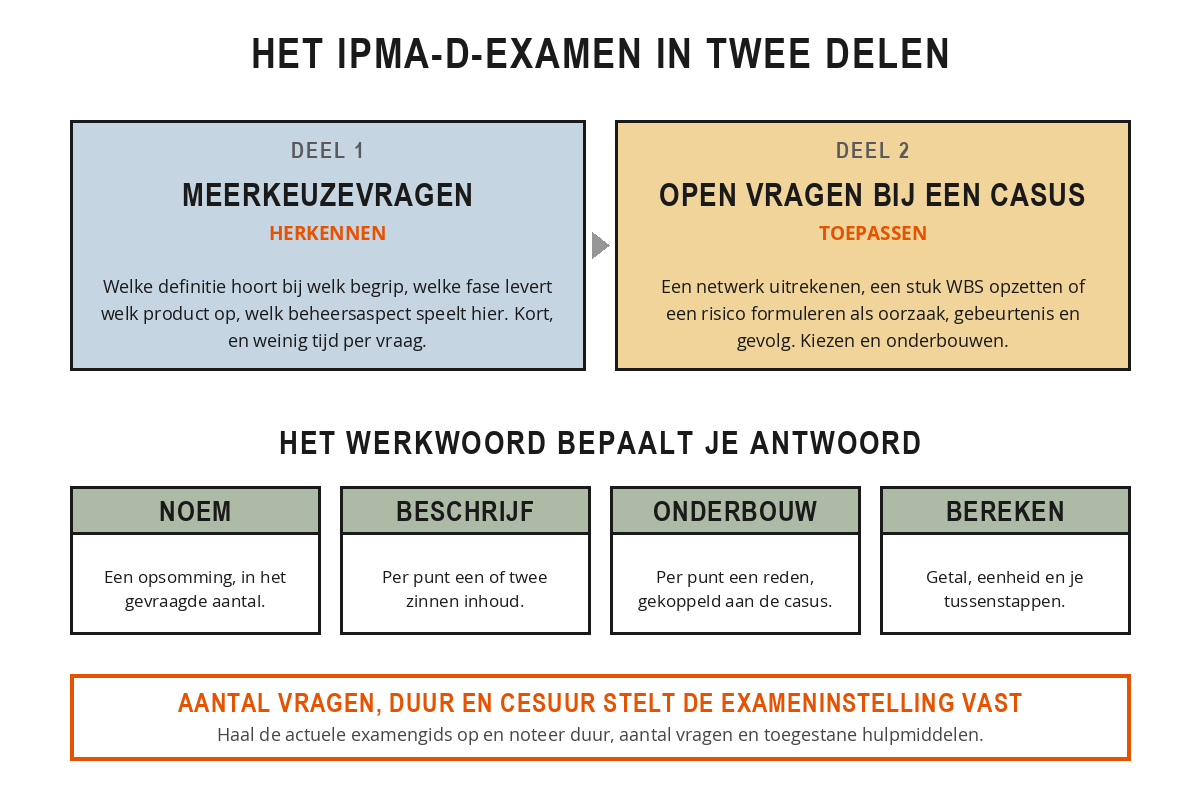
The exam falls into two parts, each asking something different of you. In the multiple-choice part it is about recognition: which definition belongs to which concept, which phase delivers which product, which control aspect from TGKIO applies here. Those questions are short and you have little time for each one.
The second part works with a case description of a project. You are given open questions that force you to make choices and substantiate them. Expect to have to calculate a network to determine the critical path, set up part of a Work Breakdown Structure or formulate a risk in the form of cause-event-consequence. Chapter 4 of this free course deals with exactly the first of these.
The course syllabus assumes a three-hour exam, but the exact number of questions, the duration and the pass mark are set by the examination body and may differ from one session to the next. Here is how to prepare for the current situation: download the most recent exam guide from your examination body, note the duration, number of questions and permitted aids on a single sheet of A4, find out whether a calculator and scrap paper are allowed, and schedule a mock exam under exam conditions at least two weeks before the actual date.
What the assessor looks for
In the open questions, assessors look at three things. Correct terminology: you use the terms as the ICB4 and the common methods use them, not your own wording from the company where you work. What you call "the weekly figures" is a progress report in the exam. Link to the case study: a generally correct answer without any reference to the given situation scores fewer points than an answer that cites the details of the case. And visible intermediate steps: in calculation questions your forward and backward pass both count. Writing down only an end date is risky.
Knowledge questions and application questions
A knowledge question asks for reproduction: which phases does the six-phase model have, which five control aspects do you distinguish, what is the difference between a milestone and an activity. You answer such a question briefly and completely. If five aspects are asked for, you name five, even if you could explain three of them in detail.
A application question is tied to a case. You are given a description of a situation of ten to thirty lines, followed by a series of questions you can only answer properly if you refer back to the case. The answer "you draw up a risk log" earns few points. The answer in which you identify two risks from the case in the form of cause-event-consequence, with a measure and an owner for each risk, does earn points.
In the case study, underline all figures, dates, names and roles before you read the questions. Assessors reward answers that refer to those specific details. An answer without a single reference to the case study is almost always too general.
Calculation questions on networks and progress
Calculation questions usually give you a list of activities with durations and predecessors, or a table with PV, EV and AC on a cut-off date. You are then asked to determine the critical path, to calculate the float of an activity, or to work out the SPI and CPI and interpret them.
This is how you tackle such a question. Draw first, then calculate: you copy the network or the schedule onto scrap paper before you start calculating. Calculation errors almost always arise because someone starts working out figures straight in the table. Noting intermediate steps: if your final answer is wrong you still get points for sound reasoning, but only if that reasoning is on paper. Stating the unit: working days, hours or euros; a bare figure without a unit cannot be assessed. And interpreting the result: almost every calculation question has a follow-up question that asks for interpretation.
In the second part, Karim calculates a CPI and arrives at 0.85. He writes down that figure and moves on to the next question. The follow-up question was simply: what does this mean for your project? The answer that earns marks is: a CPI of 0.85 means that for every euro spent you have realised 85 cents of budgeted value, and therefore that you are running over budget. Two sentences, ten seconds' work, and Karim left them on the table because he already had the figure.
Signal words in the question
The verbs in the question determine what the assessor ticks off. Four of them keep coming back. With name or give a list is sufficient; no explanation needed, but do give the number asked for. For describe or explain give one or two sentences of content per point: what it involves and what it is for. For substantiate or justify give a reason for each point that you link to the case; without "because" you lose marks here. And for calculate you give a figure plus the unit plus your intermediate steps. Adding an explanation in words takes ten seconds and often saves you half a mark.
The question reads: "In the case study, the client wants to bring the delivery date forward by four weeks. Name two measures and substantiate, for each measure, the consequence for the other control aspects."
A weak answer: "Apply crashing and fast tracking."
A strong answer: "Crashing on activities D and E, both of which are on the critical path. Deploying two extra testers shortens the lead time by around two weeks, but increases the project costs by roughly 30,000 euros. In addition, fast tracking between 'Complete design' and 'Start build' by converting the Finish-Start relationship into Start-Start with a lag of five days. That costs no extra money, but increases the risk of rework because the design may still change."
The difference does not lie in knowledge. Both answers name the same two measures. The second answer links them to the case, gives figures and states the effect of each measure, which is exactly what the verb "justify" asks for.
A study plan that counts down
Counting back from the exam date works better than planning forward from today. That way you know exactly how many weeks you have and which topics come up in which week. Eight weeks of three hours a week is enough for most candidates, provided those hours are genuinely available.
Your brain retains more from short and repeated than from long and one-off. A three-hour block on Sunday evening yields less than three one-hour blocks spread across the week. So divide your study time as follows: schedule fixed slots and put them in your diary as an appointment with a start and end time, not as an intention. Start every block with revision: five minutes looking back at the previous session, with the book closed; whatever you cannot recall is today's study material. Alternate reading with doing: after each chapter you answer three practice questions, because passive reading gives a sense of mastery that does not hold up. And keep an error log: for each mistake you note down what you thought and what the correct answer was. In the final week you study only that log.
The mock exam under exam conditions is the most important checkpoint in your entire preparation. It lets you practise two things: the material and your pace. Candidates who fail usually know the material well enough, but never get to the last case study. After the mock exam, go through your work and divide your mistakes into three categories: knowledge gaps, reading errors and lack of time. Each category calls for a different measure. You fill a knowledge gap by studying, you address a reading error by reading more slowly and highlighting, and you tackle lack of time with a tighter time budget per question.
Marjolein has her exam on 14 November and counts back. That comes to nine weeks. She plans three blocks of an hour a week, on Tuesday and Thursday mornings before work and on Saturday morning. She schedules her mock exam in week 7, so a good two weeks before the date. She sits it under timed conditions and does not get round to the last two case questions. In her review round, six mistakes turn out to be knowledge gaps around earned value, three are reading errors where she read "name" as "describe" and therefore wrote too much, and two questions were left unanswered through lack of time. As a result, her final two weeks look different from what she had expected: revising earned value, and agreeing a time budget with herself for each question type.
Your exam date on paper, and then counting back.
- Exam date, or the month in which you want to schedule it.
- Number of weeks until then.
- Two topics on which you currently consider yourself weakest.
- Number of study blocks per week and their length, including the day and time.
- The week in which you sit your mock exam.
- The person you ask to review your case study answers.
Summary
- The exam consists of two parts: multiple-choice questions in which you recognise, and open questions on a case study in which you apply.
- In the case part you can expect a network calculation, a section of a WBS or a risk in the form of cause-event-effect.
- The number of questions, the duration and the pass mark are set by the examination body. Obtain the current exam guide and note the details on a single sheet of A4.
- Assessors look for correct terminology, a link to the case study and visible intermediate steps.
- The four signal words: name (a list), describe (one or two sentences per point), justify (a reason from the case for each point) and calculate (figure, unit and intermediate steps).
- For calculation questions, first draw, note the intermediate steps, add the unit and interpret the result.
- Underline every figure, date, name and role in the case before you read the questions.
- Count your study plan back from the exam date: short repeated blocks, an error log and a mock exam under timed conditions, two weeks before the date.
- Divide the mistakes from your mock exam into knowledge gaps, reading errors and lack of time; each category calls for a different measure.
An exam question starts with "Substantiate why you would choose fast tracking in this situation." What does the assessor expect?
You calculate a critical path and your final answer turns out to be wrong. Why is it still worthwhile that you wrote down your forward and backward calculation?
Why is the mock exam under exam time, according to this chapter, the most important measuring point in your preparation?