


Introduction
A customer who feels heard tells others about it. A customer who feels fobbed off does the same, and usually to more people. That is exactly the heart of customer-focused working: satisfaction does not come from a slogan on the website, but from what you say and do in that moment of contact.
Customer focus is therefore above all a craft. You learn to listen without already thinking about your answer, to ask questions that go further than 'how can I help you', and to stay calm when someone is angry on the line. Those are skills you can practise, even if you feel you are no natural conversationalist.
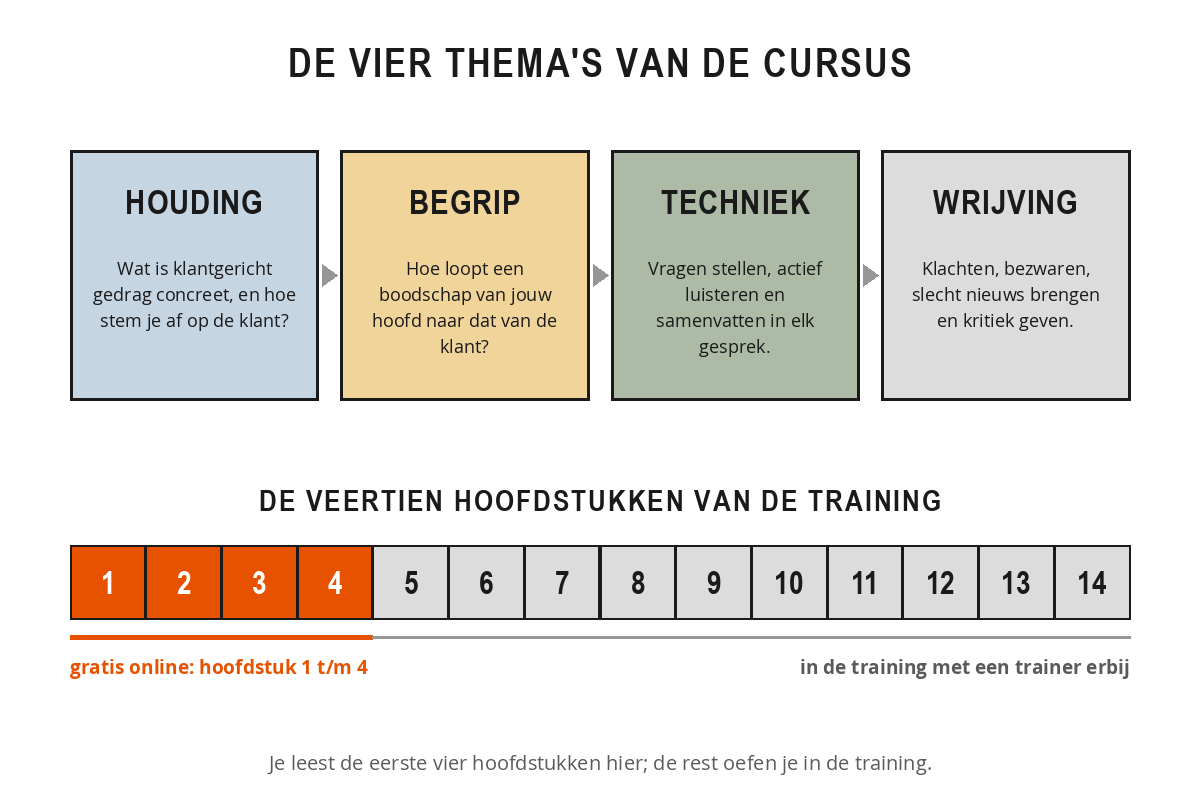
This free course contains the first four chapters: the orange part of the bar above. At the bottom of chapter 4 you will find the full course.
What you will learn
You start with your attitude: what does customer-focused working mean when you translate it into behaviour a customer can see and hear? Next you get the model that helps you understand why a message sometimes comes across quite differently from how you meant it, and why two people remember something different after the same conversation. Then come the two techniques that make the difference in every customer conversation: asking questions and active listening. The common thread: customer focus is not friendliness, it is working precisely in a conversation.
How the course is structured
The course follows four themes that build on one another. You start with posture: what does customer-focused behaviour look like in practice, and how do you adapt to the person in front of you? Then comes understanding: how does a message travel from your head to the customer's, and where does something get lost along the way? After that comes technique: asking questions, listening and summarising, the three skills with which you steer a conversation. And finally friction: complaints, objections, delivering bad news and giving criticism. Each chapter contains theory, a model, examples from practice and an exercise that you apply to your own customer contact.
Practical tips for use
- Keep a notepad or a blank document to hand. The exercises only work if you actually complete them.
- Read with a specific customer in mind. A conversation from last week that went awkwardly is the best practice material there is.
- Take one chapter a week and try it out. Reading through it in an afternoon yields less than doing something differently four times.
- Start small. Keeping up one habit at a time works better than doing everything differently from Monday onwards.
- Keep your notes. In the full course they come back in your personal action plan.
Map out your starting point before you begin chapter 1.
- Briefly describe a customer contact from the past two weeks that went well. What exactly did you do?
- Describe a contact that went awkwardly. What happened, and at what moment did it get stuck?
- Write down two things you want to be better at by the end of this course.
Each chapter ends with a short knowledge check of three questions: answer them correctly to mark the chapter as completed. Your progress is saved automatically in your browser.
Enjoy the read, and above all: enjoy the next conversation that suddenly does run smoothly.