


1. Difficult behaviour under the microscope
Some people cost you more energy than all the others in your department put together. Before you get to techniques, it pays to examine what you actually mean when you call someone difficult. Because that one word hides the whole problem of this chapter.
After this chapter:
- You know that 'difficult' is a judgement about an interaction and not a characteristic of a person.
- You can describe visible behaviour in factual terms, separate from your interpretation.
- You recognise which underlying need may lie beneath disruptive behaviour.
- You name your own part in a situation you experience as difficult.
- Know the five triggers that difficult behaviour usually stems from.
The label difficult
If you ask ten colleagues who the most difficult person in the office is, you will rarely get the same name ten times. One is worn down by the colleague who wants to check everything three times. Another finds that same colleague pleasantly precise. That difference says something important: difficult is not a label attached to someone, but a judgement that arises in the encounter between two people.
That judgement comes from somewhere. Usually the other person's behaviour clashes with something you consider important, or with the way you work yourself. You call someone difficult when their behaviour gets in the way of your goal, for example because you want to wrap up the meeting and the other person starts on a side issue. Or because the behaviour clashes with your standards: you arrive on time and consider lateness disrespectful. A third reason is that you do not know how to respond; anger or tears leave you stuck, and you attribute that feeling of powerlessness to the other person. And finally, history plays a part. After three unpleasant conversations, the fourth is already coloured before it begins.
The word difficult is therefore a summary of your own experience. As shorthand that is handy; as a starting point for a conversation it is useless. As long as you think "that's just how she is", you have no lever at all to work with.
Jasper says of his team-mate Farah: "She's blunt." If you ask what she actually does, this comes out: Farah replies to emails with a single sentence and no greeting, and she interrupts in meetings when things drag on. Jasper values a friendly tone and feels brushed aside. Another colleague calls Farah refreshingly clear and has no trouble with her at all. The behaviour is exactly the same; the judgement differs.
Do you notice yourself giving someone a label? Then replace that label with a sentence starting with "When he ..." or "When she ...". That way you automatically focus on the specific moment instead of on the person.
Fact or interpretation
Behaviour is what a camera would record. Everything beneath that is interpretation, and it is precisely that interpretation which determines how you react. An observation can be checked; an interpretation is the explanation you add to it.
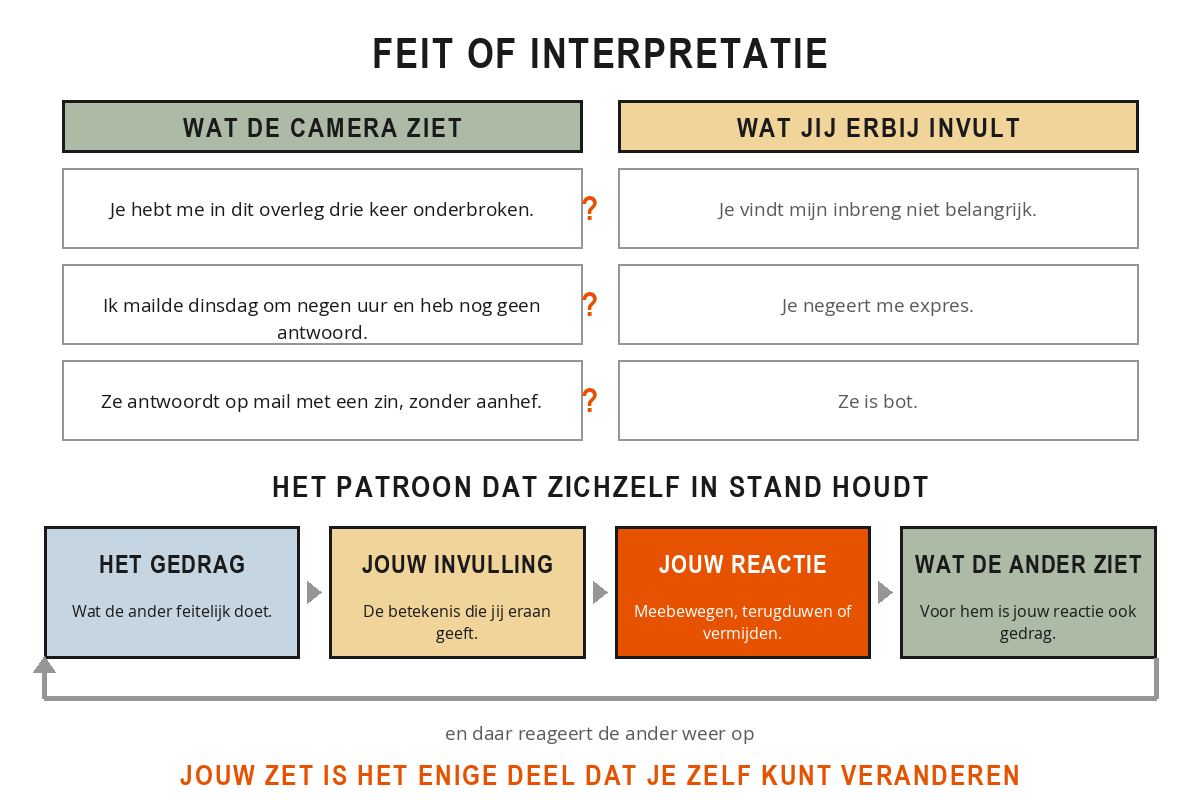
"You interrupted me three times in this meeting" is an observation. "You don't think my input matters" is an interpretation. "I emailed on Tuesday at nine o'clock and haven't had a reply yet" is an observation. "You're deliberately ignoring me" is an interpretation. And "she replies to emails with one sentence, without a greeting" is an observation, whereas "she is blunt" is your own conclusion added to it.
Interpretations are not forbidden; they are in fact unavoidable. What matters is that you know it is your own reading of the situation, and that you put it forward as a question rather than as a conclusion. Moreover, beneath visible behaviour there is almost always a need that the other person does not express and sometimes does not even see clearly themselves. Someone who clings to procedures may have a need for certainty after a reorganisation. Someone who takes everything on themselves may be afraid of being held to account for someone else's mistake. You do not have to approve of that need in order to take it into account. You simply make things easier for yourself, because behaviour can be discussed and a character cannot.
Your part in the interaction
Difficult behaviour rarely arises in an empty space. There is almost always a second person who reacts, and that person is you. Your reaction is behaviour to the other person as well, and they react to that in turn. This is how patterns arise that keep themselves going: you become curter, they become sharper, you withdraw, they push on. That does not make the other person's behaviour right, but it is the only part of the interaction over which you have direct influence. In the diagram above you see the circle: the other person's behaviour, your interpretation, your reaction, and what the other person picks up from it. Only at that third step do you hold the pen.
There are three ways in which people unwittingly contribute to the very behaviour they want to stop. The first is going along with it until you snap: you swallow four unreasonable requests and on the fifth you react sharply. For the other person that outburst comes out of nowhere, because four times they heard that it was fine. The second is pushing back in the same coin: someone raises their voice, you raise yours. The other person becomes businesslike and curt, you become even more businesslike. In doing so you confirm precisely the tone you find unpleasant. The third is avoiding and side-stepping: you send an email instead of walking over, or you discuss the matter with a colleague instead of with the person concerned. The problem remains, and grows in the meantime.
Ruben experiences his colleague Farida as bossy. She regularly walks into his office with "this has to be finished today". Ruben then says "yes, fine" and works on until half past six. He never says that it is becoming too much for him. After three weeks he remarks in a team meeting that some people around here apparently think they are the boss. Farida falls silent and has no idea where this is coming from. His part in it is that for three weeks he confirmed, with his words and with his diary, that it was not a problem.
From reflex to choice
When someone catches you off guard with a sharp remark, your body reacts faster than your head. Your muscles tense, your breathing rises, your voice changes colour. Within a second you are already pushing back, backing down or looking away. That is a reflex, not a choice.
The difference between a reflex and a response lies in the space in between, and that space is small but it does exist. You enlarge it with three things. You notice your own bodily signal on: warm cheeks, a clenched jaw or quickened breathing are your earliest warning that you are about to react out of habit. You delay half a second: you breathe out before you say anything, or you ask a question first. And you checks your intention: what do you want to achieve with your next sentence? Do you want to be proved right, or do you want to make progress? Those are rarely the same thing.
A useful rule-of-thumb question after an unpleasant conversation is: what could the other person read from my behaviour? Not what you meant, but what was visible. That is often exactly where the difference lies between what you thought you were communicating and what actually came across.
Five triggers for difficult behaviour
The behaviour you see is the tip. What lies beneath it determines whether the behaviour emerges and how hard it lands. Five triggers are the ones you will come across most often.
- Lack of clarity. People who do not know what is expected of them start covering themselves, putting things off or checking excessively.
- Loss of control. A reorganisation, a new system or a changed division of tasks all affect autonomy. Resistance is then often an attempt to regain control.
- Loss of face. Anyone who feels caught out or corrected in front of others defends themselves harder than the matter warrants.
- Overload. With structural workload pressure or worries at home, the slack shrinks. Small requests then get a reaction that fits a big problem.
- A lack of recognition. Someone who consistently feels overlooked will either start making themselves louder or demonstratively withdraw.
Triggers usually announce themselves. A colleague who normally joins in and now says nothing in three meetings in a row is giving you information. Someone who suddenly wants everything confirmed in writing is doing the same. The sooner you name such a change, the smaller the conversation you have to have.
Choose one person you currently find difficult and work out:
- The label you give him or her, in one word.
- Three concrete behaviours that a camera would record.
- What you add yourself about the other person's intention.
- Which of the five triggers might be at play.
- Which of the three patterns you recognise: going along with it, pushing back or avoiding.
- What others can read from your behaviour, and which alternative you will try next time.
Keep this sheet. In chapters 2 and 3 you will use the same situation again.
Summary
- Difficult is a judgement about an interaction, not a characteristic of a person. Ten colleagues will name ten different names.
- You call someone difficult when the behaviour affects your goal or your standards, when you do not know how to respond, or when history plays a part.
- An observation can be verified; an interpretation is the explanation you add to it. Put that forward as a question, not as a conclusion.
- Beneath visible behaviour there is almost always an unspoken need. You can discuss behaviour; you cannot discuss a character.
- Going along with it, pushing back and avoiding are the three ways in which you keep the behaviour going yourself.
- Noticing your bodily signal, slowing down for half a second and checking your intention turn a reflex into a choice.
- The five triggers are lack of clarity, loss of control, loss of face, overload and lack of recognition.
Which of these four sentences is an observation and not an interpretation?
For three weeks Ruben says "yes, fine" to every urgent request from Farida and then lashes out sharply in the team meeting. Which pattern do you recognise?
A colleague defends himself fiercely after you corrected him in front of the team. Which cause is most likely here?