


Introduction
There is always someone who drains your energy. The colleague who shoots down every proposal, the client who threatens to escalate, the team member who says yes and then does nothing. You know the feeling: you walk away from a conversation like that and notice you are still thinking about it hours later. That feeling is the starting point of this course.
Because difficult is not a characteristic of the other person. It is something that arises between two people. Once you realise that, your playing field changes, because you do not have to change the other person to make the conversation go differently. You can start with the only part of the interaction you have full control over: yourself.
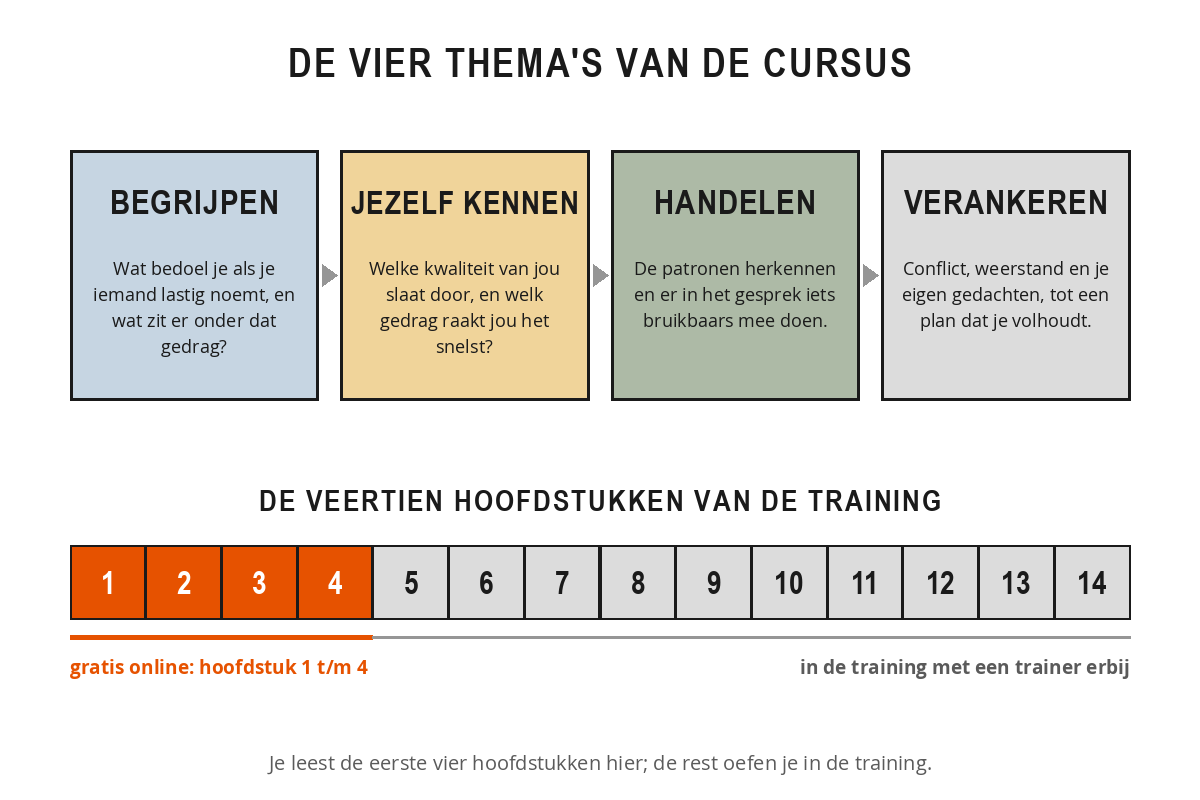
This free course contains the first four chapters: the orange part of the bar above. At the bottom of chapter 4 you will find the full course.
What you will learn
You first learn why you call someone difficult and how to describe behaviour in facts rather than judgements. Then, using Ofman's core quadrant, you discover that the irritation you feel often says something about your own qualities: the trait you are good at tips over into a pitfall, and the behaviour you are allergic to pushes you straight into it. Next you get the five patterns that recur in every workplace, with the underlying motivation for each pattern and the reflex it triggers in you. And you finish with the conversation techniques: listening, summarising and asking follow-up questions, addressing behaviour without filling in the blanks, setting a boundary and responding to criticism.
How the course is structured
The course follows four themes that build on one another. You start with understanding: what do you actually mean when you call someone difficult, and what lies beneath that behaviour? Then comes knowing yourself: which of your qualities tips over, and which behaviour in others affects you most quickly? Then comes acting: recognising the patterns and doing something useful with them during the conversation itself. And the course concludes with embedding: handling conflict, resistance, your own thoughts and a plan you can stick to. Each chapter contains theory, a model, real-life examples and an exercise you apply to your own work.
Practical tips for use
- Before you begin, choose one person who currently drains your energy the most, and keep them as a common thread through all the chapters.
- Keep a notepad or a blank document to hand. The exercises only work if you actually complete them.
- Don't read it all in one go. One chapter a week, with time to try it out, delivers more than reading through it in an afternoon.
- Describe behaviour the way a camera would record it. The moment you use a label, you have stopped looking.
- Start small. One different sentence in one conversation changes more than an entirely new resolution.
Before you start chapter 1, map out your own starting position.
- The person: describe in two sentences who drains your energy the most at work.
- The behaviour: note down what this person actually does or says, in facts and without judgements.
- Your reaction: describe what you usually do and what it achieves.
- Your goal: what would you like to do differently by the end of this course?
You will use these notes again later, with the core quadrant and with the worksheet in the pdf.
Each chapter ends with a short knowledge check of three questions: answer them correctly to mark the chapter as completed. Your progress is saved automatically in your browser.
Enjoy reading, and above all: enjoy the conversations that will go differently from now on.