


2. Ofman's core quadrant
Behind irritating behaviour there is often a quality that has gone too far. Daniel Ofman mapped that connection with a model of four concepts that keep each other in balance. You use it for the other person, but the greatest gain lies in what it says about yourself.
After this chapter you can:
- Naming the four positions in a core quadrant and distinguishing them from one another.
- Completing a quadrant from each of the four entry points.
- Recognising the quality hidden behind behaviour that irritates you.
- Identifying where your own allergy lies and what behaviour that triggers in you.
From core quality to pitfall
A core quality is a trait so much a part of you that you barely have to make an effort. Decisiveness, patience, care, humour, commitment: it is in you, you do not switch it on. Others usually notice it before you do, precisely because it comes so easily to you. What comes naturally does not stand out to you.
A pitfall is that same quality in too large a dose. Helpfulness taken too far becomes meddling. Decisiveness taken too far becomes pushiness. Carefulness taken too far becomes fussiness. So the pitfall is not the opposite of your quality, but a distortion of it. That also explains why it is so hard to shake off: you are doing exactly what you have always done well, just a notch too much.
The accusation you hear regularly therefore almost always points to your pitfall. Someone told "take it a bit easier" probably has decisiveness in them. Someone told "you are on top of it too much" probably has commitment in them. That makes the pitfall a handy way in: it lies on the surface and others name it of their own accord.
Sanne is a project manager and makes decisions quickly. Her team describes her as someone who gets things done. In the last team meeting a colleague said: "You steamroller us." That accusation hit home, but it points to her pitfall. Turn it round to the quality of which this is too much, and you arrive at decisiveness. Precisely the trait the team values her for.
The four quadrants
The challenge is the quality that balances your pitfall. It is the positive opposite of your pitfall, not of your quality. For pushiness, the challenge is patience. For nitpicking, the challenge is letting go. For meddling, the challenge is giving space. This is about both-and, not either-or. Sanne does not have to trade in her decisiveness for patience; she needs both. The more strongly she develops her challenge, the smaller the chance that she ends up in her pitfall.
Then the fourth position. An allergy is too much of your challenge, usually embodied by someone else. Sanne has little tolerance for colleagues who weigh things up endlessly without reaching a decision. Passivity is her allergy: it is patience in a dose she can no longer bear. She is at a loss with it and becomes unreasonably tetchy.
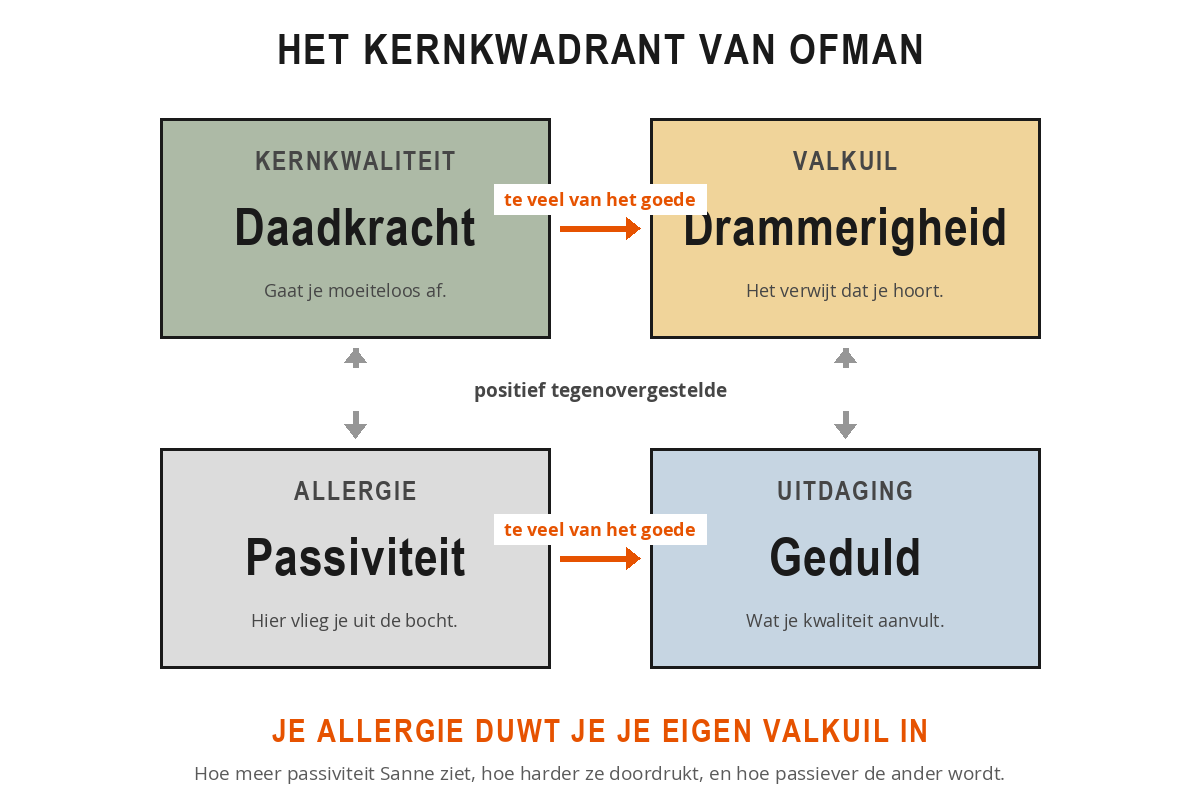
This is what the quadrant looks like. Top left is the core quality: decisiveness, which comes effortlessly to Sanne. Top right, the pitfall: pushiness, the reproach she hears. Bottom right, the challenge: patience, which complements her quality. And in the bottom left the allergy: passivity, the behaviour that drives her up the wall. Horizontally it is always too much of a good thing: from core quality to pitfall, and from challenge to allergy. Vertically it is always the positive opposite: from pitfall to challenge, and from allergy to core quality.
Why your allergy is your most vulnerable spot
This is the heart of the model for dealing with difficult people. The more you are confronted with your allergy, the harder you fall into your own pitfall. Faced with a dawdling colleague, Sanne does not become a little calmer but rather more pushy. And in doing so she draws out precisely more hesitancy in that colleague. It is not your pitfall that makes you vulnerable, it is your allergy.
This is how working relationships get stuck without anyone meaning any harm: one person's pitfall is precisely the other person's allergy. Nadia sees Bram hesitate and speeds up. Bram sees Nadia push through and slows down. Both are reacting to what they see, and both are thereby reinforcing what they do not want. That is the same pattern as in chapter 1, now with an explanation attached.
What you feel in that situation is often more than irritation. There is an edge of contempt to it. "Act normally for once." "Just say something, will you." As soon as contempt comes into play, you have lost your effectiveness: you are no longer looking at behaviour, you are looking at the person. And from that moment on you drop into your own pitfall almost automatically.
Karim is precise. That is his core quality: he delivers files in which nobody can find a mistake. His pitfall is nitpicking, his challenge is pragmatism, and that is also where his allergy sits: he is driven mad by colleagues who say it will all be fine. In a project meeting his colleague Ilse says the figures are roughly right. Karim feels his jaw clench, starts a discussion about the third decimal place and holds up the meeting for twenty minutes. Afterwards he thinks: I should not have done that. His allergy to sloppiness pushed him straight into his pitfall. And the odd thing is that Ilse is precisely the person he can learn the most from; she has, in raw form, exactly what he lacks.
That is the reversal that makes the quadrant so useful. The person you find hardest to deal with often shows you which quality you still need to develop. Not in the dose in which that person displays it, but in a milder form. Anyone who grasps this looks differently at their most difficult colleague.
Four ways into the quadrant
A quadrant does not have to start in the top left. You can enter at any of the four boxes and fill in the other three from there.
- Via the core quality. You start with what comes effortlessly to you. That is at the same time the hardest way in, because a core quality feels self-evident to you. You spot it in others sooner than in yourself.
- Via the pitfall. Usually the easiest one. Most people have been trained all their lives to look at what could be better, so the recurring criticism from those around you points you straight to the box in the top right.
- Via the challenge. You ask yourself which trait would make you a more balanced person. Often you then name something you admire in someone else.
- Through the allergy. Also a quick way in, because irritation feels sharp. As soon as you write down which behaviour raises your blood pressure, you have a word in the bottom left.
Does your quadrant not quite add up? Then your wording is probably too broad. Committed and uncommitted are opposites, not a quadrant. More concrete words that you can link to behaviour produce a sharper quadrant: "thinking along with the client" and "losing sight of the deadline" work better than abstract virtues.
Working with two quadrants side by side
The model becomes practical as soon as you place two of them side by side: yours and that of the person you find difficult. You fill in the other person's quadrant on the basis of what you observe, not on the basis of what you suspect. You start with their pitfall, because that is precisely the behaviour that bothers you. From there you look for the quality of which this is too much. Behind rigidity there is often determination. Behind meddling there is commitment. Behind bluntness there is honesty.
You do not have to start liking the behaviour and you do not have to give up your boundaries. All you are doing is making room in your head to see the other person as a fellow professional again instead of as an obstacle. If you do raise it with someone, you focus exclusively on the behaviour. Nobody is pushy; it is the pushing through in this particular meeting that bothers you. You know that separation between behaviour and person from chapter 1, and the quadrant makes it easier to keep up, because you now also see the quality that lies underneath.
For yourself, the emphasis is on the challenge. You do not need to tone down your core quality, because decisiveness does not improve by being less decisive. The more patience you develop, the smaller the chance that you will shoot into pushiness when things get tense.
Take the colleague you chose in chapter 1.
- Describe in two sentences the behaviour that bothers you, without judgement, and put it in the pitfall box of his quadrant.
- Find the core quality of which this behaviour is too much and enter it in the top left.
- Then fill in your own quadrant, starting from whichever entry point feels easiest to you.
- Put the two side by side: does his pitfall coincide with your allergy?
- Formulate one sentence with which you address him on the behaviour and name the quality behind it.
Finally, note down what changes in your view of this colleague now that you have written down his core quality.
Summary
- A core quality comes effortlessly to you; taken too far, it becomes your pitfall. The pitfall is a distortion of your quality, not its opposite.
- The reproach you hear most often points to your pitfall. That is the easiest entry point into the model.
- The challenge is the positive opposite of your pitfall and complements your core quality: both-and, not either-or.
- Your allergy is too much of your challenge in someone else, and that is your most vulnerable spot.
- Your allergy pushes you into your own pitfall, which means you provoke exactly the behaviour you wanted to stop.
- Where a working relationship is strained, one person's pitfall often coincides with the other's allergy.
- Horizontally you work through too much of a good thing, vertically the positive opposite.
A colleague is regularly told that he interferes in everything. Which core quality probably lies underneath that, according to the model?
Why does this chapter call your allergy your most vulnerable spot, rather than your pitfall?
Karim is precise; his pitfall is nitpicking. What goes in the challenge box, then?