


2. Why your brain takes to a mindmap
Your brain is not a filing cabinet but a network. That difference explains why a mindmap sticks and three pages of notes do not. This chapter is about four things that happen in your head while you take notes: your working memory fills up, you can solve that by grouping, you store word and image along two separate routes, and you forget most of it in the first few hours. With each of those four, the form of a mindmap does something for you.
After this chapter:
- You know roughly how many units your working memory holds.
- Whether you can apply chunking to information that becomes too much.
- You explain what dual coding is and why you do not need to be able to draw.
- You link the associative network in your head to the branch structure on paper.
- You use the forgetting curve to plan your repetition moments.
Your working memory is smaller than you think
Working memory is the workbench of your thinking: the part in which you hold information briefly while you do something with it. Everything you are consciously considering at this moment is lying on that workbench. And that workbench is small. For a long time the rule of thumb was seven units at a time; more recent research arrives at about four, and then only if nothing disturbs you. A phone buzzing, a colleague asking something, a thought about your shopping: each of these takes up a place. Whatever no longer fits simply disappears.
That explains a discomfort you will probably recognise. In a meeting you hear a good argument, you want to remember it, and meanwhile the speaker carries on. While you are holding on to the argument, you miss the next two sentences. Your working memory cannot hold and process at the same time without something being lost.
Chunking: more in the same space
The limitation is not in the amount of information, but in the number of units. And what counts as one unit is up to you. This is called chunking: combining separate elements into one meaningful whole, so that together they take up only one place. The series 0 6 1 2 3 4 5 6 7 8 consists of ten separate digits. If you read it as 06-12345678, there are only two or three. The same information, far less load.
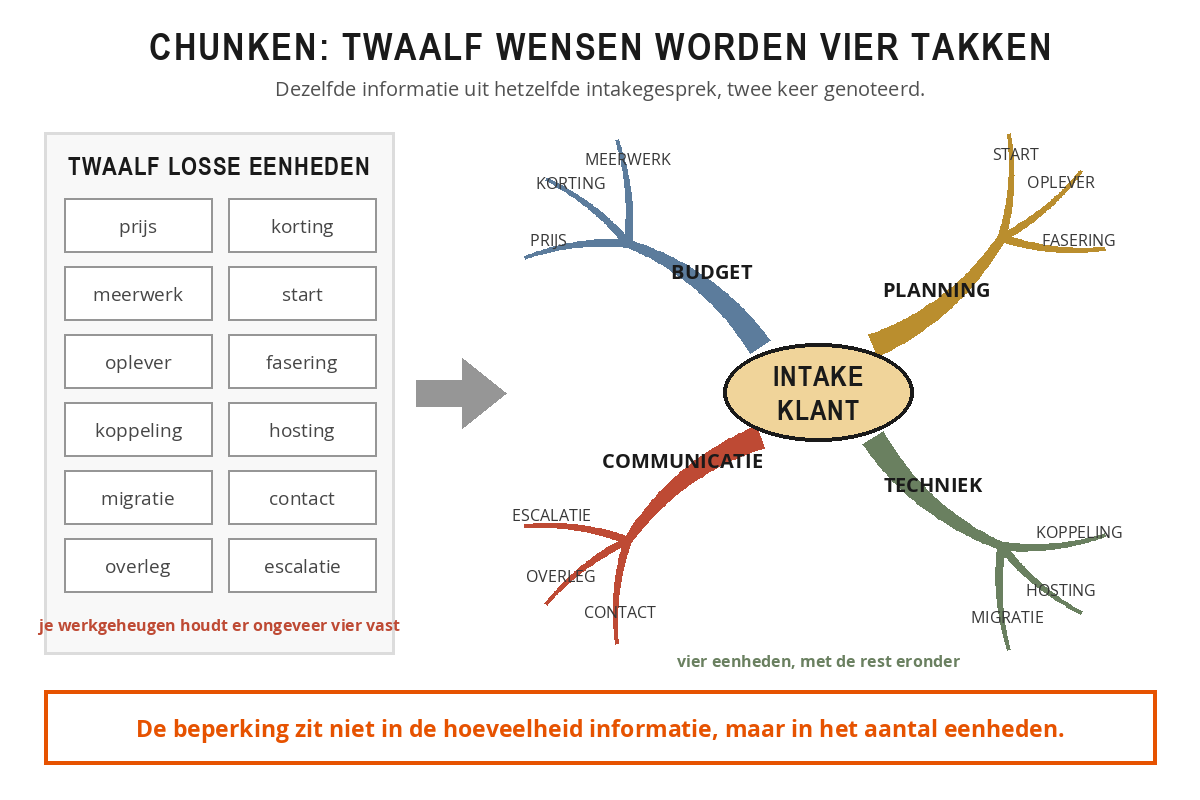
In the diagram above, the left-hand side shows twelve separate notes: price, discount, additional work, start, delivery, phasing, integration, hosting, migration, contact, consultation and escalation. Twelve units, while your working memory holds about four. On the right is the same information as a mindmap, with "client intake" in the centre and four main branches. Under budget sit price, discount and additional work. Under planning hang start, delivery and phasing. Under technique hang integration, hosting and migration. Under communication hang contact, consultation and escalation. Now there are four units, with the rest underneath. That is exactly what every main branch of a mind map does: it is a chunk. You do not have to hold on to twelve keywords, but to four branches that carry the rest. The structure on paper takes over work from the structure in your head.
In an intake meeting, project leader Ilse is given sixteen separate requirements. As separate points they are impossible to remember and hard to discuss properly, because during the meeting you cannot check whether there is a contradiction between point 4 and point 13. As she goes, she clusters them into four groups: budget, planning, technology and communication. What remains are four units with four details under each. When reporting back, she only has to call up those four main groups; the details come along automatically. And she spots something she would otherwise have missed: under budget it says "fixed price" and under planning it says "scope may still shift". Those two cannot both be true, and she now has that conversation straight away instead of in month three.
Your knowledge sits in a network
Information isn't stored in your head as separate files. Every concept is connected to dozens of other concepts, and those connections are the storage. The whole of it is called the associative network. The word "summer" might bring up sea, warmth and ice cream for you; for your neighbour it brings up hay fever, deadline and sunburn. Nobody chooses those connections consciously; they have grown out of experience, repetition and emotion.
Activation spreads through that network. Touch one node and the neighbouring ones light up as well. That is why you can sometimes retrieve a name by thinking about the situation in which you met that person. A mindmap mimics that shape on paper. You do not impose an artificial order, you make visible what is already happening.
Dual coding: word plus image
Your brain processes language and images in two different systems. The verbal system deals with words, sounds and sentences. The non-verbal system deals with images, shapes, colours and spatial impressions. The psychologist Allan Paivio called this dual coding: the same piece of information can be stored in two codes at once, and the two are linked to each other.
The consequence is simple. If you store something only as a word, you have one route when retrieving it. Store it as a word and as an image, and you have two. If one route is blocked, you can still get there via the other. That is why you can still remember that one graph from a presentation last year, but not a single bullet point.
A mind map is dual-coded by its very nature. The central image gives your subject a face, and every branch has a direction and a place on the paper, so even a branch without a drawing carries a spatial code. And because each line holds only one word, there is room left for a small symbol beside it.
Bram and Sanne both take notes at the same project meeting. Bram writes "budget overrun Q3" on a branch and moves on. Sanne writes "budget" and draws a small dripping tap next to it, with three drops underneath. Three weeks later the project leader asks about the sticking points. Bram scans his notes, reads the words and has to search for the context. Sanne sees the tap and the whole fragment comes straight back: the controller's sigh, the remark that the third quarter is always the hardest, and the agreement to adjust before 1 October. That tap is not a work of art. It is a hook.
A drawing in your mindmap takes ten seconds at most. If it takes longer, you are illustrating instead of encoding. Put a question mark next to it and carry on with the meeting.
The forgetting curve and four short reviews
The German psychologist Hermann Ebbinghaus investigated around 1885 how quickly people forget. He taught himself series of meaningless syllables and tested at fixed intervals how much was left. The pattern is known as the forgetting curve: the loss is enormous at first and then levels off. Within an hour, a large part of new, unstructured information has already gone. After a day, without repetition you are often left with only a third. What is still there then stays put for relatively long, but the first few hours are merciless.
The curve is not a verdict. Every repetition slows the decay. If you repeat something just before you lose it, the curve goes up again and afterwards drops less steeply. A workable schedule:
- After ten minutes: run through your map briefly as soon as the meeting is over. Add what you still remember clearly and move branches that are in the wrong place.
- After one day: look at the map for two minutes. Don't read it, scan it: central image, main branches, symbols.
- After one week: take a blank sheet and redraw the main branches from memory. Then compare with the original.
- After one month: one final run-through. What you still know then is usually in there for good.
Repeating four times sounds like a lot of work, and with ten pages of linear notes it is. With a mind map it is not: the whole content is on one sheet and your eyes pick up the structure in seconds. On top of that, the key words force you to retrieve the content yourself. That active retrieval strengthens the trace more than passive rereading. A written-out sentence hands you the answer; a key word makes you work.
Test the limit of your own working memory, and do something about it straight away.
- Ask someone to read you twelve random words, roughly one per second. Then write down what you still remember and note the number.
- Repeat the experiment with twelve new words, but this time group them as you listen into three categories of your own devising. Note down the number again.
- Then take a mind map you made earlier. Choose five keywords and draw a symbol for each within ten seconds. Use only circles, squares, triangles, arrows and stick figures.
- Put four empty boxes in the top right-hand corner of your sheet: 10 min, 1 day, 1 week, 1 month. Tick the first one now and put the other three in your diary as two-minute appointments.
Summary
- Your working memory only holds about four units at a time. Anything that does not fit, you lose.
- Chunking increases your capacity: separate elements that you combine into a single whole together take up just one slot. Every main branch is such a chunk.
- Your knowledge is stored in an associative network. A mind map mirrors that branching shape on paper.
- Dual coding gives you two retrieval routes instead of one. Drawing quality does not matter; a ten-second symbol does the job.
- The forgetting curve shows that the loss occurs mainly in the first few hours. Four short repetitions, after 10 minutes, 1 day, 1 week and 1 month, flatten the curve step by step.
- You can review a mindmap in two minutes, and the keywords force you to retrieve actively instead of rereading passively.
What exactly happens when you cluster twelve separate wishes into four main branches?
Sanne draws a small dripping tap next to the word "budget". According to this chapter, what is the effect of that?
You made a mind map of a meeting this morning. According to the repetition schedule, when do you look at it for the first time?