


4. Rolling with resistance
Someone tells you about a problem, and within two seconds your mind is already heading for the solution. You have the knowledge, you have the experience, you can see the way out. You tell him what he could do, and the conversation shuts down. This chapter is about that reflex, about the difference between two kinds of pushback, and about what you put in place of pushing back.
After this chapter:
- You know what the righting reflex is and why almost everyone has it.
- You recognise in yourself the signs that you have slipped into expert mode.
- You can distinguish sustain talk from friction in the relationship, and you know why that difference matters.
- You can roll with it using three types of reflection instead of going against resistance.
- You know how to give the other person's autonomy back, and what that does to the pressure in the conversation.
The righting reflex
The righting reflex is the almost automatic urge to solve a problem for someone the moment he mentions it. You hear a complaint and you start thinking along. You hear doubt and you wheel out the arguments. You hear an obstacle and you offer a solution. All with the best of intentions, and that is exactly where the trap lies.
Because look at what happens. The other person says: "I know I should drink less, but Friday nights are such good fun." You hear yourself say: "You could do it just at weekends", or "there are some nice alcohol-free alternatives these days". Perfectly reasonable remarks, every one of them. But you have now taken up the change talk from chapter 1, and the other person automatically takes the other side. "Yes, but I really don't drink that much." The paradox of persuasion, and you have just set it in motion yourself.
The reflex isn't a personal failing; it's learned. Your professional training was aimed at analysing and solving problems: diagnosing and advising is exactly what you were taught. Speed is rewarded: a ten-minute consultation, a report with concrete actions, a colleague who is quickly given a good tip. Sitting still and listening feels unproductive. The other person's doubt is uncomfortable: someone who does not know what they want creates tension, and making a suggestion takes that tension away. And finally involvement: you want things to turn out well for the other person and do not want to watch them take the wrong turning. Four understandable reasons, four times the same effect.
You notice it in yourself. You start sentences with "have you already tried to...". You use the words "you could" or "you really should". You are doing the talking and the other person only nods. You feel mild irritation because your good tip is not taken up. You give information that was not asked for. You have the feeling that you have to achieve something in this conversation. If you recognise two of these six at the same time, you are in expert mode.
Before you make a suggestion, ask yourself: did the other person ask me for this? If not, wait another half a minute. Often the silence fills with exactly the sentence you were going to say, but coming from him. And then it is change talk instead of a borrowed tip.
Why that reflex blocks change
Three things happen at once as soon as your solution is on the table. You take over one side of his doubt, and he fills in the other. You unintentionally confirm that he doesn't know himself: every unsolicited tip carries the message that you know better, and for someone who already doubts his own abilities that is a painful confirmation. And you shifts ownership: it is now your plan, so if it does not work it is your plan that failed. "Yes, I tried what you suggested, but it did not suit me." A borrowed plan rarely carries you far.
In place of the reflex you have three responses. Reflecting instead of solving: give back what you hear. "You feel that you're not going to manage it" says more than "maybe you should install an app", and it invites the other person to keep talking. Asking about what is there instead: underneath a complaint there is almost always something a person considers important. "What makes this a problem for you?" or "what would it give you if things were different?" shifts the attention from the problem to the value beneath it. And asking permission if you really do want to put something forward: "I have some experience with this, would you like to hear it?" If he says yes, it's no longer an unsolicited tip. If he says no, you respect that and he stays in charge.
A client says: "I really don't know how to snack less in the evenings."
Righting reflex: "Make sure you stop bringing sweets into the house, then the temptation won't be there."
Reflection: "You notice that the evenings in particular are difficult."
Asking further: "What is it that makes the evenings particularly difficult?"
Permission: "I know a few things that have helped other people. Shall I tell you about them, or would you rather think it through yourself first?"
Only with the first does the thinking afterwards rest with you.
Two kinds of pushback
In the past, everything that seemed to argue against change came under one heading: resistance. That distinction is now sharper, and it helps you choose what to do.
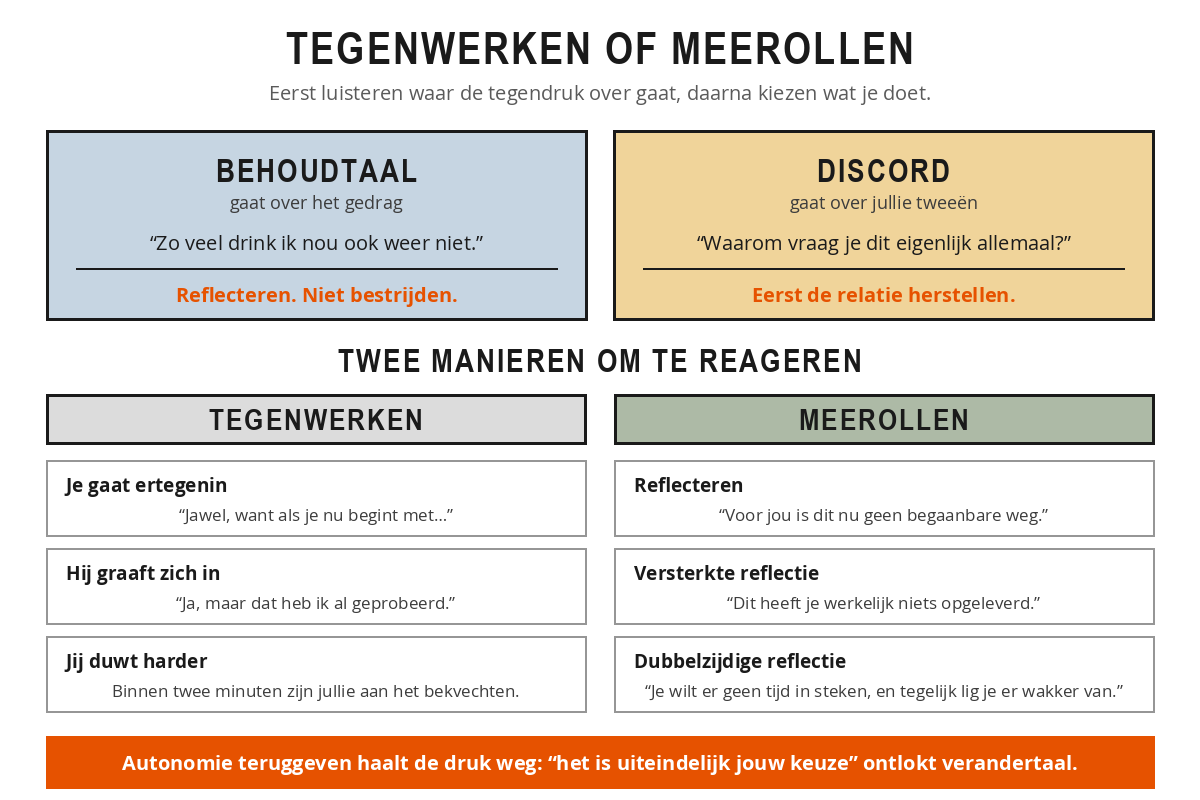
The first type is the sustain talk from chapter 2. That is about the behaviour, and the conversation itself simply carries on. "I really don't drink that much." You do not need to argue with that, you reflect it.
The second kind is discord: tension in the relationship itself. That is not about the topic but about the two of you. "You don't understand me." "Why are you actually asking me all this?" "There's no point to this anyway." Often someone also falls silent, or only gives one-word answers. As long as the relationship is out of kilter, not a single word about the content gets through. So here you first have to do something about the relationship.
If you hear pushback, the first question is not "how do I get him moving?" but "what does this tell me about our conversation?". Usually one of three things is going on. You are gone too fast: you are already planning while he isn't there yet. You are in righting reflex mode and they defend themselves. Or the agenda is off: you are talking about something he does not want to talk about, or he is missing acknowledgement for something that matters more to him. In all three cases the answer is not to push harder, but to adjust something on your side: slow down, stop solving, or ask again what he would like to talk about.
Case manager Farida is discussing a four-step reintegration plan with Rob. She explains what comes next. Rob goes quieter, looks out of the window and finally says: "You've already worked all this out, so why are you still asking what I think of it?"
Farida recognises this as discord and not as sustain talk. Rob says nothing about his behaviour and nothing about the four steps. He says something about their relationship: he does not feel heard.
She sets the plan aside: "You're right that a lot is already on paper before I even walk in here. That can feel odd. What matters to you that we do discuss today?" Rob's shoulders drop a little. The conversation can start again. Had she explained the four steps once more, it would only have gone quieter.
Rolling with it instead of pushing back
The classic response to resistance is to argue against it. Someone says "this is never going to work" and you hear yourself saying: "Yes it will, because if you start by...". He digs himself in deeper, you push harder, and within two minutes you're squabbling about something you were simply having a conversation about five minutes ago.
Rolling with resistance is the countermove. If the other person pushes, you don't push back. You go along in the direction he's moving, stay alongside him and keep the conversation open. It's a stance borrowed from martial arts: don't block the other person's force, move around it, so that space opens up again. In practice you have three options.
- Reflecting what you hear, especially when it doesn't suit you. If someone says "I'm really not going on with this", the rolling-with-resistance response is: "For you, this isn't a workable route right now." Not: "Shall we give it another go anyway?" By taking his position seriously, you take the pressure out of the conversation. He doesn't have to hold on to it more firmly, because you aren't pulling at it.
- The amplified reflection. You give something back slightly more strongly than they said it. "I don't see the point of it" becomes, in your words: "For you this has genuinely produced nothing at all." Often you hear them correct themselves: "Well, nothing at all is putting it a bit strongly." Be careful with it, because if you overdo it, it sounds like sarcasm.
- The double-sided reflection. You place their objection alongside something they said earlier. "You don't want to put any more time into this, and at the same time I heard you say last time that it keeps you awake at night." No counter-argument, but a mirror in which both sides are visible.
If you notice that you are negotiating ("yes, but...", "still, I think that..."), you have stepped out of the rolling-with-it stance. Pause, take a breath, and make your next response a reflection: give back what you just heard, without adding anything to it.
Giving autonomy back
Autonomy is the most underrated part of the method. You can spot change talk flawlessly and still ruin a conversation by taking over control at the decisive moment. Respecting autonomy means acknowledging, in your words and your attitude, that the other person ultimately chooses for himself what he does with his life. Even when he chooses something you consider unwise.
That is harder than it sounds, because you are rarely neutral. The client has to reintegrate, the patient has to stop smoking, the employee has to go through that process. That is precisely why it is your job to show that the choice is not yours. It sits in small formulations. "In the end it is your choice." "You know better than I do what works for you." "I can give you information, what you do with it is up to you." They sound casual and they do something fundamental: they take the pressure away. As long as someone feels that you are requiring something of him, he will keep resisting, even things he actually wants himself.
GP Tim is talking to Jamila about her blood sugar. He has explained the figures, she nods, and then says: "I know, doctor, but I'm really not going to give up my pasta in the evening."
Tim feels the urge to explain once more why it matters. Instead he says: "You know what the figures say, and you have decided yourself that the pasta stays. That is your choice and I respect it. What would be open for discussion, do you think?"
Jamila is quiet for a moment. Then she says: "Well... maybe walking after dinner."
There is something paradoxical about this. As soon as you explicitly hand the choice back, the urge to keep defending often disappears. The other person no longer has to protect himself against your pressure and can allow himself to be a little more honest about what might be possible. Pressure calls up sustain talk; acknowledging autonomy draws out change talk.
Respecting autonomy does not mean you approve of everything or are not allowed an opinion. You may name concerns, you may share facts after asking permission, and you may clarify what the consequences could be. The difference is that you put that information on the table and let him choose, instead of pushing him towards one outcome.
Think of a conversation in which you had a clear preference for what the other person should choose.
- What was it about, and what did you want him to do?
- Which unsolicited tip or solution did you offer? Write it down word for word.
- Which of the six signs of expert mode do you recognise in yourself at that moment, looking back?
- Was the pushback you got sustain talk or discord? How can you tell?
- Formulate a rolling-with-it response: a reflection, an amplified reflection or a double-sided reflection.
- Write down the sentence you would have used to hand the choice back explicitly. Word for word, so that you can use it.
Keep those two sentences. In the next comparable conversation you use them as your first response, instead of your automatic reflex.
Summary
- The righting reflex is the urge to solve things as soon as someone mentions a problem; it comes from your training, from being rewarded for speed, from discomfort with doubt and from genuine involvement.
- You recognise it by six signs in yourself, including "have you already tried", unsolicited advice and mild irritation when your tip is not taken up.
- The reflex blocks change because you take over one side of their doubt, erode their self-confidence and shift ownership to yourself.
- Three responses work instead: reflecting, asking about what they find important, and asking permission before you put anything forward.
- Sustain talk is about the behaviour and you reflect it. Discord is about your relationship, and there you repair something first.
- Pushback tells you that you were going too fast, that you were fixing things, or that the agenda is wrong. The answer is never to push harder.
- You roll with resistance using three kinds of reflection: plain reflecting, the amplified reflection and the double-sided reflection.
- Explicitly handing autonomy back takes the pressure away. Pressure calls up sustain talk; acknowledging autonomy draws out change talk.
During a conversation someone says: "Why are you actually asking me all this? There's no point to it." What do you hear here?
According to this chapter, what is the effect of an unsolicited tip on someone who doubts their own ability?
Someone says: "I'm really not carrying on with this." What is the rolling-with-it response?
Ready for the next step?
You have completed the free starter of Motivational Interviewing. The next chapter in the full course is The spirit of motivational interviewing: PACE: partnership, acceptance, compassion and evocation, and how you can tell you're slipping back into expert mode.
Take the 1-day training course →From €625,- excl. VAT · with an experienced trainer alongside you