


3. Recognising and evoking change talk
"I'd actually quite like to do some sport again." "Next week I'm going to ring my GP." Two sentences that both point in the direction of change, and yet carry very different weight. The first is a wish, the second is a commitment. Anyone who hears that difference knows what to do in the conversation. Anyone who doesn't starts planning too soon or keeps exploring too long.
After this chapter:
- You recognise change talk when you hear it, even in among sustain talk.
- You know why change talk is a gauge of the likelihood that someone will actually start moving.
- You can distinguish the four forms of preparatory change talk (DARN) from the three forms of mobilising change talk (CAT).
- You can deliberately evoke change talk using four types of question.
- You know how to reinforce a statement, and which three responses make it evaporate.
Why change talk matters
Change talk is anything someone says out loud in the direction of change: a wish, a possibility, a reason, the realisation that things cannot go on like this. It is the mirror image of the sustain talk from chapter 2, and the two alternate constantly within a single conversation.
Research by Miller and Rollnick shows that the amount of change talk someone expresses during a conversation is related to the likelihood that they will actually change their behaviour. The more often and the more firmly they hear themselves say that they want something different, the more likely it is that something will happen. The reverse holds too: someone who mainly hears themselves say that they won't manage it anyway is building up their own position in the current situation during that very conversation. People convince themselves as they talk.
That changes your task. You don't have to formulate the arguments for change yourself; that is the pitfall from chapter 1. You have to listen and ask questions in such a way that the other person hears the change talk in their own mouth.
And that is not a matter of waiting and seeing. Change talk arises in the interaction. If someone says "I think I'm drinking too much lately, but then again, it's part of the job to some extent", there are two sides in a single sentence. If you respond to the second part ("tell me, what is that like at work?"), the conversation turns to the justification of the current behaviour. If you respond to the first part ("you're noticing it's becoming too much lately"), you open up the side of change. Both are technically correct, and they lead to very different conversations.
DARN and CAT
Not all change talk carries the same weight. Someone who says "I'd actually quite like to stop" is in a different place from someone who says "next Monday I'm starting". Miller and Rollnick therefore separate preparatory from mobilising change talk, and summarise them in two sets of letters.
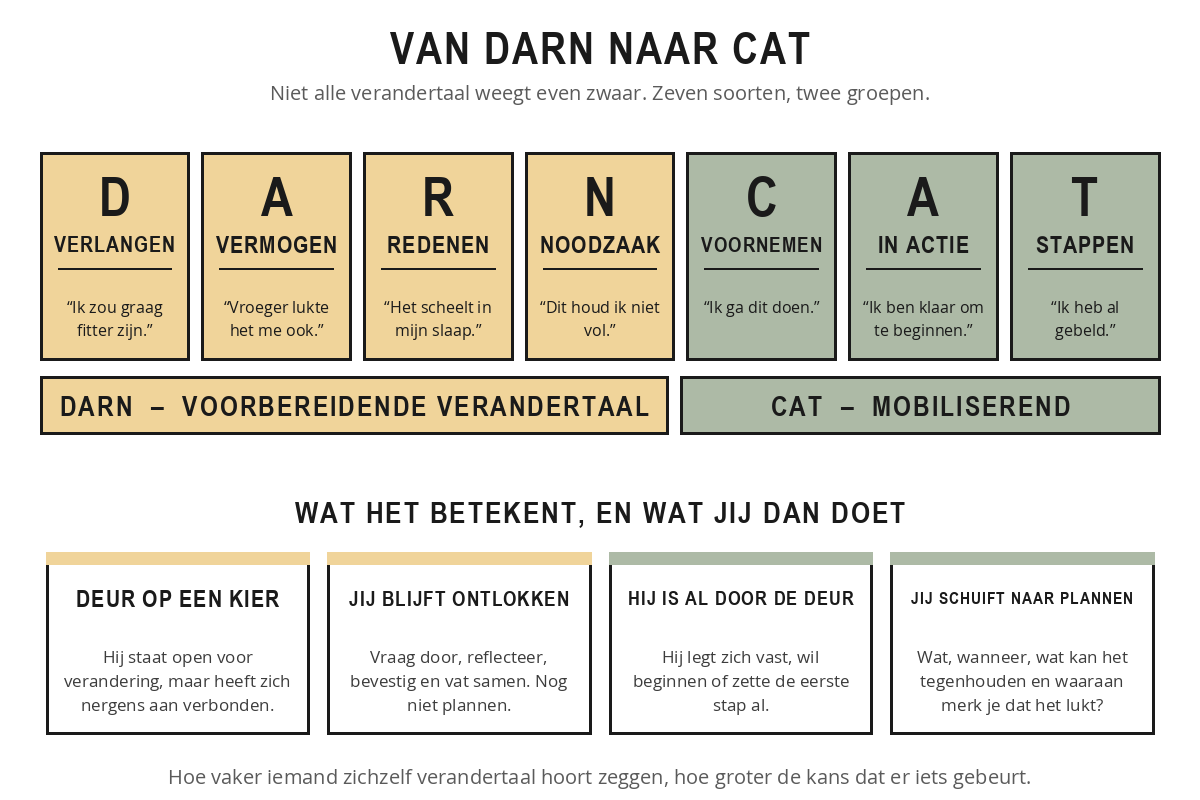
DARN is preparatory change talk: someone is open to change, but has not committed to anything. The D is desire, desire: statements about wanting. "I'd like to be fitter." The A is ability, ability: statements about being able to. "I managed it before." The R is reasons, reasons: statements about why it would pay off. "It simply makes a difference to my sleep." The N is need, need: statements about having to. "I can't keep this up."
CAT is closer to action. The C is commitment, commitment: he commits himself. "I'm going to do this." "From next week I'm not drinking during the week." The A is activation, taking action: he is showing willingness. "I'm ready to start." The T is taking steps, taking steps: he talks about something he has already done. "Yesterday I took my trainers out of the cupboard." "I've made an appointment with the dietician."
The difference between the two groups is greater than it seems. DARN means the door is ajar. CAT means someone has already stepped through it. If you hear DARN, you carry on evoking and reinforcing. If you hear CAT, you move on to planning: what, when, what could get in the way, and how will you know it worked.
Lifestyle coach Mounir is talking to Petra, 44, who hasn't done any exercise since her divorce a year and a half ago. Here's what she says in ten minutes:
"I just don't feel good in myself." (R, reason) "I'd quite like to take up running again." (D, desire) "I used to do five kilometres three times a week, so it can be done." (A, ability) "But in the evenings I really have no energy left." (sustain talk) "And it can't go on like this either, I sleep badly and I'm grumpy with the children." (N, need)
Four DARN statements and one piece of sustain talk. Not a single CAT yet. So Mounir is not ready for a schedule with running days, however tempting that may be. He probes further into the need: "You notice it in your sleep and in how you are with the children. What else?"
Four ways to bring out change talk
Waiting for change talk to surface spontaneously can take a long time. You can evoke it, and you do so not by supplying arguments but by asking the right question at the right moment. Four types of question demonstrably work.
- The evocative open question. An open question that can only be answered with a DARN or CAT statement. "What would you like to be different a year from now?" evokes desire. "What makes you think about this now?" evokes reasons. "Suppose you decided to change something, what would be a first step?" evokes ability.
- The scaling question. You ask for a number and then ask not about the number, but about the difference. "On a scale of 0 to 10, how important is this change to you?" Answer: a 6. Follow-up question: "Why a 6 and not a 3?" The other person will now start formulating arguments for change of their own accord. Ask "why not an 8?" and you evoke precisely the opposite.
- Looking back and looking ahead. "What was it like before, when this wasn't an issue?" creates the contrast with the present. "How do you see yourself in five years' time if nothing changes?" does the same, but in the other direction. Both produce reasons.
- The extreme question. "What is the worst that could happen if things stay as they are?" or "What would be the very best thing that could come out of a change?" These questions bring to the centre what is simmering in the margins.
If an evocative question produces sustain talk, that isn't a failure. You now know where the obstacle lies. Reflect back what you hear and try a different angle a little later. Evoking isn't a contest in which you have to hit the mark first time.
Reinforce, or let it evaporate
Evoking a statement is step one. What you do next determines whether it grows or sinks away again. You have four moves at your disposal. Reflecting: you give the statement back, so that the other person hears it once more, now from someone else's mouth. Asking follow-up questions: you invite them to expand on the statement, and every sentence they then say in the direction of change counts. Confirm: you make visible what lies behind the statement. "The fact that you are naming this now, when it isn't easy, says something about how seriously you are dealing with it." That isn't a compliment, that is naming the effort. Summarising: you collect several statements and place them side by side, so that they hear their arguments as a whole rather than as separate thoughts.
Just as important is what you leave out. Three responses nip change talk in the bud. The first is move on to your next question: the statement hangs in the air and sinks in. The second is stepping in with arguments of your own: if someone says "I think it would be better for my fitness" and you say "yes, and for your blood pressure and your sleep too", you take over the thinking and they stop speaking for themselves. The third is the jump to planning: responding to a tentative DARN statement with "how would you go about that?" pushes open a door that was only slightly ajar.
Case manager Fatima is speaking with Erik, 51, who has been on unemployment benefit for two years following a reorganisation. He says: "I don't know, applying for jobs gets you nowhere at my age anyway."
Fatima asks a scaling question: "How important is it to you to be back in work within a year, on a scale of 0 to 10?" Erik: "A 7 or so."
Fatima: "A 7. Why not a 4?" Erik thinks it over. "Well... it doesn't make me happy, being at home. And I miss having something to do with people. And my son starts studying next year, that simply costs money."
Three reasons, in twenty seconds, and not one of them from Fatima. She could also have asked "why not a 9?", and then Erik would have explained just as convincingly why it will come to nothing at his age. Fatima summarises: "It doesn't make you happy at home, you miss contact with people, and there's a course coming up next year. And at the same time you doubt whether it will work out at your age." Erik: "Yes. But I would like to give it another go, I think."
Take a conversation you will be having soon in which you hope someone will take a step. Prepare it as follows:
- Write down three evocative open questions that fit this subject. Test them: can each question only be answered with a DARN or CAT statement?
- Write down two scaling questions, each with the follow-up question "why that score and not a lower one?"
- Make an agreement with yourself: you will reflect on at least every change-talk statement you hear. Do not move on to the next question.
Have the conversation. Afterwards, note down which statements you heard and whether they were DARN or CAT, which of the four ways of reinforcing you used, and what happened in the conversation after your response.
Summary
- Change talk is everything the other person says out loud in the direction of change; the more of it there is, the greater the chance that something will happen.
- Change talk arises in the interaction: which part of a sentence you respond to determines which way the conversation goes.
- DARN is preparatory change talk: desire (wanting), ability (being able), reasons (why it is worthwhile) and need (having to).
- CAT is mobilising change talk: commitment (I am going to do this), activation (I am ready for it) and taking steps (I have already rung).
- DARN means the door is ajar: keep evoking. CAT means they have gone through it: move on to planning.
- Four ways to elicit change talk: the evocative open question, the scaling question with "why not a lower number", looking back and looking ahead, and the extreme question.
- Four ways to reinforce it: reflecting, probing, affirming and summarising.
- Three ways to make change talk evaporate: moving on to your next question, joining in with your own arguments, and jumping to plans too soon.
Someone says: "I made an appointment with the physiotherapist yesterday." What kind of statement is this?
You ask a scaling question and someone answers with a 6. Which follow-up question draws out change talk?
Someone makes a tentative statement about wanting something. You immediately ask: "And how are you going to go about that?" What goes wrong here?