


Introduction
You negotiate more often than you think. With a supplier about a rate, with a colleague about who picks up a job, with a client about a delivery date, and at home about who does the shopping this weekend. Most people do it on instinct and get away with it reasonably well. Even so, every year sums of money and hours go by that no one has ever asked a question about. This course is about asking that question.
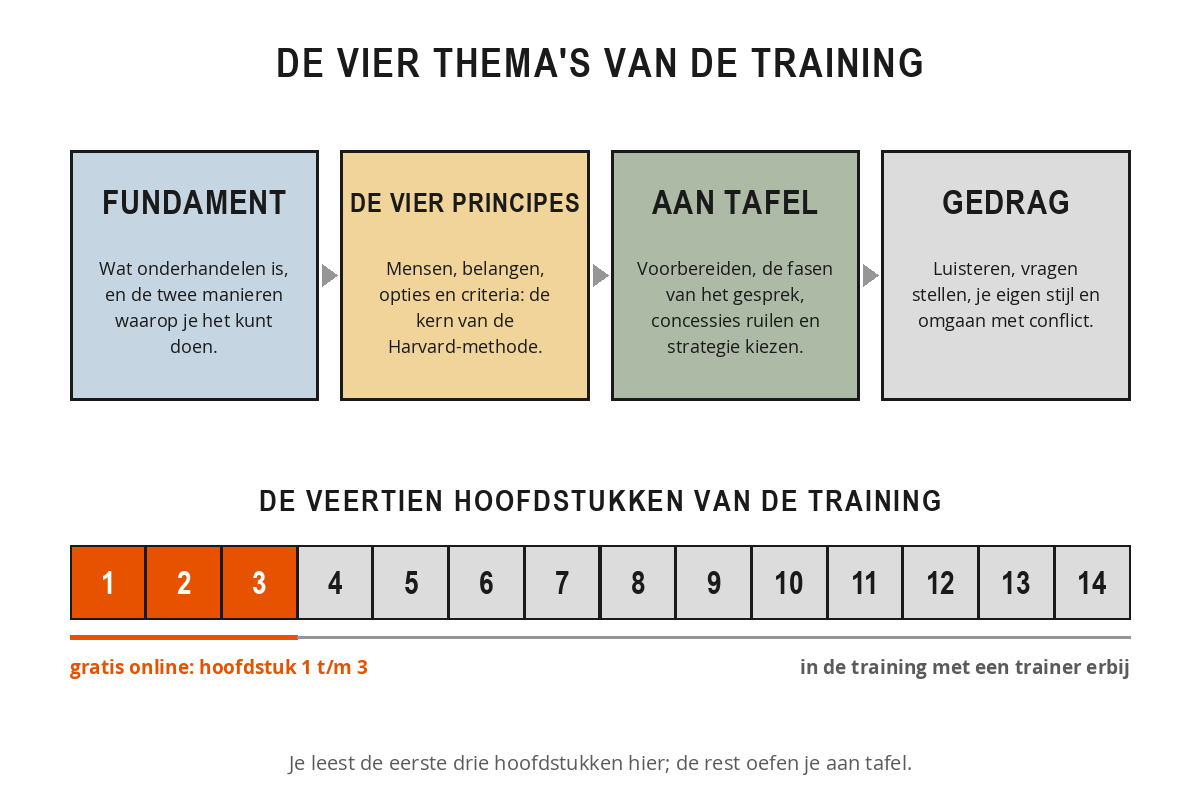
This free course contains the first three chapters: the orange part of the bar above. At the bottom of chapter 3 you will find the full course.
What you will learn
You first learn to recognise when a conversation is a negotiation and when it isn't, and where you yourself tend to go the moment things get tense. Then you see why pushing positions back and forth achieves so little, and what the best-known alternative to it is: soft on the people, hard on the problem. The third chapter makes that practical. You learn to show understanding without giving anything away, you recognise the yes-but spiral before it gets going, and you build the first five minutes of a conversation in such a way that you get information out of it instead of just coffee.
How the course is structured
The course follows four themes that build on one another. You start with the foundation: what negotiating is and which two ways there are of doing it. Then come the four principles of the Harvard method: people, interests, options and criteria. Then it covers what at the table happens: preparing, the phases of the conversation, trading concessions and choosing a strategy. And you finish with behaviour: listening, asking questions, recognising your own style and dealing with conflict. Each chapter contains theory, a model, examples from practice and an exercise that you apply to your own situation.
Practical tips for use
- Keep a notepad or a blank document to hand. The exercises only work if you actually complete them.
- Pick one negotiation from your own practice and use it in all three chapters. The exercises build on one another.
- Take an example from your private life as well. There you often spot your own pattern sooner than at work.
- Don't read it all in one go. A chapter, and then a conversation in which you try it out, gets you further than reading through it in one afternoon.
- In the very next conversation you have, focus on one thing at a time. Nobody manages to change everything at once.
Each chapter ends with a short knowledge check of three questions: answer them correctly to mark the chapter as completed. Your progress is saved automatically in your browser.
Enjoy the read, and above all: good luck at the table.