


1. Negotiating as daily practice
You negotiate more often than you think. With a supplier about a rate, with a colleague about who picks up a job, with a client about a delivery date. And at home about who does the shopping this weekend. Most people do this on instinct. They have never given any thought to what they are actually doing. This chapter therefore starts at the beginning: what exactly is negotiating, when is a conversation a negotiation, and which stance do you usually take without noticing it?
After this chapter:
- You can describe negotiating as two-way communication aimed at reaching agreement.
- You recognise whether a conversation is a negotiation or something else.
- Can you separate the shared interest and the conflicting interest in a given situation.
- You know what the soft and the hard negotiator do and what that costs.
- You can place your own preferred position on the strategy continuum, from fleeing to fighting.
What negotiating is, and what it is not
Negotiating is two-way communication aimed at reaching agreement. That sentence sounds like a dictionary entry, but it conceals three things that set it apart from other conversations.
Firstly, it is two-way. Both parties talk, listen and influence each other. A manager who announces a decision is not negotiating. They are informing. Secondly, there is something to be divided. There is a price, a deadline, an amount of work or a responsibility on the table, and several outcomes are possible. Thirdly, there is mutual dependence. You need the other party to achieve your goal, and the other party needs you. Without that dependence you would simply walk away and find another party.
If any one of those three is missing, it isn't a negotiation. Anyone who tries to negotiate a decision that has already been made is talking to a wall. Anyone who treats an open discussion as an announcement is leaving opportunities on the table.
A buyer is told by a supplier that prices will go up by four per cent from 1 January. He is annoyed, but accepts it: "that's just how it is". Only later does he hear that a competitor bought off the same increase with a two-year contract. It was a negotiation after all. The supplier needed the buyer as a customer, several outcomes were open, and both parties were able to talk. Only one of the two did.
Shared and conflicting interests
Negotiating is rarely a pure battle. Almost always both parties have interests that partly coincide and partly clash. A client and a supplier both want the assignment to succeed. That is shared. On price and lead time they think differently. That is conflicting.
It helps to separate those two layers deliberately before you sit down at the table. The shared interest is the reason you are talking to each other at all. The conflicting interest is what the conversation is about. Anyone who only sees the second layer experiences every conversation as a fight. Anyone who only sees the first layer goes home empty-handed.
The more overlap there is between the interests, the more room you have to achieve something that benefits both sides. In the next chapter you will see why that search stalls as soon as both parties commit to a position.
Sanne wants to work from home two days a week. Her manager wants the team at full strength on Thursdays for the client meeting. Shared interest: Sanne stays motivated and the client meeting runs well. Conflicting interest: how Thursday is filled in. As long as the conversation is only about "working from home or not", it stalls. As soon as both layers are on the table, things start to move: Thursday in the office, two other days at home.
Negotiating on the strategy continuum
Negotiating is one of the ways of dealing with conflicting interests, and certainly not always the best. You can set the options out on a line, from withdrawing completely to pushing on completely. That is the strategy continuum.
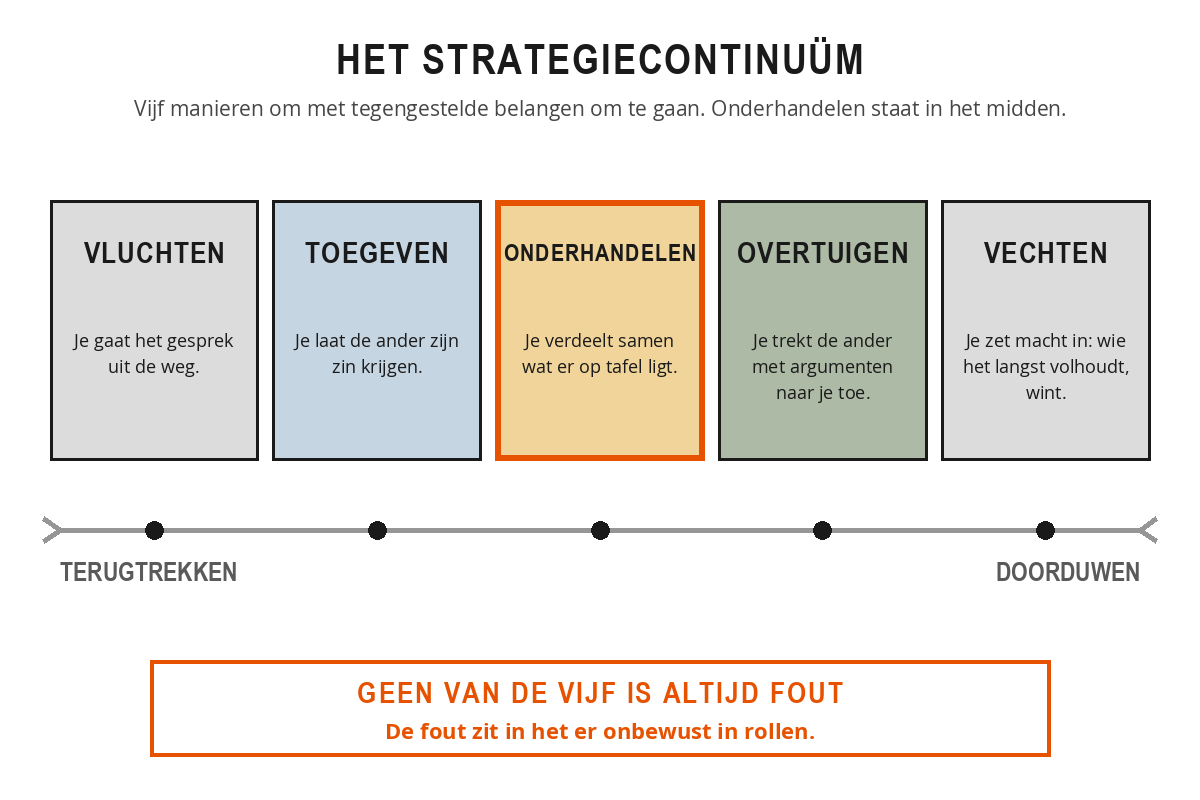
On the far left is avoidance: you steer clear of the conversation. Next to it is giving in: you let the other party have their way. In the middle is negotiating. To the right of that is persuading: you try to win the other party over with arguments. And on the far right is fighting: you use your power, and whoever holds out longest wins.
None of those five is always wrong. If the subject barely affects you, avoidance costs you little. If the other party has far more at stake than you do, giving in is a sensible move. And if the rules are already fixed, in a collective agreement or in law, there is nothing to trade and negotiating serves no purpose. The mistake is not in the strategy itself. The mistake is drifting into it unawares.
Most people have a preferred position. Under pressure they always shift the same way, whether it suits the situation or not. One gives in as soon as things get uncomfortable. Another digs their heels in. If you know which way you naturally move, you can put something up against it.
The soft and the hard negotiator
Within the middle of the continuum you regularly come across two extremes. The soft negotiator wants to avoid personal conflict at all costs. He makes concessions quickly to keep the atmosphere pleasant, changes position easily and volunteers how far he is willing to go. The agreement is reached, but satisfaction afterwards is low. On the way back he thinks: did I really have to give that away?
The hard negotiator sees every negotiation as a trial of strength. They take an extreme position, dig in and assume that whoever holds out longest wins. That sometimes produces a better result. But the relationship takes a knock, and next time the other party plays it just as hard. In the long run, they pay for it.
Both styles produce the same dilemma: you choose between the result and the relationship. In the next chapter you will see a third route, one in which that choice isn't necessary. For now, what matters is that you recognise which way you tend to lean.
Think back to your last three negotiations, at work or privately. What did you do when things got tense: did you give in, push on, or put the conversation off? If the same answer comes back three times, you have found your default position. That is not a judgement. It is the place you set out from.
The sliding scale of interests
How much room you have at the table depends on how the interests relate to one another. That is not a matter of yes or no, but of more or less. Think of it as a scale.
On the left-hand side of that scale you want the same thing as the other party. There you are not talking about terms, but about execution. On the right-hand side, what one party wins equals what the other loses. There the willingness to move disappears. The interesting area lies in between. There is enough shared interest to stay at the table, and enough opposition to have something to divide.
The good thing is that your position on that scale is not fixed. As soon as you ask about the interest behind a position, the dial often shifts to the left. A supplier demanding a five per cent discount sometimes turns out to want certainty about volume above all. A colleague who insists on leading a project turns out mainly to want visibility with the board. Such interests are often easier to serve than the position laid on top of them. That shift is the real work of a negotiator.
Before going into a conversation, assess where you stand on the scale. If you are at the far right, investing in a creative solution is wasted effort and you are better off discussing the split straight away. If you are in the middle, probing almost always pays off. In that case, ask this question first: why is this important to you?
Map out your own practice. Note down five situations from the past month in which you negotiated. Include at least two from your private life. Then pick the situation that has stayed with you most and answer for yourself:
- What did you want to achieve, and what did the other party want to achieve?
- Which interest did you share, and which interest clashed?
- Where on the strategy continuum were you during the conversation: avoiding, giving in, negotiating, persuading or fighting?
- Was this really a negotiation, or was the outcome in fact already fixed before the conversation started?
Keep your answers. In the following chapters you will return to this situation.
Summary
- Negotiating is two-way communication aimed at reaching agreement. There is something to be divided and you need each other.
- Almost every negotiation contains a shared interest and a conflicting interest. Separate those two.
- On the strategy continuum, negotiating sits between avoidance and fighting. Not every situation calls for it, but don't drift into it unawares.
- The soft negotiator sacrifices the result for the relationship; the hard negotiator does the opposite.
- Interests lie on a sliding scale. Probing into the why shifts that scale towards agreement.
Your manager calls the team together and announces that the holiday arrangements will change as of next year. The decision has already been taken by the board. Is this a negotiation?
A colleague almost always gives in quickly in meetings to keep the atmosphere pleasant, and volunteers how far they are prepared to go. According to this chapter, what is the consequence of that style?
A supplier demands a five per cent discount. You probe further and hear that what he mainly wants is certainty about next year's purchase volume. According to the chapter, what happens on the sliding scale of interests?