


2. Positional versus principled negotiation
Two parties each name a figure and from then on only defend what they have said. It is the way most negotiations go, and at the same time the way that yields the least. In chapter 1 you saw that the soft and the hard negotiator both face the same choice: the relationship or the result. This chapter shows where that choice comes from, and how to get out from under it.
After this chapter:
- You recognise positional bargaining from the behaviour of both parties.
- You can explain why digging in on positions leads to a deadlock.
- You know the essence of principled negotiation: soft on the people, hard on the problem.
- You can set soft, hard and principled behaviour side by side and tell them apart.
- You know the four principles that underpin the rest of this course.
Digging in on positions
In positional negotiation each party takes up a position, defends that position and gives away a little of it at a time until a compromise is reached. You are then negotiating about what you say you want, not about why you want it. That looks straightforward. Everyone knows where they stand, and the give and take has something of a game about it. But it takes time, it usually produces a mediocre outcome, and it eats away at the relationship.
That is because something happens the moment you state a position. You start defending it. Your ego becomes entangled with the figure you named, and going back on your position then feels like losing face, even when you have long known that a better solution exists. The more firmly you have staked out your position, and the more people have heard it, the more expensive it becomes to deviate from it.
Rachid supplies software developers and opens at 95 euros an hour. Els is the buyer and says: 85 euros, there is no more. Three rounds follow in which they each shift a few euros. They end up at 90 euros and shake hands. Nobody asked where that 95 came from or why the budget stopped at 85. The fact that Rachid was mainly looking for steady turnover for two of his people, and Els mainly wanted a predictable set of annual accounts, never comes up. A two-year contract at 88 euros would have given them both more than that 90.
The choice between the relationship and the result
There is a second problem attached to positional negotiation, and that is the problem from chapter 1. As soon as the conversation is only about positions, it forces you to choose. Choose the relationship and you drift towards the behaviour of the soft negotiator and give in too quickly. Choose the result and you end up as the hard negotiator, pushing on until the other person drops out or walks away.
Both choices come at a price you only pay later. The soft negotiator ends up with an agreement he cannot explain to his own organisation. The hard negotiator gets a better deal and a counterpart who pushes back harder next time. Anyone who regularly sits at the table with the same people loses in the long run what they won in the short run.
Do you notice a conversation going round in circles, with both parties repeating the same arguments in different words? That is the sign that you are negotiating positionally. At that point, ask out loud: "What is this figure actually based on for you?" You are not asking for a concession, but for information. That is harder to refuse.
Hard on the issue, soft on the person
The third way is not the middle ground between hard and soft. Principled negotiation combines both, but directs them at different things: firm on the substance, flexible on the relationship. You do not give up your interest to save the atmosphere, and you do not put the other party under pressure to get your way.
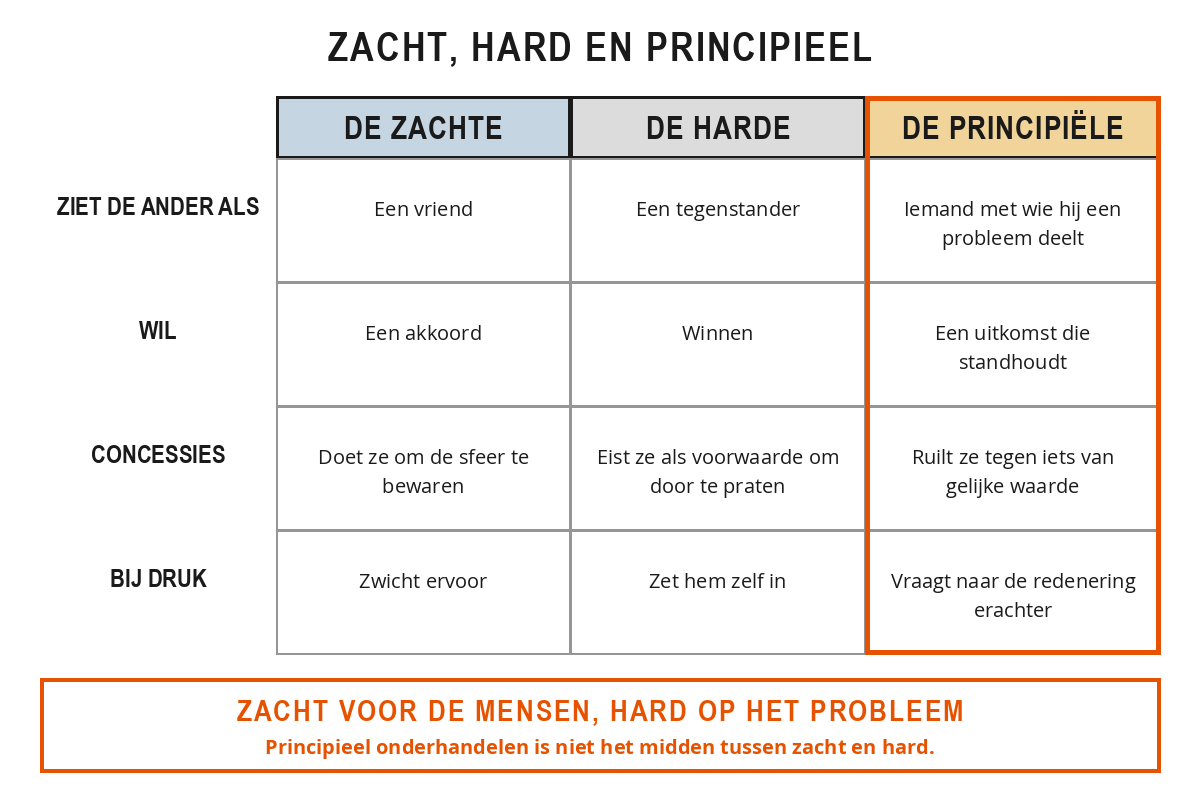
The three styles differ on four points. They see the other party differently: the soft negotiator sees a friend, the hard one an opponent, the principled one someone with whom he shares a problem. They want something different: the soft one wants an agreement, the hard one wants to win, the principled one wants an outcome that holds up. They deal with concessions differently: the soft one makes them to preserve the atmosphere, the hard one demands them as a condition for continuing, the principled one trades them for something of equal value. And they respond differently to pressure: the soft one gives in to it, the hard one applies it himself, the principled one does not go along with it but asks for the reasoning behind it.
In practice, that distinction feels unnatural. Anyone who holds firm on the substance is easily seen as unpleasant. Anyone who stays friendly feels the urge to give way on the substance as well. It is precisely that link you let go of. You can like someone a great deal and find their proposal completely unworkable.
Marloes is running a project and hears that her supplier will deliver two weeks late. She says: "I appreciate how quickly you respond to my emails, that makes things easy to work with. At the same time, I can't live with this schedule. The delivery date of 1 June is in our contract with the client and it carries a penalty of five hundred euros a day. Let's look together at what is needed to meet that date after all." There are two messages in that statement. The relationship is acknowledged, the problem stays fully on the table. Marloes does not soften her demand in order to be nice, and she does not become unpleasant in order to give her demand more force.
The result of that separation is that your position is no longer your identity. If the other person rejects your proposal, they are rejecting a proposal, not you. That saves a great deal of defensive energy, and you can put that energy into the solution instead.
The four principles
Principled negotiation is set out in four principles that reinforce one another. Together they form the thread running through the rest of this course and of the training course.
Separate the people from the problem. You treat the person and the issue as two separate things. The next chapter is about that: how to do it when emotions run high.
Focus on interests, not on positions. Behind every position lies a reason. A position is a single point you can only shift towards; an interest can be served in several ways. That is why Rachid and Els would have got further with a two-year contract than with that 90 euro.
Look for solutions that serve mutual interests. Before you choose, you gather variants. More options on the table means a better chance of a division that leaves both parties better off. Keep that gathering and that choosing separate.
Insist on objective criteria. The outcome rests on a yardstick outside the two of you: a market price, an index, a valuation, an earlier agreement. It is then no longer about who pushes hardest, but about what is reasonable.
Take out your notes from chapter 1, on the negotiation that has stayed with you most. First answer these five questions:
- Which position did you state first? Write it down word for word, including the figure or the condition.
- Which position did the other person state first?
- How many rounds of back-and-forth shifting followed after that?
- What was the outcome, and how far was it from your opening position?
- Which question could you have asked that you never asked?
Then go through the four principles and write one sentence for each. Where was it about the person instead of the issue? Which interest of the other party did you never hear? How many solutions were on the table, one or several? And what was the final amount based on, other than who pushed hardest? Mark the principle where your conversation left the most on the table. That is your point to work on.
Summary
- Positional negotiation revolves around positions you defend and slowly adjust. It takes time and rarely produces the best outcome.
- Once you have stated a position, you will defend it, even when you have long known that something better exists.
- Positional bargaining forces you to choose between the relationship and the result. Principled negotiation removes that choice: soft on the people, hard on the problem.
- Soft, hard and principled differ in how they see the other party, what they want, how they handle concessions and how they respond to pressure.
- The four principles: separate the people from the problem, focus on interests, look for solutions of mutual benefit and insist on objective criteria.
According to this chapter, why does digging into a position lead to a deadlock?
Marloes tells her supplier that she values the working relationship, and immediately afterwards that she cannot live with the new schedule. What is she doing?
How does a principled negotiator deal with concessions, compared with the soft and the hard negotiator?