


3. Separate the people from the problem
At the table sits a person, not a position. As soon as someone feels attacked, their energy goes into defending their own dignity and no longer into the issue at hand. This chapter is about the first principle from chapter 2, and it is the first for a reason: as long as this goes wrong, the other three never get their turn.
After this chapter:
- Can you explain what separating the people from the problem means, and why that makes a negotiation easier?
- Whether you explore the other party's point of view without giving up your own position.
- You can show understanding without agreeing on the substance.
- Recognise the three ways communication goes wrong at the table, and the yes-but spiral that follows from it.
- Whether you can deliberately build up the first five minutes of a negotiation.
Two things at once at the table
At every negotiating table, two things run together: the business issue and the relationship between the people. As long as those two are tied together, a critical remark about a proposal is heard as a judgement about the person who made it. The response is then defensiveness instead of substance, and within two minutes the conversation is no longer about anything.
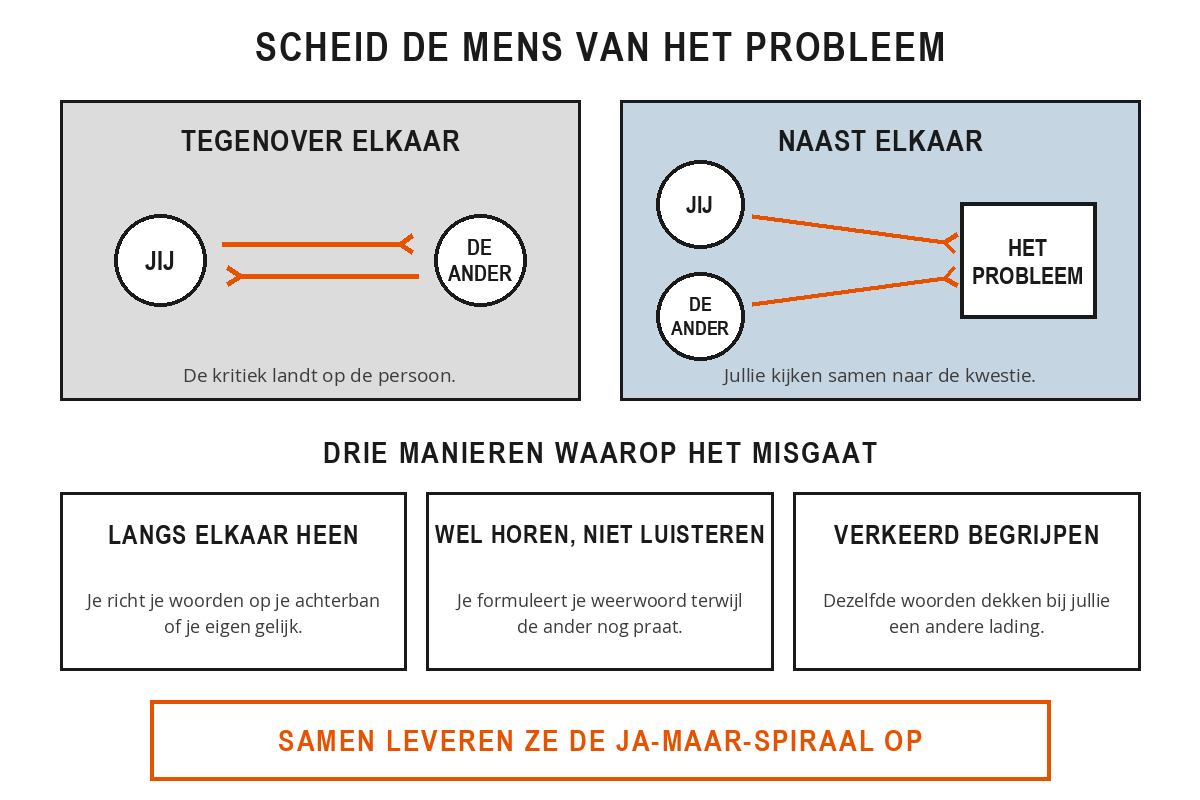
Separating the people from the problem means that you treat those two sides separately, each with its own approach. You maintain the relationship with attention, listening and respect. You handle the issue in a businesslike and firm manner. The picture above shows the usual situation on the left: two parties opposite each other, with the arrows pointed at each other. On the right is where you want to get to: both on the same side, with the arrows pointed together at the problem that lies between them. This is not a matter of being nice. It is a way of keeping your attention in the right place.
Your picture is not the situation
You see the situation as you see it. The other person does the same, from a different position, with different information and different concerns. Both pictures are incomplete, and that is not a matter of good will. Anyone who assumes their own view is the only correct one misses precisely the information that would get the conversation moving.
The awkward thing is that we usually fill the gap in our information with an explanation about the other person. Not with "I don't know why he is asking this", but with "apparently he doesn't trust us". That explanation feels like an observation, while it is a guess. And then you go on to negotiate with your guess instead of with reality.
Bram supplies building materials and, on an order of 60,000 euros, asks for forty per cent payment in advance. Ingrid does the purchasing and thinks: they don't trust us, even though we have been a client for six years. Bram thinks: this month I have to buy 24,000 euros' worth of steel and my bank is no longer supporting that. As long as Ingrid treats her own explanation as the truth, she is negotiating about trust, and there is nothing to divide there. As soon as she asks why that advance payment is necessary, she is negotiating about payment terms and material purchasing. That is solvable: she pays the steel order directly and the rest stays on thirty days.
Showing understanding without giving in
Showing understanding means making clear that you have heard the other person's reasoning and feelings. It is not agreement. You are not saying that the other person is right; you are saying that you understand how they arrived at their position. That costs you nothing on the substance and gains you a great deal in atmosphere, because the other person no longer has to worry about whether they are being taken seriously.
Most people do this by halves. They show understanding and immediately tack a "but" onto it, which withdraws the understanding again. Leave that word out. Show understanding, allow a short silence, and then ask your question or make your proposal.
Three sentences that show understanding without giving anything away: "I understand that deadline carries a lot of weight for you." "If I were in your position, I would find that important too." "Am I right that it's mainly about certainty for you?" Practise that last one: you summarise what you think you are hearing and check it. If you are wrong, the other person corrects you and you know more than you did before you asked.
Three ways it goes wrong
Even if you keep the person and the issue neatly separate, the conversation can still be heavy going. The communication itself goes wrong in three ways, and they are shown at the bottom of the diagram above.
The first is talking at cross purposes. You aim your words not at the other person, but at your own colleagues or at proving yourself right. The other person hears a plea instead of an invitation, and answers with a counter-plea. You recognise it by sentences that start with "as an organisation, we believe".
The second is hearing but not listening. While the other person is talking, you are formulating your rebuttal. You hear the sentences, but the concern underneath them escapes you. This is the most common of the three, and the hardest to catch yourself doing.
The third is misunderstanding what is being said. The same words carry a different meaning for two different people. "We'll take a flexible view of it" sounds to you like room to manoeuvre and to the other person like non-commitment. "As soon as possible" means this week to one person and this quarter to another. Only when you spell it out in a date or an amount do you know whether you mean the same thing.
The yes-but spiral
Those three problems come together in a pattern you see at almost every table. Someone makes a proposal, the other person starts with "yes, but" and follows it with a counter-argument. The word "yes" pretends that someone has listened, the word "but" immediately wipes that away. Anyone who experiences that three times starts talking louder, and the conversation shifts from the issue to the person. From there there is no way back unless someone deliberately takes it.
Joost, project manager at a software company, says: "Yes, but you delivered the specifications three weeks late." Nadia, the buyer, replies: "Yes, but you only asked your questions in week three." Within two minutes it is about blame and no longer about the schedule. Joost steps out of it with a single sentence: "We have both lost time. What is needed to get the final module finished before 1 June after all?" He concedes nothing, he denies nothing, and he puts the conversation back on the issue. Nadia comes up with a proposal: freeing up two of her people for two days a week for the acceptance test.
If you want to break the spiral in yourself, replace "yes, but" with a summary followed by an open question. "So the specifications came in late and that has affected your planning. What is needed now to meet the date?" The same content, without the attack.
Settling in: the first five minutes
Anyone who gets straight to the point opens on content while the atmosphere is still tense. Fitting in means making contact first and only then doing business. It takes two to five minutes and it often yields the most important information of the entire conversation, because in those minutes people say things they would not say later on.
This is how you build that opening. You welcome the other person personally and pay attention to the practical things: coats, coffee, where someone sits. You open with a neutral topic that has nothing to do with the issue: the journey, a renovation, a mutual acquaintance. You say out loud how much time you have and what you want to discuss. You ask the other person what they would like to add to that agenda, and that is more than politeness: this is where you hear what it is really going to be about. And then you switch over explicitly: "Shall we look at the figures?"
Arrange the chairs so that you are both looking at the same screen or the same sheet of paper, instead of directly facing one another. Side by side facing the problem works literally as it is meant figuratively. If you are online, a shared screen with the figures on it does the same job.
Choose a negotiation in which you got stuck on the person rather than on the issue, and put four things on paper: what it was about in business terms, how you saw the situation, how the other party probably saw it and with what concerns, and what information you were missing because you didn't ask further. Then note at least one point on which the other party acted entirely reasonably from their own position.
Then prepare the first five minutes of a conversation that is coming up in your diary:
- Who is sitting opposite you, and what do you know about them?
- Which neutral topic really fits here? Don't invent one; choose one you actually mean.
- In which single sentence do you state the subject and the time you have together?
- What is your transition line into the substance?
- Which sentence from the other person gives away that the yes-but spiral is starting, and what do you say then?
Summary
- At the table, the issue and the relationship get tangled up. Deal with them separately: businesslike on the substance, careful with the person.
- Don't sit opposite one another but side by side, with both of you focusing on the problem.
- Your picture of the situation is not the situation. You fill the gap in your information with a guess about the other party, and then you negotiate on the basis of that guess.
- Showing understanding is not the same as agreeing. Leave out the word "but" and then ask your question.
- Communication goes wrong in three ways: talking at cross purposes, hearing but not listening, and misunderstanding. Together they produce the yes-but spiral.
- The first five minutes are not a warm-up. Fitting in yields information you will not get later on.
Ingrid hears that her supplier wants forty per cent paid in advance and thinks: they don't trust us. According to the chapter, what is going wrong here?
What is the objection to "yes, but" as the opening of your response?
You open a negotiation and ask the other party what they would like to add to the agenda. Why is that more than politeness?
Ready for the next step?
You have completed the free starter course of Negotiation. The next chapter in the full course is Interests behind positions: The difference between a position and an interest, the five needs that lie beneath them and the two questions that bring them to the surface.
Take the 2-day course →From €1250,- excl. VAT · with an experienced trainer included