


Introduction
You usually know what you ought to do. Have that conversation, draw that line, not go straight on the defensive when a colleague replies curtly. And yet things often turn out just a little differently. A good intention falls apart in week two, you say yes when you mean no, and a week later you are irritated by exactly the same things. Personal effectiveness is about those moments. Not about working harder or planning more cleverly, but about knowing yourself and directing yourself.
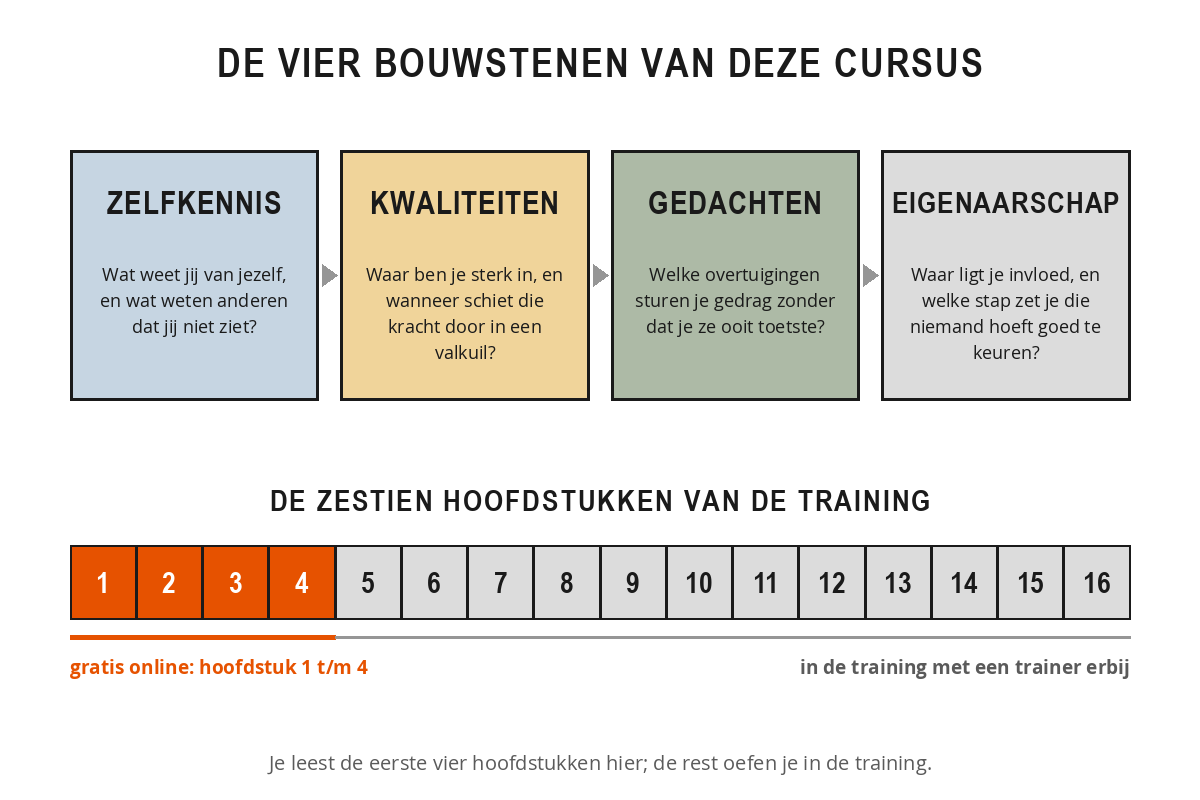
This free course contains the first four chapters: the orange part of the bar above. At the bottom of chapter 4 you will find the full course.
What you will learn
You are given four models, each of which makes a different side of yourself visible. With the Johari window you map out what others see in you and you don't see yourself, and you learn to back up your strengths with situations rather than with labels. With the Ofman's core quadrant you see how your strongest characteristic can overshoot into your biggest pitfall, and why some colleagues get under your skin so quickly. With the ABC model of REBT you bring to the surface the thought that drives your behaviour, and you turn it into something that does hold up. And with the circle of influence you determine where your attention yields something and where it only costs energy.
The common thread is always the same: you have more room to manoeuvre than you think, but that room lies in your own behaviour, not in someone else's.
How the course is structured
The four chapters build on one another. You start with self-knowledge: what do you actually know about yourself, and where is the information you are missing? After that it is about your qualities: what are you strong at, and when does that same strength become a problem? Next you delve into your thoughts: which beliefs drive your behaviour without you ever having tested them? And you finish with the ownership: which step will you take, today, for which you need no one's permission. Each chapter contains theory, a diagram, examples from practice and an exercise that you apply to your own work.
Practical tips for use
- Keep a notepad or a blank document to hand. The exercises only work if you actually complete them.
- Don't read it all in one go. One chapter a week, with time to try it out, delivers more than reading through it in an afternoon.
- For each chapter, choose one concrete situation from your own work to apply the content to. Preferably a situation that still doesn't sit well with you.
- Put the outcome to a colleague at some point. Three of the four models in this course work better with information from outside than with thinking it over on your own.
- Start small. Sticking to one different behaviour works better than being a new person from Monday onwards.
Each chapter ends with a short knowledge check of three questions: answer them correctly to mark the chapter as completed. Your progress is saved automatically in your browser.
Enjoy the reading, and above all: enjoy the conversations that go differently from now on.