


1. Self-awareness with the Johari window
Who you think you are and who others see is never exactly the same. That difference is not a problem, it is information. But that information does not sit with you, and that makes it hard to get hold of. This chapter is about where that information sits and how to obtain it.
After this chapter:
- You know what self-awareness is and why your intention and your effect diverge.
- Do you know the four areas of the Johari window and can you come up with your own examples for each.
- You know which two movements make your open area bigger.
- Can you support a strength with a situation rather than with a label.
- You have a fixed set of questions that make your own development visible.
Your intention and your effect are two different things
Self-awareness is the ability to recognise your own thoughts, feelings and behaviour at the moment they occur, and to see what effect they have on others. The first part is looking inwards: noticing that your shoulders rise, that you start talking faster, that you leave something out because you want to keep the conversation short. The second part is looking outwards: understanding how that behaviour lands with the other person.
That second half is the difficult one, and that is down to an unfair distribution. You have access to your intention, the other person only to your effect. You meant your question as involvement; the other person heard control. You meant your silence as giving space; the other person read disapproval into it. Without information from outside you carry on believing in your own intention, and then nothing changes, however often you reflect on it.
Self-awareness is therefore not a trait you either have or do not have. It is a skill that grows as soon as you place two sources side by side: what you observe in yourself, and what others observe in you. That is exactly what the Johari window was made for.
The four areas of the Johari window
Joseph Luft and Harrington Ingham devised this model in the 1950s. They joined their first names together to make "Johari" and set two simple questions against each other: is this known to me, and is this known to others? This produces four areas.
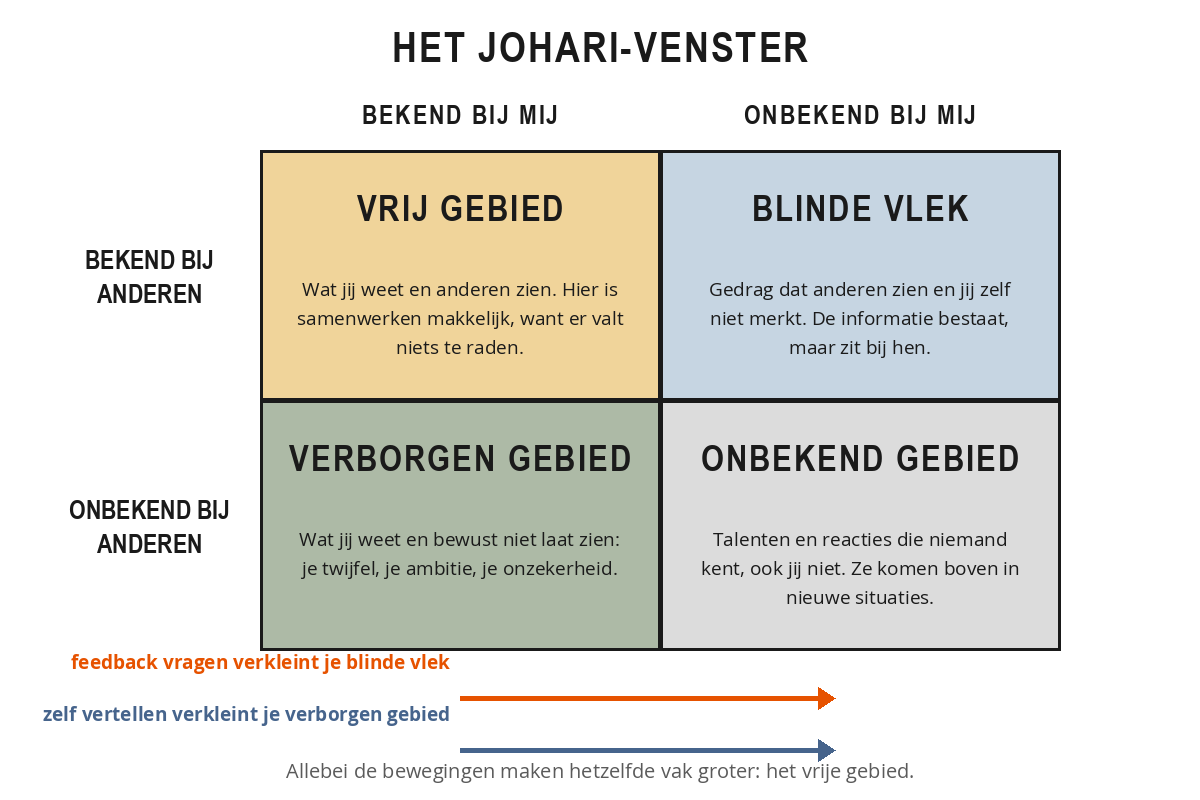
The open area is everything you know about yourself that others can see as well. You decide quickly, you cope badly with chaos, you would rather email than call. Working together is easy here, because nothing has to be guessed.
The blind spot is behaviour that others see in you while you do not notice it yourself. You interrupt more quickly than you think, or you sigh audibly when someone revisits a decision that had already been made. The information does exist, it simply sits with others rather than with you.
The hidden area is what you know about yourself and deliberately do not show: your doubts about a project, your ambition for a different role, the feeling that a colleague makes you insecure. Sometimes that is sensible. Often it keeps the conversation shallower than it needs to be.
The unknown area are the talents, reactions and motives that nobody knows yet, including you. They surface in situations you have never encountered before: a reorganisation, a conflict, suddenly inheriting a team.
The most important thing about the model is that the four panes shift. If you say something about your doubts, your open area grows and your hidden area shrinks. If you ask someone what they notice about the way you chair a meeting, a piece of your blind spot moves into the open area. A larger open area means less noise, quicker trust and less energy leaking away into interpretation.
Karin is a team leader at an insurance company. For two years running, her appraisal has said that she sometimes comes across as "a bit dominant" in meetings. She doesn't recognise it: she feels she is keeping things moving because nobody else makes decisions. A classic blind spot.
She decides to measure it instead of continuing to think about it. She asks three colleagues simply to keep track of how many minutes she is speaking during the next forty-minute team meeting. The outcome: eighteen of the forty minutes, while six people were at the table. Her own estimate was "about eight minutes". Only with that figure does it become something she can work with.
Two movements, one pane that grows
You have only two ways to enlarge your open area, and each of them works on a different quadrant.
The first is asking for feedback. That reduces your blind spot: you gather information that only other people have. It works better if you ask small and concrete questions. "Do you have any feedback for me?" almost always produces "no, it was fine". "What did you notice about the way I closed that meeting this morning?" does produce something, because you are asking about one moment the other person has just experienced.
The second is telling others yourself. That reduces your hidden area: you show what you already knew but kept to yourself. "I notice that I'm unsure about this" or "I'd really like this project, because I want to move in that direction" takes a bit of effort, and almost always results in the other person sharing something too.
Never ask for feedback on yourself in general, but on one specific moment, preferably within a day of it happening. The fresher and the smaller, the more useful the answer.
From label to evidence
A list of strengths is quickly drawn up and usually unusable. Words such as driven, flexible and team player appear on half the CVs in the Netherlands and say nothing about what you actually do in a concrete situation. An overview only becomes usable once you add a situation to each point, in three parts: what the circumstances were, what you did and what effect that had. Without that effect it remains a story about yourself; with that effect it becomes something another person can confirm.
That requirement is strict, and that is precisely the point. Your self-image is built on your intentions, while the people around you judge you on your effect. By looking for a situation with every point, you force yourself to look at that effect.
Thomas works in a purchasing department and lists "I am good at collaborating" among his strong points. He looks for a situation to go with it and finds this one: when two departments were working against each other over the new schedule, he spoke to both team leaders separately before the joint meeting started. In that meeting an agreement was reached within half an hour, whereas the two previous meetings had ended without a decision.
Among his weak points he writes "sometimes a bit blunt". He looks for three situations and notices that all three involve the same colleague. So it is not about his pace in general. His wording changes to: "with Erik I cut in before he has finished making his point." He can start working on that tomorrow; with "a bit blunt" he could not.
Not every strength comes from the same source, and that difference determines what you can do with it. A talent has come easily to you since childhood and costs you hardly any energy; you are sometimes surprised that others find it difficult. A skill is something you have learned and can develop further; you still remember how clumsy you were at it, and that is often where the quickest gains are, because you already know the route. A habit is something you do so often that it no longer takes any attention; handy as long as the situation stays the same, risky as soon as circumstances change.
If a point remains without a situation, that is not a mistake. It is an indication. Sometimes the label has been borrowed from an old appraisal round, sometimes the point sits in your blind spot and you need to gather the information from outside.
Self-evaluation with fixed questions
Self-evaluation is the recurring moment at which you assess your own performance using the same set of questions. Because the questions do not change, what does change in your answers becomes visible. That is where your development lies. Without fixed questions, self-evaluation turns into mood: after a good week you consider yourself competent, after an awkward conversation you doubt everything.
These seven questions are a starting point. You may adjust the wording, as long as they stay the same afterwards.
- What went better this week than I expected?
- Where did I run into the same wall as last time? Repetition is the strongest indication of a pattern.
- In which conversation did I feel tension, and where in my body was that tension?
- Where did I do what I found easy instead of what was needed?
- What feedback did I receive, and what did I do with it?
- What would a colleague have said about me this week?
- What is my one action for next week, in behaviour you can observe?
Weekly works better than monthly, and ten minutes works better than an hour: a long session gets put off, a short one you keep up. Attach it to something that already exists, for instance the end of your Friday afternoon. Put a longer moment in the diary twice a year to read six months' worth of answers in one go. What looked like an incident on a single Friday often turns out to be a pattern over twenty weeks.
There are three ways this predictably goes wrong. In the grading mode you give yourself a mark and stop there; a mark without a situation is a judgement, not information. With only evaluating after a setback you build up a file of mistakes and lose sight of what does work. And with answers about other people your sentence begins with "my manager again failed to provide clarity", which puts the answer outside your influence. In that case, reformulate it in terms of your own part: what did you do when that clarity failed to materialise?
Make your own self-evaluation in three rounds. Set aside twenty minutes for it and write in half sentences.
- Note down three strengths, and add to each point a situation with an effect that someone else can confirm.
- Note down two points that are getting in your way, again with a situation attached.
- For each strong point, note whether it is a talent, a skill or a habit.
- Place the points in the window: which point would a colleague mention about you spontaneously (open area), which point do you deliberately keep to yourself (hidden area), and for which point can you not find a situation?
That last point is your homework. This week, ask one colleague what they notice about your behaviour on that one point, and ask for one specific moment.
Summary
- You know your intention, the other person only knows your effect. Without information from outside, you go on believing in your own intention.
- The Johari window has four areas: the open area, the blind spot, the hidden area and the unknown area.
- Asking for feedback shrinks your blind spot, disclosing things yourself shrinks your hidden area. Both make your open area bigger.
- Ask for feedback on one specific moment, not on yourself in general.
- A strong point without a situation and an effect is just a label. Distinguish between talent, skill and habit.
- Self-evaluation works with a fixed set of questions, short and weekly, and with answers about yourself rather than about other people.
Your colleagues notice that you sigh audibly in meetings when someone revisits a decision. You have never noticed it yourself. Which area of the Johari window does this behaviour sit in?
You want to enlarge your open area. Which question yields the most for that?
Why does this chapter require a situation with an effect for every strong point?