


2. Ofman's core quadrant
What comes naturally to you and what others find irritating about you are often two sides of the same trait. Daniel Ofman captured that connection in a model of four positions. It explains in a single diagram why under pressure you often do exactly the wrong thing, and why some people can wind you up within two minutes.
After this chapter:
- You can explain what a core quality is and how it differs from a learned skill.
- You recognise the pitfall that goes with your strongest quality, and the signal that you are in it.
- You know what a challenge is and why it is not the opposite of your quality.
- You understand why your allergy points back to your own challenge.
- You can fill in a complete quadrant and test it against a real situation.
Core quality: what was always there
A core quality is a trait that belongs to you and that you use without effort. You did not learn it on a training course; it was already there when you were eight. Think of carefulness, humour, perseverance, commitment or decisiveness.
Two things make a core quality recognisable. First, it costs you hardly any energy, and you are sometimes surprised that others find it difficult. Second, it cannot be switched off: even at moments when it is unhelpful, you do it anyway. That is what distinguishes it from a skill, which you have built up deliberately. Your core quality is more your keynote than your repertoire.
Pitfall: too much of a good thing
A pitfall is your core quality in overdrive. Not the opposite of your quality, but the same quality with the volume turned up too high. Carefulness becomes nit-picking. Involvement becomes meddling. Decisiveness becomes pushiness.
The tricky part is that you rarely feel your own pitfall. On the inside you are doing exactly what you always do and what usually works; from the outside, someone else sees you overshooting. Your pitfall therefore often sits in the blind spot from chapter 1.
There is one signal you can watch for yourself: under pressure you push harder on your quality. Someone who likes order makes even more lists when faced with chaos. Someone who likes pace talks even faster when things slow down. Someone who is involved asks how you are doing even more often when there is distance. More of the same is almost always the moment at which the quality tips over.
Sander is a project manager and is known for his decisiveness. In a meeting that has ground to a halt, he settles three issues within ten minutes. Everyone is relieved, and the following week the project is moving again.
Two weeks later the same meeting overruns. Sander becomes impatient and takes the decisions again, but this time without waiting for the doubts of two team members. Over coffee, those two hear from each other that neither of them agreed. Three weeks later the decision has to be reversed after all, costing the project eleven days. The same decisiveness, only used too soon.
Challenge: the quality you lack
Every pitfall has a positive counterpart, and that is what makes the model useful: it shows the direction of your development without you having to give up your quality.
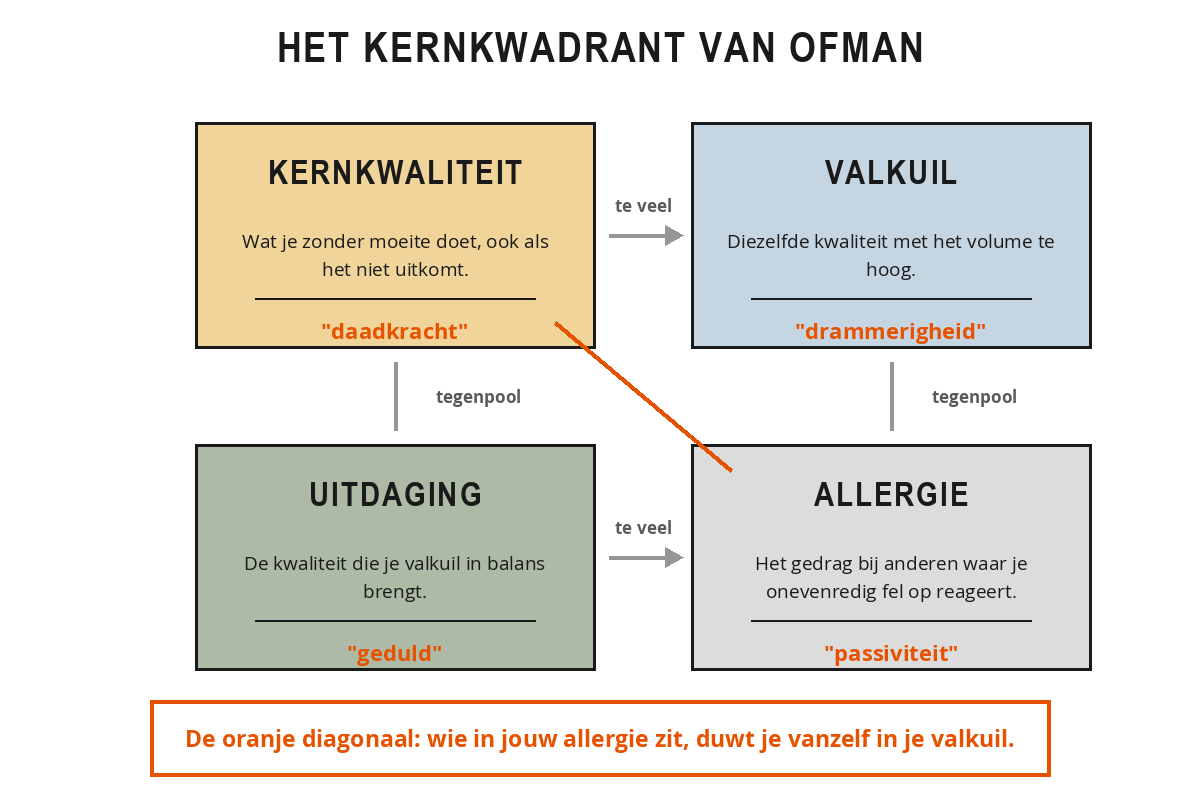
Your challenge is the positive counterpart of your pitfall: the behaviour you do not yet use automatically and that brings your pitfall into balance. It is emphatically not the opposite of your core quality. You do not have to unlearn your decisiveness in order to develop patience; you add something alongside it.
You find your challenge by asking one question about your pitfall: which quality would have helped here? For pushiness that is patience, or giving space. For meddling it is being able to give trust. For being chaotic it is creating structure. Your challenge is often something your colleagues are admired for and that you secretly feel does not suit you. A challenge rarely feels pleasant: it takes effort, it goes slowly and you feel as though you are giving something up. That is precisely why you usually leave it to others.
Allergy: what you cannot stand
If you take your challenge to the extreme, you end up at your allergy: the behaviour in others that you react to disproportionately strongly. Not mildly irritated, but with an intensity out of all proportion to what is happening.
Someone with the core quality decisiveness and the challenge patience often becomes allergic to passivity and endless deliberation. Someone who is careful and has courage as a challenge is allergic to people who can't be bothered to do things properly. Someone who is committed and has to learn to keep their distance gets stuck on colleagues who act cold and businesslike.
That sharpness is useful information. Your allergy always points back to your own challenge: you react so strongly because the other person's behaviour is the extreme version of what you still need to develop in yourself. What you keep at arm's length in someone else, you also keep at arm's length in yourself.
The diagonal with the most tension
There are two diagonals in the quadrant. One connects your pitfall with your challenge; that is your learning point. The other connects your core quality with your allergy, and that is where the most tension lies. If you meet someone who sits exactly in your allergy, you fall into your pitfall. In doing so you provoke in the other person precisely the behaviour you can't stand. Both people reinforce each other's pitfall, and neither understands why this conversation is so difficult.
Sander's complete quadrant looks like this. His core quality is drive. His pitfall is pushiness; his team members call it "steamrolling us". His challenge is patience and giving others room: he is capable of it, but only when he remembers to. His allergy is indecisiveness.
In practice: in meetings, Nadia likes to work through every scenario. Within two minutes Sander feels his jaw tighten. The longer Nadia sets out her scenarios, the shorter Sander's responses become. He cuts her off, he pushes through. Nadia feels steamrollered and next time phrases things even more cautiously and at even greater length. His allergy draws out his pitfall, his pitfall draws out her behaviour. Two people both doing their best, and a meeting that becomes more awkward every time.
Filling in your own quadrant
Filling in a quadrant is not a form-filling exercise but a process of searching. You can start at any of the four positions, and along the way it usually turns out that your first choice of words isn't quite right yet. This is how you work it out.
- Choose a way in. Start at the position where a word comes to you fastest, usually your core quality or your allergy. With an allergy you often have a face in mind straight away.
- Fill in the position next to it. From your core quality you move horizontally to the pitfall: what happens when you use this quality too much? From your allergy you move horizontally to the challenge: which healthy variant lies beneath that behaviour?
- Check the diagonals. Once all four words are in place, you check whether your core quality and your allergy really are opposites, and whether your pitfall and your challenge are too.
- Test it in a situation. Look for a concrete moment from the past month in which all four positions were visible. If the quadrant is right, that situation will fit into it smoothly.
- Put it to someone else. Ask a colleague whether they recognise the pitfall and which word they would choose. Their word often hits your blind spot exactly.
Three mistakes that make the quadrant useless
Quadrants go askew in a few standard ways. All of them can be put right by adjusting one word.
The first mistake is filling in the opposite of your core quality quality as your challenge. "Decisiveness" set against "passivity" tells you that you have to give up part of yourself. That is not right and it motivates no one. Your challenge is the opposite of your pitfall, not of your quality.
The second mistake is filling in an allergy with a name instead of with behaviour. "Nadia" is not an allergy. "Endlessly wanting to lay out every scenario side by side" is. As soon as you name the behaviour, you can look for the challenge underneath it.
The third mistake is choosing words that are too big. "Incompetence" and "arrogance" are judgements: they hurt and they achieve nothing. Words pitched a little lower, such as "deciding too early" or "talking too fast", give you something to practise with tomorrow.
A quadrant is not only useful for a quality you are proud of. You can also fill it in starting from a colleague you find difficult: you put their irritating behaviour in the pitfall box and work back from there to their core quality. That exercise often changes more in the working relationship than a conversation about the working relationship.
Complete one full quadrant and test it straight away.
- Core quality: the word colleagues use to describe you.
- Pitfall: the same behaviour taken too far, phrased as behaviour and not as a character trait.
- Challenge: the quality that brings your pitfall back into balance.
- Allergy: the behaviour in others that you react to disproportionately strongly.
- Test situation: one concrete moment from the past month in which all four were visible.
- The person who sits most squarely in your allergy, and what you did when they displayed that behaviour.
- One different behaviour to try out next time.
Watch out on that last point: choose behaviour, not an intention. Not "I am going to be more patient", but "I let Nadia finish her sentence before I respond".
Summary
- A core quality costs you no energy and cannot be switched off. That is what distinguishes it from a skill.
- Your pitfall is the same quality with the volume too high. Under pressure you push harder: that is your signal.
- Your challenge is the positive counterpart of your pitfall, not of your core quality.
- Your allergy is the extreme version of your challenge as seen in someone else, and therefore points back to yourself.
- The diagonal between core quality and allergy explains why certain people push you into your pitfall so quickly.
- Keep the words small and behavioural, and test your quadrant against a real situation and against someone else's word.
A colleague has carefulness as a core quality. What belongs in the box marked "pitfall"?
You notice that you react disproportionately strongly to a colleague who can't be bothered to do things properly. According to the model, what does that allergy say about you?
Sander is decisive and allergic to indecisiveness. In meetings, Nadia works through every scenario. What does the diagonal in the quadrant predict?