


3. Breaking patterns with RET
Some situations always end the same way, even when you had decided beforehand that this time it would be different. You intend to say something in that meeting, and again you say nothing. You intend to hand that task back, and again you finish it yourself. There is almost always a pattern behind that, and a pattern can be changed as soon as you see how it works.
After this chapter:
- Can you describe what a behavioural pattern is and why it keeps itself in place.
- You know the three links in the ABC model and which link you can change.
- You can recognise a limiting belief by the words it is phrased in.
- You know the four families these beliefs usually fall into.
- You can turn a limiting belief into a helpful thought using four questions.
How a pattern comes about
A behavioural pattern is a fixed chain of situation, thought, feeling and behaviour that plays out in the same way every time a comparable trigger comes along. It happens not once but again and again, and so fast that you usually only notice it afterwards. It is not a character flaw, but a route your brain has travelled so often that it has become the shortest one.
The chain often begins in a situation where the behaviour once did exactly what it needed to do. A child who noticed that hard work earned admiration learned that performing brings safety. Someone who noticed that a conflict at home ended badly learned that it's better to keep quiet. That worked at the time. The problem is that the route remains in place while the circumstances change. Your colleague is not your father, but the reaction is still there.
Why a pattern keeps itself going
A pattern sustains itself because the behaviour at the end of the circle confirms the thought at the beginning. You think your colleague doesn't rate your work, so you don't ask, and the thought therefore goes unchallenged. Every round produces evidence for an assumption that has never been tested.
And there is more to it. Patterns provide relief in the short term. You say nothing in the meeting and the tension drops immediately. That relief feels like a good choice, while the price only comes later: the point has not been made, the decision is taken without you, and next time the step is bigger still. In chapter 2 you saw how your core quality can overshoot into a pitfall. A pattern is the path that takes you there time after time.
Sanne is a project leader. As soon as someone misses a deadline, she quietly takes the work over. Her thought: "If I raise it, it will turn into a discussion and then the project will grind to a halt." Her feeling: unease. Her behaviour: working on by herself until eleven at night.
The result is that the project runs and that nobody hears that something went wrong. The next time, the same person misses another deadline. Sanne concludes from this that she is indeed better off doing it herself. Within six months she puts in seven extra evenings, and the colleague in question still does not know to this day that there is a problem. The circle is complete, and nobody has ever broken it.
The ABC model of RET
Rational Emotive Therapy was developed by the American psychologist Albert Ellis. His core idea goes against what most people intuitively think: it is not the event that determines how you feel, but what you think about it. The ABC model makes that intermediate step visible.
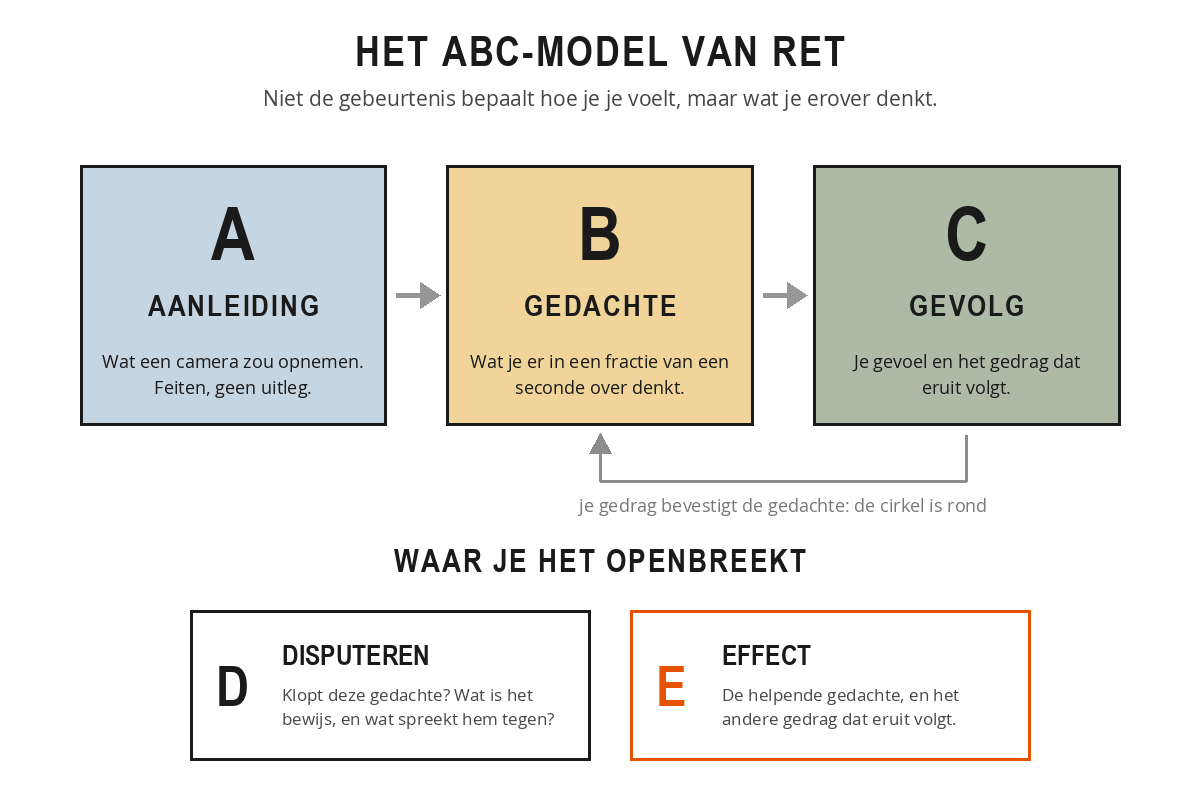
The A is the reason: the event as a camera would record it. You describe facts, not interpretation. "My colleague did not reply to my email" is an A. "My colleague is ignoring me" is not, because that already contains an explanation.
The B stands for beliefs, your thoughts: everything you think about that trigger in a fraction of a second. Those thoughts are usually unconscious and are rarely said out loud. This is the link that produces the feeling.
The C are the consequences: your feeling and the behaviour that follows from it. The tension, the silence, the snapping, the putting off.
Two people can experience the same A and have completely different Cs. That difference lies entirely in B. And that is why B is also the only link where you can change something without depending on others. You cannot arrange for your colleague to reply; you can do something about what you think about it.
Recognising limiting beliefs
A limiting belief is a thought you treat as truth while it is not correct, and which restricts your behaviour. The tricky part is that such a thought rarely feels like an opinion. It feels like an observation, as if you were simply describing how things are. That is precisely where its power lies: what you take to be fact, you do not examine.
There are two ways in to get hold of them nonetheless. The first are the absolute words: always, never, everyone, no one, must, cannot. The second is the size of the feeling. It is bigger than the situation warrants. "I have to get this right first time" produces panic, "I'd like to get this right" does not, because the latter leaves room for a second attempt.
Most limiting beliefs fall into one of four families, and they often occur in combination.
- Demands. You phrase a wish as a law. "Colleagues ought to reply on time." "I mustn't make mistakes in front of others." Recognisable by must, ought, always and never.
- Catastrophising. You follow a setback through to the worst imaginable ending. "If I say this, the atmosphere will be ruined and I will never be able to work here normally again."
- Low frustration tolerance. You declare something unbearable when it is mainly unpleasant. "I can't stand it when someone sends my work back in public."
- Global condemnation. On the basis of a single piece of behaviour you stick a blanket judgement on yourself or on the other person. "I'm just not assertive." "He's a control freak."
In a team meeting Sanne is asked whether her report is finished. She answers briefly that it is nearly done, and for the rest of the meeting she says nothing more. Afterwards she writes down at B what she was thinking at that moment: "If I admit that I'm behind, everyone will think I can't handle it."
Two families are folded into one another there. "Everyone thinks" is a global condemnation, "that I cannot handle it" is catastrophising about the consequences. If Sanne looks only at her behaviour, she sees a quiet colleague and cannot make sense of it. If she looks at B, she sees the rule that kept her quiet. And that rule can be tested; her silence cannot.
A thought that holds up is one you can support with a concrete situation in which things went exactly that way. If you can't manage that within ten seconds, you probably aren't dealing with an observation but with a belief.
Four questions that open up the thought
Identifying a belief changes nothing in itself. The change lies in the step after it: challenging the thought and formulating an alternative. In REBT this is called the D of disputing and the E of effect. You put the thought at B to four questions, and each question opens a different gap.
- What is the evidence? Name the facts that support this thought, and then at least two situations that contradict it.
- What happens in the worst case? Simply write out the worst-case scenario, and add how you would deal with it. That takes the disaster out of the disaster.
- Does this thought help me? This question is not about truth but about usefulness. Even a thought that is partly correct can hold you back.
- What would I say to a colleague who was thinking this? With someone else you are usually a good deal more reasonable than with yourself.
Next you formulate a helpful thought. That is not a positive slogan and it does not deny the discomfort, but it is accurate and it leaves room to act. "Everyone thinks I am wonderful" helps nobody, because you do not believe it yourself. "I am behind on this report and I can flag that today with a new date attached" does work. That difference changes the C noticeably: the tension drops enough for you to actually say something.
A helpful thought remains theory as long as you do not attach a different action to it. So always finish with the question of what you will now do differently in concrete terms in the same situation. That behaviour breaks the confirmation with which the pattern kept itself going.
Take a situation from the past two weeks that did not go the way you wanted, and work through it.
- Trigger (A): in no more than two sentences, what a camera would have recorded.
- Thought (B): what you were thinking at that moment, in the words you used in your head.
- Consequence (C): the feeling in one word, and underneath it what you actually did or failed to do.
- Confirmation: what your behaviour produced that left the thought at B unchallenged.
- Family: is it a demand, catastrophising, low frustration tolerance or a global condemnation?
- The four questions: evidence for, evidence against, the worst-case scenario and what you would say to a colleague.
- Helpful thought: a sentence that holds up, that you believe and that contains an action.
- Next action: what you will do from now on in the same situation, in behaviour that someone else can see.
Summary
- A behavioural pattern keeps itself going because your behaviour confirms the underlying thought over and over again.
- The ABC model places the trigger, the thought and the consequence side by side. It is not the A that determines the C, but the B.
- B is the only link you can change without depending on other people.
- You can recognise limiting beliefs by absolute words and by a feeling that is bigger than the situation.
- They usually fall under demands, catastrophising, low frustration tolerance or global condemnation.
- Four questions turn it into a helpful thought: the evidence, the worst-case scenario, the usefulness and what you would say to someone else.
- Without different behaviour it remains theory. The circle only breaks when you do something differently.
Which of these four sentences is a pure A, in other words a trigger as a camera would record it?
Why is B the link where you tackle the pattern?
"If I say this, the atmosphere will be ruined and I will never be able to work here normally again." Which family does this thought mainly fall under?