


4. Responsibility and ownership
Complaining about the reorganisation costs energy and achieves nothing. Everyone knows that, and yet everyone does it. This chapter is about the place where it does achieve something: the part that lies within your reach. That part is usually smaller than you would like and larger than you think.
After this chapter:
- You know what proactivity is and how that attitude differs from a reactive one.
- You can distinguish between your circle of concern and your circle of influence.
- You recognise from your own choice of words where your attention is at that moment.
- You know what ownership asks of you in a situation you did not cause yourself.
- You can turn a signal into a proposal that lands.
Two circles that everyone carries around with them
Stephen Covey described two areas. Your circle of concern contains everything you worry about or are irritated by: your board's decision, the workload in your team, the way a colleague chairs meetings, the economy, the weather. Your circle of influence is the part within it where you can genuinely change something through your own behaviour: your reaction, your agreements, what you do and do not raise, and the quality of your own work.
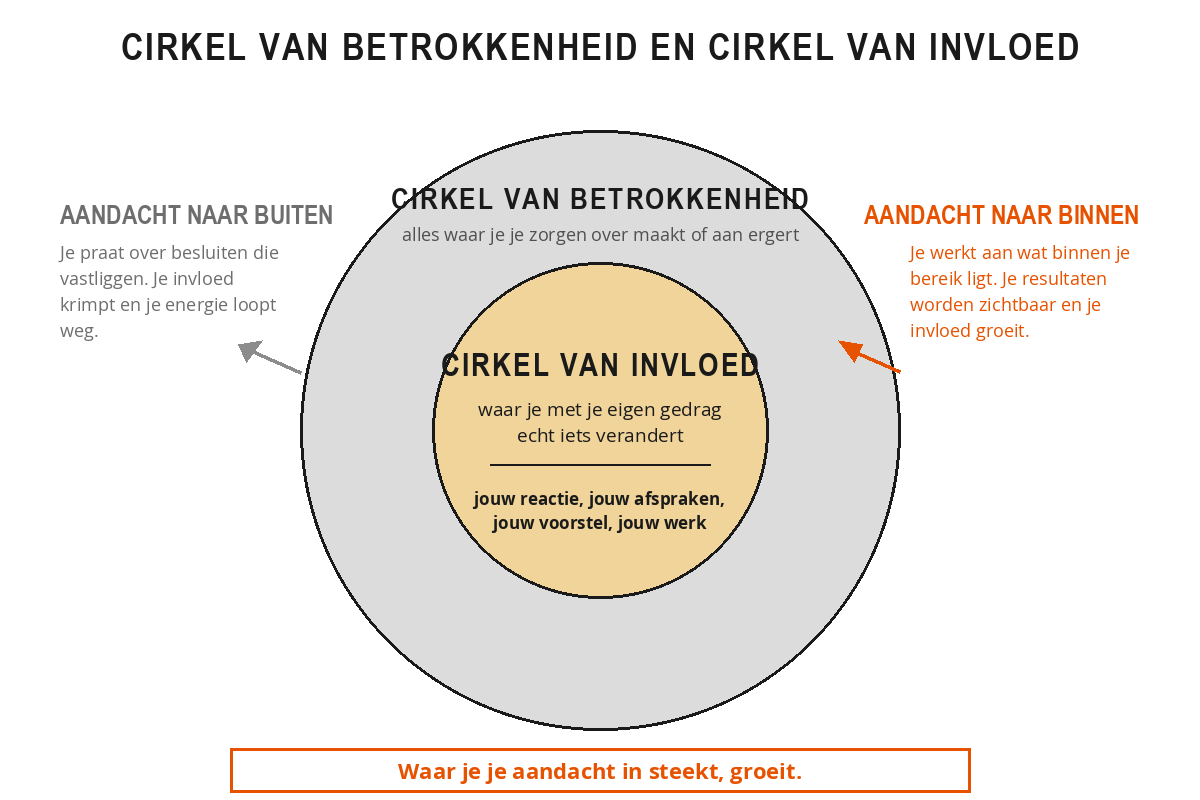
Proactivity is the ability to let your behaviour be determined by your own choices rather than by circumstances. It is about the space between what happens and what you do. That space is always there, even when it is small.
The interesting thing is that the circle of influence is not a fixed quantity. It moves with whatever you focus your attention on. If you put your time mainly into things you can do nothing about, the area in which you can actually get something done shrinks: your energy drains away and others start to see you as someone who offers commentary. If you work on what lies within your reach, the opposite happens. Your results become visible, people involve you more often, and your influence grows outwards.
Where your attention goes during a working week
The way you divide your attention can be measured. Go through an average week and you will see where the time goes. Conversations about others, such as the coffee-machine conversation about how slow another department is, usually sit entirely within your circle of concern. Conversations with the person concerned move that same topic into your circle of influence, because the person who can do something about it is now at the table. Repeatedly worrying about decisions that have already been made feels like working on the situation, but nothing changes in the world and nothing changes in you. And preparation for what is possible, such as writing a proposal or making an appointment, is small and falls entirely within your reach.
Bram hears that his team is taking on two more projects without extra people. For three weeks he mainly talks about who came up with this and why it is not realistic. His colleagues agree with him, and nothing changes, except that he grows more tired.
Then his approach shifts. Bram draws up an overview of what the team can handle in a quarter, with a proposal to push three tasks back. He asks his manager for twenty minutes and puts it forward as a choice, not as a complaint. It does not reverse the reorganisation. Two of the three tasks are pushed back, and when the next decision comes up, his manager calls on him first.
Do you notice that a conversation is covering the same impossible decision for the third time? Then one question helps: "What can we do about this ourselves?" If the answer stays empty, this topic is finished and you can turn your attention to something that does produce a result.
Ownership is not the same as blame
Ownership means taking responsibility for a situation or result, even when you are not the cause of it. You stop waiting for the person it should have come from. The question is always: what part of this is mine, and what am I doing with it?
That is emphatically something other than blame. Blame is about the past and about who got it wrong. Ownership is about what happens next. Someone may be entirely blameless for a strained working relationship and still take ownership of opening the conversation.
The absence of ownership is easy to hear. Someone without ownership tells a story in which they do not appear themselves: it was down to the schedule, to the reorganisation, to that one colleague. Everything said may well be true. Even so, the story does not produce a single action, because the main character is missing.
Ownership asks three things of you. You acknowledge the situation as it is, without making it bigger or smaller. You name your part in it, however small. And you choose one action that falls within your influence and for which you need no permission.
A project is running three weeks behind because of a delay at a supplier. Karin was not the one who chose the supplier and holds no contract.
Without ownership it sounds like this: "I'm waiting for procurement to sort it out, it's their file." With ownership it sounds like this: "I have no influence over the delivery. I do have influence over what the rest of the team does in the meantime, and over the information the client receives. I'll ring procurement today to find out the new date, and I'll email the client a revised schedule with two scenarios."
The delay stays exactly as long. What changes is that someone is at the helm, that the team does not grind to a halt for three weeks, and that the client does not hear about it by a roundabout route.
Reactive and proactive language
Your language gives away your position. Reactive sentences place the cause outside yourself, and with it the solution: "I have no choice", "they leave me no option", "if only he would", "that's just the way I am". Proactive sentences leave a person who acts: "I choose to", "I can", "I'll look at what options there are", "I'll pick this up".
This is not a word trick. As soon as you say out loud "I choose to", you have to choose something, and that feels different from "I have to". For a week, you can single out one word in your own speech: "must". Every time you use it, mentally replace it with "I choose to, because...". Sometimes there is a good reason behind it and the sentence finishes itself. Sometimes you notice you are doing something without knowing why.
The limits of your ownership
Ownership without a limit ends in exhaustion. You cannot own your colleague's behaviour, the market or the board's decision. You do own your reaction, your agreements, what you do and do not raise, and the quality of your own work. Anyone who fails to make that distinction takes the whole circle of concern onto their shoulders and will not last six months.
From signal to proposal
Initiative is ownership made visible. It almost always starts with something you notice and that nobody is doing anything about. The difference between people who take initiative and people who do not rarely lies in the noticing. It lies in the step that follows. This is how you turn an observation into something someone else can work with.
- Name the signal factually. Describe what you see in observable terms, without judgement. "Over the last four weeks, the timesheets came in an average of three days late."
- Make the consequence visible. Explain what it costs in time, money, quality or collaboration. Without a consequence it remains an opinion.
- Come with a proposal, not a problem. One concrete solution is enough. Half a plan works better than no plan, because there is something to respond to.
- State what you will pick up yourself. This is what distinguishes initiative from complaining with a solution attached. Name the part you will do yourself.
- Ask for what you need. A mandate, time, a decision or a name to liaise with. Those who ask for nothing get nothing.
Not every initiative lands, and often not because the idea is poor but because the moment or the form is wrong. So choose a quiet moment rather than the end of a packed meeting. Keep your proposal small enough to try out within two weeks. And let the credit for the result go round, because people are happy to contribute to something they themselves feature in.
If your proposal is turned down, ask further about the reason rather than pressing your point harder. "What makes this a poor fit right now?" yields information that will make your next proposal stronger. Asking for feedback works on ideas too, not just on behaviour.
This exercise consists of two parts. Allow half an hour.
Part 1: mapping your circles. Note down five things at work that have occupied you most over the past month. Mark each item with a C if it falls entirely within your circle of concern, and an I if part of it lies within your influence. For each C item, estimate how much time you spent on it over the past month, in conversations and in your head. For each I item, pick the smallest part that is entirely yours, described as an action and not as an attitude.
Part 2, from signal to proposal. Take one subject that has been striking you for some time and that nothing has been done about so far, and fill in:
- Signal, in one factual sentence, as a camera would record it.
- Consequence, in terms of time, money, quality or collaboration.
- A proposal that can be tried out within two weeks.
- Your own part: which bit will you carry out?
- Your request: what do you need, and from whom?
- When: the person, the day and the time at which you put it forward.
Summary
- Proactivity begins in the space between what happens and what you do. That space is always there.
- Your circle of concern contains everything you worry about; your circle of influence is the part where your behaviour makes a difference.
- The circle of influence grows when you put your attention into it and shrinks when your energy goes to the outer ring.
- Ownership is about what comes next, blame is about the past. You can take ownership without being at fault.
- Reactive language places the cause outside yourself; proactive language leaves an acting person in the sentence.
- Ownership has a limit: your reaction, your agreements and your own work are yours; another person's behaviour is not.
- Initiative lands when you state the signal factually, make the consequence visible, put forward a small proposal, name your own part in it and ask for what you need.
According to this chapter, what happens if you put your attention mainly into your circle of concern?
A project is delayed by a supplier you did not choose. What is taking ownership?
You want to put an idea to your manager. Which approach fits "from signal to proposal"?
Ready for the next step?
You have completed the free starter of Personal Effectiveness. The next chapter in the full course is Personal leadership: steering from within yourself: The gap between knowing and doing, Kolb's learning cycle and determining your own starting point.
Take the 3-day course →From EUR 1950 excl. VAT · with an experienced trainer on hand