


2. Starting with your why
People rarely remember a list of facts. They remember what happened, with whom, and how it ended. You can make use of that characteristic of your listener. This chapter is about the content of your pitch: not which words you choose, but where you begin. And that is almost never with your job title.
After this chapter:
- You know what narrative thinking is and why a story sticks better than a list.
- Can you name the three rings of the Golden Circle: why, how and what.
- You build your pitch from the inside out, that is, starting from your driver.
- Use a struggle from your own practice as the narrative arc.
- You know the four parts of that struggle and which part you must never skip.
Thinking in terms of story
Narrative thinking means organising your information as a story rather than as an overview. There is a main character, often you or your client, there is something that person wants, something gets in the way, and there is an outcome. The same content, but in a form that your listener's brain automatically responds to.
You notice the difference straight away. "I'm an interim controller and I help organisations with their financial processes" is correct and complete. It's just that nothing happens in your listener's head. "Last year a director rang me on a Friday afternoon: his bookkeeper had left and nobody knew where the figures were" immediately creates a picture, and a question: and then?
A story gives you three things at once. It gives sequence, so your listener does not have to puzzle out what belongs where. It creates tension, so he keeps listening until the end. And it gives meaning, because a story shows what something matters rather than claiming it. On top of that, stories get passed on. Nobody repeats your three core values on the drive home. Your anecdote about that Friday afternoon, they do.
Why, how and what
Simon Sinek used three rings to describe why some stories catch on and others do not. He called it the Golden Circle.
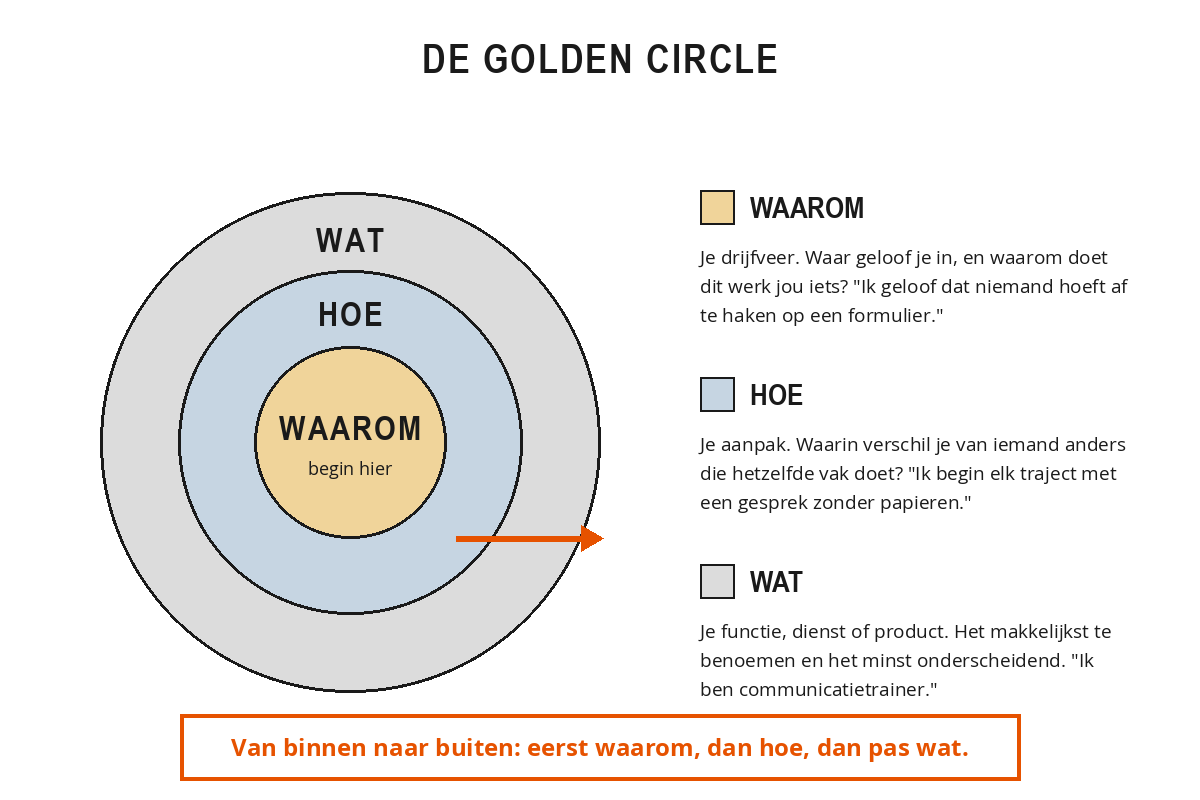
The outermost ring is your what: your role, your service, your product. That is the easiest thing to name and the least distinctive, because the colleague three tables away says exactly the same thing. "I'm a communication trainer."
The middle ring is your how: the way you work and how you differ from others. "I start every project with a conversation without any paperwork."
The innermost ring is your why: your driving force. What do you believe in, and why does this work mean something to you? "I believe no one should have to give up because of a form."
Most pitches start on the outside. You mention your job, then your working method, and you never get to what drives you, because the minute is up. Working from the inside out works better: first what you believe in, then how you go about it, and only then what you deliver. That order feels awkward at first, because you are used to starting your story with the answer to the question someone literally asked. But the question "what do you do?" is rarely a question about your job title. It is a question about whether you are interesting.
Two openings of the same pitch, by the same trainer.
From the outside in: "I am a trainer in the field of customer communication and I mainly work for local authorities and care institutions."
From the inside out: "Three years ago I was standing at the front desk of a local council, behind an employee who was handing an angry resident the same form for the fourth time. I thought: this isn't about rules, this is about language. Since then I've been training front-desk staff in conversations that do end well."
The same person, the same profession, a different effect. In the second version her why comes first, her how after that, and her what right at the end, in four words.
The power of a struggle
A story in which everything goes right straight away is not a story. The struggle is the moment when things went wrong: the client who pulled out, the project that ground to a halt, the question you had no answer to. That moment is the engine of your pitch. It creates tension, it makes you human and it gives your listener a reason to keep listening until you reach the turning point.
Many people skip that struggle. It feels vulnerable, and at networking drinks you want to show that you have things under control. Yet it works the other way round: a story made up only of successes sounds like a brochure. Your listener recognises themselves precisely in the dip. Almost everyone has at some point been stuck in something that came without a manual. The moment you name that, attention shifts from polite listening to genuine involvement.
A struggle in a pitch has four components, and together they fit into twenty to thirty seconds.
- The situation: where were you, what was the context? One sentence is enough.
- The struggle: what went wrong or what didn't work? This is where the tension lies, so you can linger here for a moment.
- The turning point: what did you discover, how did your approach change?
- The result: what does that actually deliver for other people? This is the bridge to what you offer.
The final element is the one you cannot skip. Without a turning point and an outcome you remain stuck in a tale of woe, and then your listener may have sympathised but has nothing to take forward.
Karin does the books for small business owners. Her old pitch: "I help entrepreneurs with their administration. I work quickly and accurately and I like to think along with my clients." Correct, and entirely interchangeable.
Her pitch with a struggle in it: "Five years ago I sat down with a client who had three years' worth of receipts in a shoebox. He was mortified and no longer dared to ring his bookkeeper. That's when I realised that my work isn't about figures, but about taking away that shame. Since then I start every project with a conversation without any paperwork. Of my sixty clients, nine now ring at the moment things go wrong, instead of six months later."
Four elements, in just over twenty seconds: the situation at the table, the struggle of that shoebox, the turning point in her own mind, and the result in a number.
Your struggle doesn't have to be a great drama. A missed deadline, a presentation that ground to a halt or a client who walked out halfway through is enough. It's about recognisability, not spectacle. But bear in mind: a pitch is not therapy. Choose something you have processed yourself and can talk about with a degree of lightness. If your listener feels uncomfortable, the tension has ended up in the wrong place.
Where your why comes from
Your why and your struggle are connected. At the moment something went wrong, you usually discovered why this work means something to you. Karin in the example above can now name her motive ("I believe nobody should have to feel ashamed of their own bookkeeping") precisely because she went through that one moment at the table. Anyone who tries to think up their why behind a desk ends up with something that resembles a corporate value: reliability, quality, customer focus. Those aren't motives, they're words.
A useful exercise: go through three moments from your working past when you became angry, moved or genuinely delighted. Not the major milestones, but the small scenes. Your why is in one of those three. Write down what happened and what you thought at that moment, and see which sentence from that is also true for the people who are going to listen to you.
You put your own story together.
- Write your what down in one sentence, the way you would say it now.
- Write your how on: how do you differ from someone with the same job? One sentence.
- Write your why on: what do you believe in? Start with "I believe that …" and complete it.
- Choose a struggle from your own practice and note down the four elements: situation, struggle, turning point, result. Put a figure with the result.
- Say the whole thing out loud, in the order why, how, what, and time it. If you go over forty seconds, cut into the situation, not into the turning point.
Summary
- Narrative thinking organises your information as a story: main character, wish, obstacle, outcome. That sticks longer than a list.
- The Golden Circle has three rings: what (your role or service), how (your approach) and why (your driver).
- You build from the inside out: first why, then how, and only then what.
- A struggle makes your story human and gripping. It consists of situation, struggle, turning point and result.
- You must never leave out the turning point and the outcome, otherwise all you're left with is a tale of woe.
- Choose a struggle you have processed yourself, so that the tension stays with the story and doesn't end up with your listener.
- You find your why in small scenes from your working past, not in corporate values.
In what order do you build up your pitch according to the Golden Circle?
Which part of a struggle should you never skip, according to this chapter?
Why does a story work better than a list of your services?