


Introduction
Filling in a personal development plan form takes twenty minutes. The difficulty lies before and after. Before, because you often don't know what your employee actually wants to learn, and they haven't worked that out clearly themselves either. After, because the plan is on the table in February and is still sitting in the folder in exactly the same state in November. The form was there, the development wasn't.
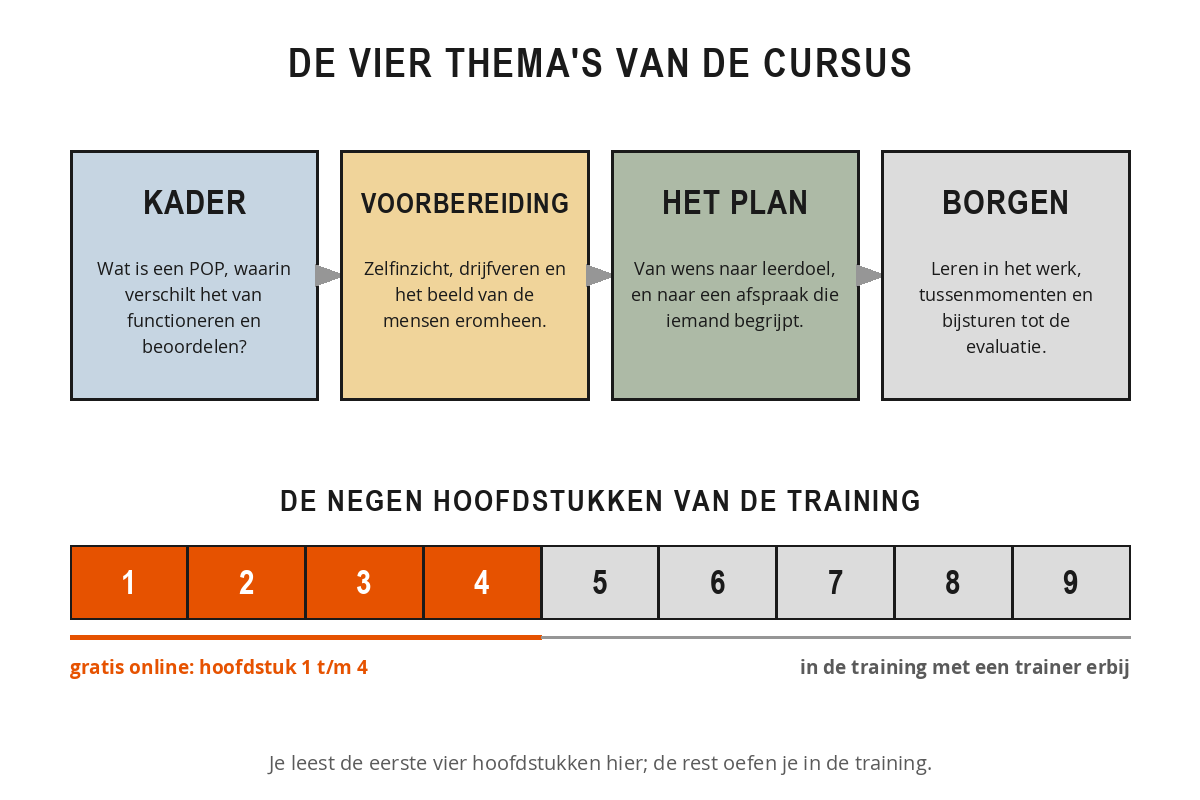
This free course contains the first four chapters: the orange part of the bar above. At the bottom of chapter 4 you will find the full course.
What you will learn
You learn what a Personal Development Plan is, how the PDP meeting differs from the performance review and the appraisal interview, and how the PDP cycle runs from preparation to evaluation. After that it turns to preparation: which questions make a staff member really think, how to get motives and ambition out in the open, and what you gain by also asking the people around them for their impression. In the third chapter you reduce a handful of signals to a single learning objective and write it down in an agreement that an outsider can make sense of. The fourth chapter deals with the stage at which most plans founder: implementation.
How the course is structured
The chapters follow the cycle of the PDP itself. You start with the scope: what kind of plan is this and what is it not. Then the preparation: where do you get the information that a goal can be based on. After that the plan: from wish to goal to agreement. And finally the embedding: learning on the job, interim moments and adjusting course. Each chapter contains a model, examples from practice and an exercise that you apply to one of your own staff members.
Practical tips for use
- Before you start, choose one staff member with whom you will shortly be holding a PDP meeting, and use that person as the thread running through all the exercises.
- Keep a blank document or notepad to hand. The exercises produce material you can use in the real meeting.
- Don't read it all in one go. One chapter a week, with a conversation in between, sticks better.
- Test your assumptions. You learn more from the points where you were wrong about what someone wants than from the points where you were right.
- It's about someone else's plans. If you notice that you are the one filling it in, put the pen down.
Each chapter ends with a short knowledge check of three questions: answer them correctly to mark the chapter as completed. Your progress is saved automatically in your browser.
Enjoy the read, and above all: good luck with your next meeting.