


1. The PDP as a plan and as a process
Ask ten managers what a PDP is and ten times you will get a description of a form. That form does indeed exist, but it is the smallest part of the matter. The gain lies in what happens around it: the conversation in which the plan takes shape, the months in which it is worked on, and the moment at which you look back together. If one of those is missing, all you are left with is a completed sheet of paper.
After this chapter:
- Can you explain what a Personal Development Plan is and which five components belong in it.
- You identify the difference between the PDP meeting, the performance review and the appraisal interview.
- You know the four phases of the PDP cycle and you know in which phase most plans run aground.
- You know what the employee, you and HR each contribute to one plan.
- You can tell from three signals whether ownership really lies with the employee.
Why an organisation invests in this
Ten years ago the main question was whether someone was doing their job well. Now a second question has been added: will this person still be in the right place three years from now? Jobs change faster than people change employers. A new system arrives, tasks shift to another department, legislation changes. An organisation that does not move along with its people has to buy that knowledge in from outside, and that is expensive and slow.
For the employee, something else is at play. Anyone who develops keeps their options open. This is called employability: the extent to which someone remains able to find and keep valuable work, inside or outside the current organisation. It comes down to three things at once: up-to-date professional knowledge, broad skills such as collaborating and planning, and the willingness to keep learning. That last point is what makes it interesting for you. You cannot develop someone. You can create the conditions in which someone develops themselves, and the conversation about that is your instrument.
At an insurer, the claims department is switching to a new system. Two employees are offered the same three-day course. For Peter the reason is: it has to be done, because the system is coming. In Ilse's case the team leader has a short conversation with her beforehand, and it turns out she would like to become a key user. Ilse takes the same course, with a goal that reaches beyond the roll-out. Six months later she is supporting her colleagues, which saves the department two external support days a month. Peter uses the system, nothing more. Same offering, same budget, different return.
The difference was not in the course, but in the connection between what the organisation needed and what Ilse herself wanted. That connection is exactly what you record in a PDP. As soon as a programme only serves the organisation's interest, motivation drains away. As soon as it only follows the employee's wish list, the organisation will not keep it up for long.
What the plan contains
A PDP is a written agreement between employee and manager about what the employee wants to learn in an agreed period, how that will happen and what is needed for it. So it is not a wish list and not a training request, but a plan with an owner, a timeline and a moment at which you look back together. The content differs from one organisation to another, but five components are almost always included.
- The development goal. What the employee can do or does at the end of the period that they cannot manage yet.
- The rationale. Which interest of the employee and which interest of the organisation come together here.
- The activities. The concrete ways in which learning takes place: a training course, a project, shadowing a colleague, guidance from a fellow professional.
- The support. The hours, the budget and the support the organisation provides, including who arranges what.
- The timeframe and the feedback. The period in which the plan runs and the dates on which progress is put on the table.
One to three goals is enough. With five or more, attention is spread so thinly that not a single goal reaches the finish line.
Three meetings, three different things
The HR interview cycle is the fixed series of meetings an organisation holds with every employee each year. The PDP meeting is not separate from it, but has a character of its own, and keeping that distinction clear stops your meeting from changing colour halfway through.
The performance review looks back and adjusts, is about the work of today, is two-way and results in working agreements. The appraisal meeting also looks back, but passes judgement: it is one-sided, you deliver the verdict, and the consequences affect salary, contract or promotion. The PDP interview is the only one that looks ahead, is about knowledge, skills and career, is two-way with the employee as owner, and results in development agreements.
The trickiest moment arises when an employee expresses a development wish that you then bear in mind at appraisal time. Once that has happened even once, openness disappears from all your subsequent PDP meetings. So state at the outset which kind of meeting you are holding and what you will do with the information.
Schedule the personal development plan meeting a few weeks after the performance review, not on the same day. The performance review provides the building blocks (where things get stuck, where the talent lies), and the employee gets time to think about it themselves.
The four phases of the cycle
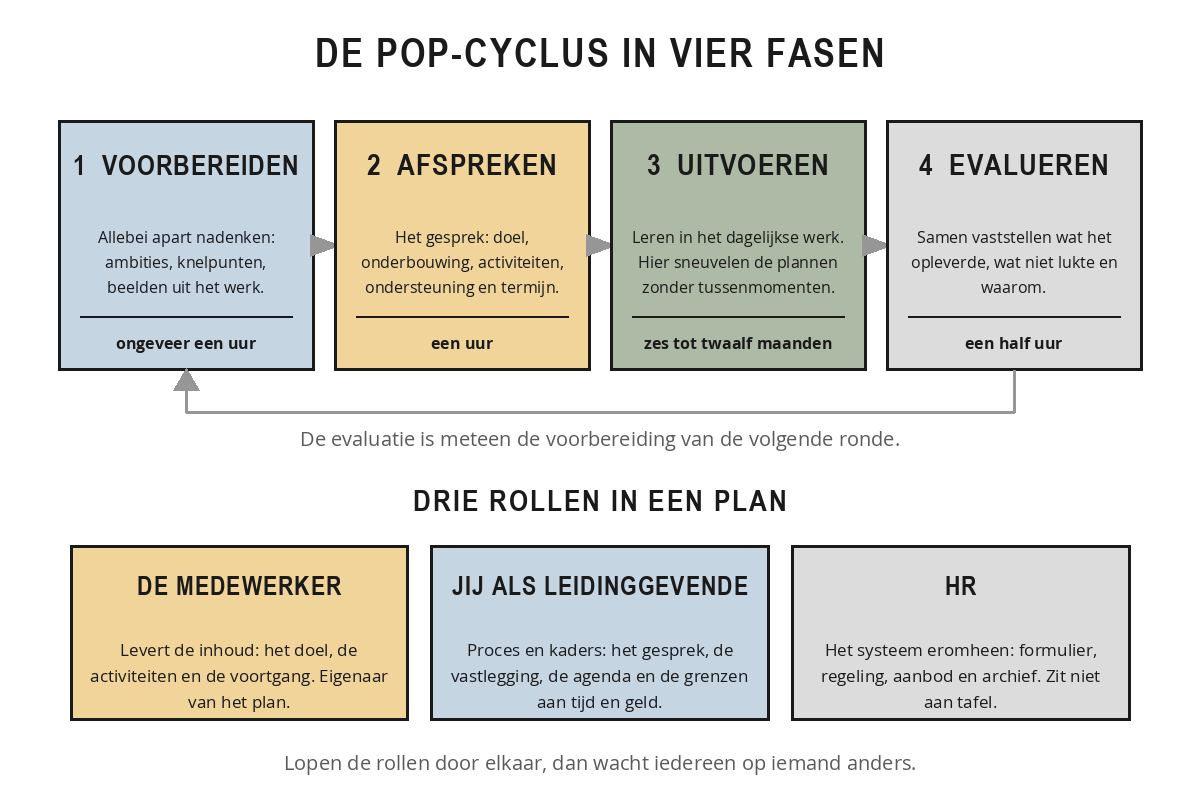
The PDP cycle is the fixed round that a development plan goes through. It has four phases.
Phase 1, preparing. You and the employee gather information separately. The employee thinks about ambitions, strengths and sticking points. You collect impressions from the work: results, signals from colleagues, client contact. This phase rarely takes more than an hour, but it determines the quality of everything that follows.
Phase 2, agreeing. In the conversation the two pictures come together and the plan takes shape. You set down the goal, the reasoning, the activities, the support and the timeframe. Allow at least an hour.
Phase 3, execution. The employee learns in their day-to-day work. This is the longest phase, usually six to twelve months, and at the same time the phase in which most plans peter out.
Phase 4, evaluating. Together you establish what the plan has delivered, what did not work and why. The outcome feeds straight into the preparation for the next round.
The pitfall is almost always between phase 2 and phase 4. The conversation went well, the plan looked tidy, and after that attention went to the daily rush. Eleven months later nothing has come of it and the evaluation becomes a painful formality. Two twenty-minute check-ins, around month three and month eight, prevent that scenario better than any wording in the plan. Put them in both diaries in the same week that you hold the conversation; if you do it later, you will not do it at all.
Three roles in one plan
Three parties are always involved in a PDP. The employee supplies the content: what they want to be able to do a year from now, what work goes with that and which activities they choose. During the implementation phase they keep track of what does and doesn't happen and raise it when something gets stuck. You are responsible for the process and the frameworks: you make sure the conversation takes place, that the plan is recorded and that the check-ins are in the diary. You bring in what the team needs over the coming year, and you name the limits. If there is no budget this year for a two-year programme, the employee should hear that in the conversation and not three months later. HR monitors the system around it: the form, the study costs scheme, the range of courses on offer and the storage of the plan. HR is not at the table and does not determine the content.
Jasper wants to take an eighteen-month post-bachelor's programme in data analysis. He puts the goal on the table and explains what work he wants to take on with it. You check whether that fits the direction of the team and say what is available this year: twelve study hours per month and half the tuition fee. HR provides the study costs scheme and the application form. Three roles, one plan, and after an hour Jasper knows exactly where he stands. Without that conversation he would have submitted a request in May that would have been rejected in July.
Where ownership lies
Ownership means the employee is responsible for the content and the execution of the plan. You are responsible for the preconditions and for the conversation. Three small things tell you whether that is actually the case. Who talks the most: in a healthy PDP conversation the employee says the most, and if you are talking seventy per cent of the time, it has become your plan. Who holds the pen: let the employee write out the plan, because whatever you type yourself feels like an instruction. And who schedules the interim review: if you always have to chase it, the plan lacks support.
Take one employee with whom you made a development agreement over the past year and run through the cycle.
- Phase 1: what exactly did you do in the preparation, and what did the employee do?
- Phase 2: is the plan written down anywhere? Where, and who typed it?
- Phase 3: how many interim moments have there actually been?
- Phase 4: has the evaluation taken place, and what came out of it?
Note down at which phase the trail went dead and write in one sentence what caused it.
Summary
- A PDP connects what the organisation needs with what the employee wants. If it only serves one of the two, it will not last a year.
- The plan contains five components: development goal, rationale, activities, support, and timeframe with review points.
- The performance review looks back at the work of today, the appraisal interview passes judgement and affects salary or contract, and the PDP interview looks ahead and belongs to the employee.
- The cycle has four phases: preparing, agreeing, implementing, evaluating. The implementation phase lasts six to twelve months and is the phase in which plans fall apart.
- Two twenty-minute check-ins, around month three and month eight, go straight into the diary.
- The employee provides the content, you provide the process and the frameworks, HR provides the system around it.
- You can see ownership in who talks, who writes and who schedules the next moment.
What sets the PDP meeting apart from the other two meetings in the HR cycle?
In which phase of the PDP cycle do most plans run aground, and why?
Afterwards you notice that you did most of the talking during the meeting and that you typed up the plan. According to this chapter, what does that tell you?