


2. Self-insight and all-round feedback
An employee who doesn't know where their strength lies will formulate goals that actually come from someone else. Hence this chapter: before you talk about a plan, there has to be something to discuss. That material comes from two directions. From within, because the employee looks back on their own work. And from outside, because the people around them say what they see.
After this chapter:
- You ask reflection questions that help an employee put their own performance into words.
- You know why reflection often stays superficial and what helps with that.
- Recognise the motives behind a development wish and the three directions in which someone can grow.
- You name the four feedback sources and what each source can and cannot see.
- You read the outcomes of such a round without damaging safety.
Five questions that get something moving
In the preparation phase, the employee does most of the work alone. You help by giving them questions that are concrete enough to think about, but open enough to leave room. These five work well in practice.
- The best moment at work. Which moment from the past year would you want to experience again, and what exactly were you doing there?
- The most difficult moment at work. Which situation went differently from how you wanted it to, and which part of that was down to you?
- The energy balance. Which tasks give you energy, and which ones cost you a disproportionate amount of effort?
- How others see you. What do colleagues say about you that you wouldn't be the first to mention yourself?
- The following year. What do you want to be able to do in a year's time that you cannot manage now, and why that in particular?
The fourth is the hardest, because that is where the employee comes up against the difference between their own self-image and how others see them. Later in this chapter you will see how to draw out that difference systematically.
Reflection is a skill, not a character trait. Anyone who has never practised it gets no further than saying it actually went quite well. That is not unwillingness, but a lack of language and of prompting. Three things help. Time: questions emailed a day in advance produce answers thought up in the car, and two weeks is a reasonable period. Concreteness: a question about a specific situation yields more than a question about someone's performance. And your attitude: if a silence falls, resist the urge to fill in the answer yourself.
Karim, customer service team leader, sends his team member Femke four reflection questions two weeks in advance. For the third question Femke writes: I get energy from customers who really have a problem, and reports take me twice as long as they take other people. In the meeting Karim does not ask about those reports, but about the first part: what do you do with a customer like that which gives you energy? Femke arrives at investigating and asking follow-up questions. That produces a development goal around handling complex complaints, not around reporting faster. The question Karim did not ask determined the direction of the plan.
Don't send the reflection questions as a plain list, but with three lines of writing space per question. That small detail often doubles the amount of answer you get back.
Motivations and the direction of an ambition
Drivers are the underlying needs that determine where someone gets their energy from and what choices they make. They explain why two employees with the same role and the same qualities want to make completely different plans. If you fail to identify them, you choose activities that look right on paper and grind to a halt in practice. You rarely ask about them directly; you infer them from examples. Someone who tells a story three times about being allowed to choose for themselves is showing autonomy. Someone who mainly talks about the colleague who learned something from her is showing connection and craftsmanship.
Pay attention to what ambition means in this conversation. If you only ask about the next step up the hierarchy, you exclude most employees. There are three directions. Vertical: more responsibility, a role with staff or budget. Horizontal: a different role at the same level, a different field or a different department. In depth: the same role, but at specialist level. That last direction delivers returns most quickly in your current work and strengthens employability, yet it is the one that comes up least in conversations.
A motivation, by the way, is not yet a development goal. Autonomy only becomes a goal once you link it to behaviour: managing a project budget independently, or handling a client case from start to finish without an intermediate check. In the full course you also work with Ofman's core quadrant, which takes you from the pitfall via the core quality to the challenge.
Looking all round
What someone sees of themselves is only part of the story. With 360-degree feedback you systematically gather impressions from everyone who, from their own position, can say something about a person's performance, and you set those alongside the self-image. The term comes from the circle: you look not only from the top down, but all the way round.
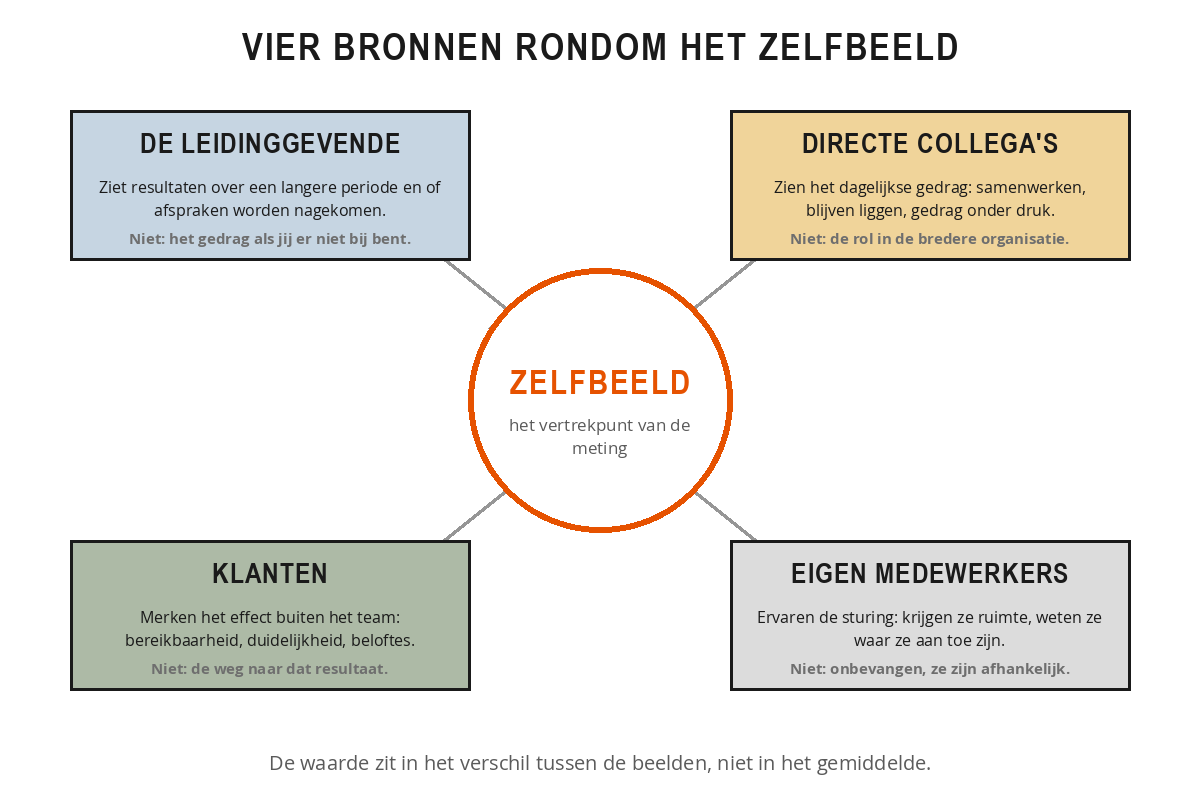
The value lies in the difference between the images. An employee who considers herself a mediocre presenter while four colleagues praise her precisely for her calm in front of a group does not need presentation training but information. And the other way round: someone who thinks he delegates well while his team still double-checks everything has a real development goal there.
Four sources, plus the self-image as a fifth. The manager sees results over a longer period, whether agreements are kept and how someone develops; what you do not see is the behaviour at moments when you are not there, such as the tone in a client conversation. Immediate colleagues see day-to-day behaviour at close range: how someone works with others, whether tasks are left undone, what happens under time pressure; they have no overview of how someone performs in the wider organisation, and their picture may be coloured by the relationship between them. Internal or external clients notice the effect outside the team: availability, clarity, whether a promise is kept; they cannot say anything about the route to that result, because how much overtime went into it remains invisible to them. Employees whom the person manages experience the leadership from the receiving end: do they get room, do they know where they stand, do they dare to report something going wrong; this source yields the sharpest information about leadership and at the same time the greatest reticence. Without self-score finally, you are left with only a judgement from outside, and precisely the gap that holds the development question disappears.
Within a personal development plan (PDP) you use this in the preparation phase. It is an aid to arriving at a goal, not an assessment instrument. As soon as employees suspect that the outcomes will end up in their personnel file, the character of the answers changes and you lose precisely what you were after.
Whom do you ask, and how many
A full round of all the sources is rarely necessary. The development question determines who you invite. If it is about collaboration, that means colleagues and you. About managing and delegating: the employee's own team members and you. About client focus: clients and the colleagues who look on. About professional growth: you and senior colleagues. Together you formulate the question behind the assessment in one sentence, let the employee suggest who he wants to ask, add to that list where a source is missing without removing any names, and make sure every source has at least three people. With fewer, an answer becomes traceable and people hold back.
Nadia wants to move into a coordinating role. Her development question: can I direct other people's work without pulling it towards myself? Asking only colleagues would give a friendly but irrelevant picture. She therefore asks three colleagues from the project team she led last year, two internal clients and her manager. Six people, eight questions, completed within a week. The colleagues praise her grasp of the whole, the internal clients miss interim feedback. That last point had not come up in any earlier conversation.
Reading the outcome and reporting it back
A completed questionnaire soon produces thirty scores. The temptation is to start with the lowest one and elevate it to a development goal. That is almost always the wrong move, because a single score says little and the pattern says everything. Look at the difference between self-image and the environment: if the self-score is consistently higher, you are touching on a blind spot, and if it is lower, the employee is more in need of confirmation. Look at the spread within a single source: if four colleagues score the same competency a 2, a 3, a 4 and a 5, the employee probably behaves differently depending on the situation, and that is a more interesting question than the average. Look at the difference between the sources: high client scores with low team scores are about collaboration, not about craftsmanship. And look at the two outliers rather than at the weakest point; leave the middle ground alone. An average across all sources together makes exactly the difference you were looking for disappear, so keep the scores per source separate.
The feedback session is the most vulnerable moment of the whole assessment. Give the employee the report at least two days in advance, so that the initial shock does not take place at the table. Open with the question of what stood out: the employee summarises, not you. Preserve the anonymity of the respondents, even if pressed on who wrote something down; you talk about the picture, not about the source. Together, pick no more than two themes. And translate those into a goal: what will the employee be able to do in six months' time that does not work now, and how would colleagues notice it? Two pitfalls lie in wait. In repair mode you play down the low scores to spare the other person, and you take the urgency out of it. In proof mode you use the report to back up your own judgement, and then the instrument is burned for good.
Choose an employee with a concrete development question and put together the set of sources.
- Formulate the development question in one sentence of no more than fifteen words.
- For each source, note down which names you would invite, at least three per source.
- Note down which source you deliberately leave out and why it adds nothing here.
- Write down one question that you put to the clients and not to the colleagues.
- Work out your answer to: who gave that 2?
Summary
- Without self-insight, a plan rests on assumptions. Reflection questions are about concrete situations and go out two weeks in advance.
- You infer motivations from examples, not from a direct question. A motivation only becomes a goal once you link it to behaviour.
- Ambition has three directions: vertical, horizontal and in-depth. The in-depth direction is the one most often skipped.
- Four sources around your self-image: your manager, immediate colleagues, clients and your own team members. Each source sees something different and misses something different.
- The development question determines who you invite, with at least three people per source.
- Read the differences, the spread and the outliers, not the lowest score. Keep the sources separate.
- During the feedback session the employee summarises, respondents remain anonymous and you pick no more than two themes.
- As long as the outcome stays out of the appraisal file, it remains usable.
An employee rates himself 4,5 on collaboration and his colleagues give him an average of 2,8. What do you do with that difference?
Why do you ask at least three people per source for feedback?
Which source can say something about the effect of someone's work outside the team, but nothing about how they got there?