


3. From development wish to learning goal and agreement
A well-prepared conversation easily throws up ten points that deserve attention. At most two of those are worth turning into a goal. Narrowing that down and sharpening it is where most plans fall apart: anything written down too broadly can no longer be pinned down in month four.
After this chapter:
- You can distinguish a development need from a working agreement and from a wish to attend a course.
- You can reduce signals from four directions to a single theme.
- Can you state the difference between a learning objective and a performance objective.
- Do you phrase a development goal precisely without turning it into a performance agreement.
- Do you know which sections a PDP agreement consists of and what does not belong in it.
What exactly is a development need
A development need is the difference between what the employee can do or does now and what the job or the ambition requires, plus the wish to bridge that difference. Both parts are necessary. A difference without a wish does not produce a development need but at most a working agreement. And a wish without a difference is a wish to attend a course: someone wants to go on a course because it sounds enjoyable. Making that distinction saves you a great deal of skirting around the issue. If you notice that the difference is felt only by you, you have ended up in a performance review and not in a personal development plan meeting.
The funnel
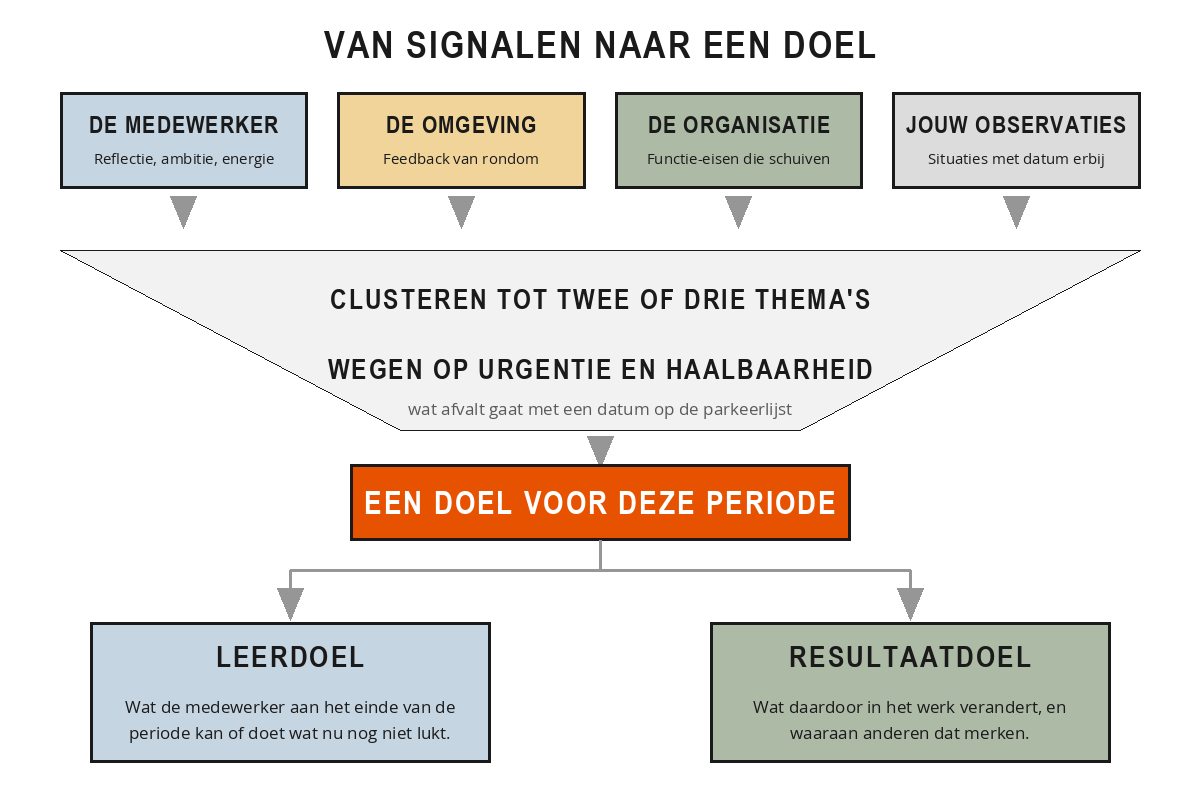
Signals come together from four directions. From the employee themselves: what came up from the reflection, a direction of ambition, energy draining away somewhere. Of the environment: the gap between self-image and the image held by colleagues or clients. Of the organisation: job requirements that shift, a new system, a client demand that changes. And from your own observations: situations in which you saw something go wrong or, conversely, surprisingly well, with the date and context noted.
Individual signals do not yet amount to a need. You turn them into a need by asking three questions about each signal, and that immediately shifts the thinking to the employee. You ask about the situation: when did you last notice this, and what exactly happened? You name the gap: what did you need at that moment that you did not yet have? And you test the wish: if this goes differently a year from now, what will that give you? If that third question is met with silence, this is not the right theme. A small goal with energy behind it works better than a big goal that you think is important.
Often three or four themes remain. You weigh them up on two things: how urgent it is for the work, and how feasible it is within the time frame and the support available. Urgent and feasible becomes the objective for this period. Urgent but not feasible you cut up until there is a first step in it. Feasible but not urgent you park. Not urgent and not feasible you let go. What drops off does not disappear: those themes go on a parking list with a date, so that you return to them at the evaluation and the employee sees that nothing has been quietly swept aside.
One main goal per period, possibly with a second small goal that takes little time. Anyone working on three development goals alongside their normal work is in practice working on none.
Learning objective and performance objective
A development need is a direction, not an objective. As soon as you convert that direction into language with a date and a noticeable result, something arises that you can come back to in the interim meetings. Two sentences belong with that. A learning objective describes what the employee will be able to do, or will be doing, at the end of the period that is not yet working now. A result objective describes what visibly changes in the work as a result. Both belong in it, because a learning objective without a visible effect remains vague, and a result objective without a learning objective is simply a production agreement. With a learning objective you ask: what is the employee learning? With a result objective: how will others notice it?
Bram, an internal sales employee, puts it like this: I get stuck when a client is dissatisfied and I keep putting that conversation off. His learning objective becomes: I can handle a complaint in a single conversation, I summarise, I state what is and isn't possible and I agree on the next step. His performance objective: complaints that come to me are back with the client within two working days, with an agreement about what happens next. The employee learns something and the organisation notices it. That also makes the case to the management team a good deal simpler.
With development goals, making them SMART does not mean imposing a standard. It means that in month six the two of you can establish together whether there is any movement. Specific: the goal names concrete behaviour in a concrete situation, not a trait; communicating better is a trait, ringing purchasing yourself when a delay is looming is behaviour. Measurable: you have agreed how you will both see it, and with development goals that is often an observation or a response from those around you, not a figure. Acceptable: the employee wants this goal, and you can provide the time and support that go with it; without that second part it becomes an instruction. Realisticit fits within the period and the workload, and if in doubt you break it up. Time-bound: there is an end date and there are interim moments. For the M, the question how will we see that later? is more useful than how many per cent?; that way it stays a learning objective and does not become a target.
Milestones and the language of the objective
A twelve-month objective is too far off to keep someone moving. So cut it up into two or three milestones with their own visible result, and let these coincide with the interim moments in the cycle. Take the objective: in December I will chair the monthly client meeting independently, including the agenda and the list of decisions. In month three the employee draws up the agenda and you chair. In month six the employee chairs, you are present and you give feedback afterwards. In month nine they run the meeting alone and deliver the list of decisions within a day. For each milestone, note down who gets to see the result: a milestone without an audience almost always slips.
The words in which the objective is written down reveal whose objective it is. "There needs to be more communication with the purchasing department" is an observation of yours. "I will call purchasing myself as soon as a delivery looks likely to shift" is an objective of the employee's. Two rules of thumb help: the objective starts with I and contains a verb that the employee carries out themselves. And the employee does the typing, not you. Once the objective is roughly in place, you hand it back with four questions. How would you explain this to a colleague? What does this give you, apart from what it gives the team? How much do you feel like doing this, on a scale of 1 to 10? And: what is your first step, and when will you take it? At a 6 or lower you probe further: what would make it an 8? A first step within two weeks turns a plan into behaviour.
The agreement on paper
What sounded clear in the conversation turns out, three months later, to be remembered differently by the two people involved. That is why you put it in writing, signed by both of you. It is not an employment law document and no sanction is attached to it; its value lies in both parties putting their name to an effort, so that the agreement is traceable for anyone looking at it later, even if you hold a different role by then. Seven sections belong in it: details and period (without a start and end date there is nothing to evaluate), starting point (where the employee stands now and what that picture is based on), development goal (the learning goal and the performance goal, this is where you put most of your time), activities, support and facilities, milestones and feedback with specific dates instead of "halfway through", and the signing with two names, a date and a version number.
A workable agreement fits on a single A4 sheet and can be read by someone who wasn't in the conversation. Those two requirements filter out almost all vagueness. Three rules for wording keep it standing up. A name with every action: "a coaching programme will be started" leaves open who calls, who chooses and who pays, whereas "Sanne will select two coaches from HR's list before 1 March" can be checked. Delete aspirational language: as much as possible, where possible, in consultation and where the diary allows all give both parties a way out. And make every agreement reciprocal: every effort by the employee should be matched, in the same line, by an effort from the organisation. The employee provides time, commitment and the willingness to do something badly at first; the employer provides hours, money, guidance and access to work in which what has been learned can be practised. If only the left-hand column is full, it isn't an agreement but an instruction.
Two employees fill in the same Activities section. Youssef writes: take a project management course and gain more project experience. Sanne writes: in April I will take the two-day Project-Based Working course, after that I will lead the relocation of the archive as project leader, with Karin as a sparring partner, half an hour every three weeks. The second version names what, when, with whom and how often. At the interim meeting in June, this makes it possible to establish in two minutes whether it has happened. With Youssef, that conversation becomes a discussion about what it was we meant again.
Always note three things alongside the budget: the amount, the number of hours within working time, and what happens if the course turns out to be more expensive. Otherwise that discussion comes back just as the employee is getting enthusiastic.
Finally, the file. Agree explicitly who can see the plan: by default the employee, you and HR, and therefore not team members or other managers, not even if the plan is about collaboration. Agree where it is kept: in the HR system, not in a personal mail folder, and when there is a change of manager you hand it over with the employee's knowledge. And agree what it does not contain: information about health, diagnoses or personal circumstances does not belong in it, even if it came up in the conversation. The plan states only what affects the work: which adjustment is needed, not why. The development file stays separate from the appraisal file. An employee who knows that their own doubts will resurface later in an appraisal will, in the next plan, keep quiet about precisely what needs developing.
Take the last development plan you recorded, or write one for the employee from chapter 2.
- Underline every agreement that does not name anyone and rewrite two of them with an owner and a date.
- Behind every effort made by the employee, put what the organisation offers in return. Where does the right-hand column stay empty?
- Split the objective into a learning objective and a result objective, each in one sentence.
- Cross out every percentage or benchmark figure that does not belong.
- Note down two or three milestones with a date and with who gets to see the result.
Summary
- A development need is a difference plus the wish to bridge it. If the wish is missing, what you have is a working agreement.
- Signals come from the employee, the environment, the organisation and your own observations. You cluster them and weigh them up on urgency and feasibility.
- One main objective per period. The rest goes visibly onto a parking list with a date.
- The learning objective says what the employee will be able to do, the result objective what others will notice of it. Write down both.
- SMART here means: it can be established whether there is movement. Not: a standard or a percentage.
- Break an annual goal down into two or three milestones, each with a date and an audience.
- The goal is stated in the first person, in the employee's own words, with a first step within two weeks.
- The agreement fits on a single sheet of A4, has a name and a date for every action, and is reciprocal.
- Private and health data do not belong in the plan, and the development file stays separate from the appraisal file.
An employee says he would like to do the Excel Advanced course, but can't say which part of his work would then be done differently. What have you got on your hands?
Which wording belongs in the Activities section of a PDP agreement?
What is the difference between a learning objective and a result objective?