


4. Learning on the job and keeping the plan alive
The conversation has taken place, the agreement is on paper and both names are under it. This is the moment at which most programmes grind to a halt. Not because the goal was wrong, but because two things are missing: activities that sit within ordinary work, and moments at which someone asks about them. This chapter is about both.
After this chapter:
- You apply the 70-20-10 model when choosing activities.
- You name at least five informal learning formats and link them to a goal.
- You recognise when a course is and when it is not the logical activity.
- You name the six reasons why development plans run aground.
- You set up an annual rhythm and hold a progress meeting that ends in a decision.
Where the learning comes from
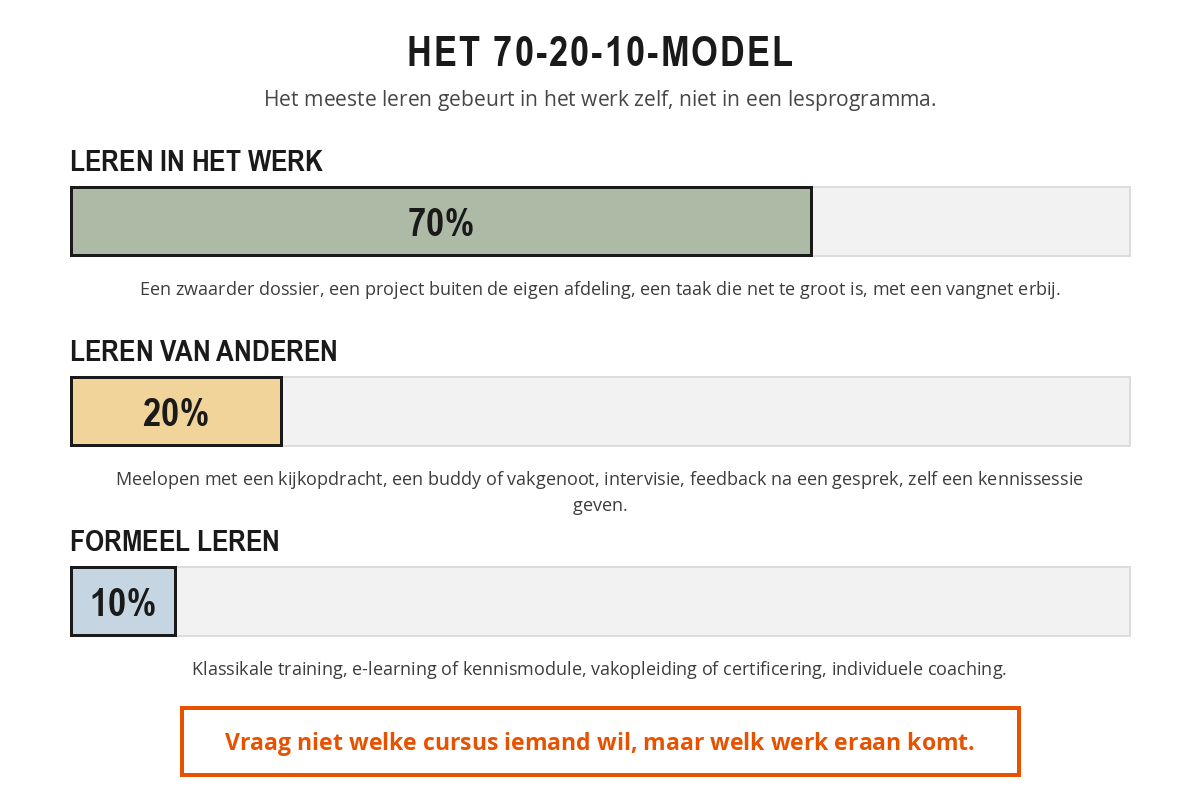
The model comes from research by the Center for Creative Leadership, in which managers were asked where their most important development steps had come from. Approximately 70 per cent of what they had learned came from the work itself: a project that went wrong, a role they could not yet fulfil. Such a 20 per cent came from other people, through feedback, observing others or a conversation with someone who could already do it. The remaining 10 per cent came from formal learning: programmes and courses.
That ratio is not a scientific standard and you do not have to calculate with it. As a rule of thumb when filling in the activities, though, it is useful. As soon as you notice that a plan consists of nothing but the name of a course, you know that ninety per cent of the possible learning gain is still untapped. The consequence for the conversation is small but noticeable: the first thing you ask is not which course someone wants to take, but which work this employee is going to do over the coming months that he does not yet master. The course comes into view after that, as an addition to that work.
Rachid wants to get better at difficult client conversations. His first proposal is a two-day Conversation Skills course in March. In the end the plan turns out differently: he takes over three difficult cases from a colleague, his team leader sits in twice and gives feedback afterwards, and the course follows in month five, once he knows where his own sticking points are. The same course, the same budget of EUR 1,150, a different effect. In March he would have done the exercises using a case study from the book; in September he did them using his own case from three weeks earlier.
A useful check with every course you choose: which work are you going to apply this to within two weeks of finishing? If there is no concrete answer, the course has been scheduled too early.
The range of learning formats
The rule of thumb only becomes usable once you know what there is to choose from. Most plans get stuck on two options: a course, or shadowing a colleague. The palette is broader.
Formal learning formats are organised around a programme, with a facilitator and a set content. They are strong on new knowledge and on establishing a common language within the team. A classroom training course is strong for skills you want to try out in a safe setting before you use them with a real client. E-learning or a knowledge module suits factual knowledge, legislation and system use, at your own pace. A vocational training or certification is needed when a diploma is a requirement for the job. Individual coaching suits behavioural issues that lie differently for each person.
Informal learning formats are not part of a course programme, but sit within existing work. There is no trainer and no certificate; there is a task, a colleague and a moment at which you look back. They usually cost no budget, but they do cost attention and room in the diary. Broadening the role or taking on a more demanding case: work that sits just above the current level, with a safety net in place. Taking part in a project outside your own department: a temporary role produces situations that do not occur in your own work. Shadowing and observing: a day working alongside a colleague, with an observation brief agreed beforehand on one specific point. A buddy or peer who looks in periodically and gives feedback on specific behaviour. Peer supervision: a fixed group that discusses real work issues using a set method. Giving a knowledge session to the team: anyone who passes something on has to get it clear for themselves first. And standard reflection questions in the team meeting: a recurring round-up of what went differently than expected makes learning part of the week.
The working method follows the type of goal. For knowledge, a module or a reading assignment works. A skill calls for practice with feedback. For behaviour or attitude you need repetition in real situations, plus someone who observes. Two or three working methods per goal is enough; more produces a schedule nobody can keep up. Take into account how someone starts out: one person prefers to begin by doing and looks afterwards at what came of it, another wants to understand the model first. A preference is not a limitation, and those who complete the whole cycle (doing, reviewing, explaining, trying again) learn the most.
Why plans run aground
In the implementation phase, some of the plans fall by the wayside, and the causes are remarkably predictable. Almost all of them can be headed off at the moment the agreement is written down.
- No date, no owner. If it says that you will take a look at how things are going halfway through, that moment will never come.
- Today's work crowds out tomorrow's learning. Study time is there on paper, but it is the first thing to be given up when there is a peak in the workload.
- The goal has remained too big. Twelve months without milestones offers no single moment at which anyone feels any progress. Motivation drops off in month two.
- Nobody asks about it. If you do not ask about it for eight months, the employee learns that the plan is not important. Attention is the cheapest safeguarding instrument you have.
- The support never materialises. The budget was never applied for, the buddy was not given any hours, the place on the project went to someone else.
- The work or the role changes. A reorganisation or a new manager sometimes makes the goal obsolete. That is not a failure, but a reason to adjust it.
In February, Esther agrees that she will start conducting client meetings independently. She is allowed to shadow an experienced colleague and a course is planned for the autumn. By June, nothing has happened: the colleague was not allocated any hours, the course was fully booked and nobody had touched the subject since February. At the appraisal in December it looks as though Esther took no initiative. In reality, her plan foundered on points four and five, and in March that would have been visible in a ten-minute conversation.
Four moments in the year
Deming's improvement cycle has four steps: plan, do, check, act. You make a plan, carry it out, check what it produced and adjust. With development plans, the first two steps are usually fine: the agreement is in place and the employee gets to work. Check and act are missing. Without check, nobody knows whether the goal is still achievable. Without act, an activity that isn't working stays in place until December, even if you can both see it is producing nothing.
Those two steps only get carried out once they have a place in the year. Four fixed moments are enough for most plans, as long as they are in both diaries. The starting point: immediately after signing, you put the follow-up moments in the diary and block out the learning time for the whole year; whatever does not go into the diary now will not go in later either. The quarterly check: ten minutes in the regular one-to-one, with a single question: has anything happened on your plan since last time? The progress review: halfway through, twenty minutes for status, obstacles and adjustment, separate from the one-to-one and with its own invitation. And the final evaluation, which you schedule at the start of the year, well before the December rush.
Let the employee send out the invitations. Whoever manages the diary feels ownership of the plan. Your role is to confirm and to be there.
The progress review
A progress review takes about twenty minutes and establishes where the plan stands, what has happened since the last agreement and what needs to change in order to achieve the goal. It is not about performance and does not produce a judgement. It produces a decision: carry on as agreed, or adjust. You keep it tight, in five steps. The employee looks back first on the activities and the milestones; you then add what you have seen in the work. Each goal gets a status: on track, behind schedule or stuck, along with what tells you that. If it is behind schedule, you look for the cause: is it in the workload, in an activity that does not fit, in missing support, or in doubt on the part of the employee? Then you take a decision: adjusting, replacing a working method, extending the support, or dropping a goal that has lost its value; the latter is a valid outcome, not a failure. And before you leave the room, the new date in both diaries.
With a goal that has stalled, start by asking: what would make it easier for you to work on this over the next two months? The answer often turns out to be small and easily arranged: a block in the diary, a colleague who looks along, or one step fewer in the plan. What you agree goes into the development file: the agreement with a version number, half a page per interim moment with status, decision and new date, and the completed evaluation. Loose impressions and anything that smacks of an appraisal stay out.
Take a plan that is currently running, or the last one you completed.
- Divide the activities across the 70, the 20 and the 10. Which part is structurally under-resourced in your case?
- Go through the six causes and note for each cause whether it applies, or applied, to this plan.
- Which cause is the most dangerous for this plan, and why?
- Is there a specific date in the diary on which progress will be discussed? If not, note down now which date that will be.
- What may the employee adjust themselves without you, and what requires your approval?
Summary
- Around 70 per cent of learning takes place in the work itself, 20 per cent comes from other people and 10 per cent from a taught programme. So ask first which work is coming up, not which course.
- Informal learning formats: job enlargement, a project outside the department, shadowing, a buddy, peer supervision, giving a knowledge session yourself, and fixed reflection questions in the team meeting.
- Formal formats: training courses, e-learning, vocational programmes and individual coaching. Two to three formats per goal is enough.
- Knowledge calls for a module, a skill for practice with feedback, and behaviour for repetition in real situations with someone observing.
- Plans run aground at six predictable points, and most of these you settle when writing down the agreement.
- Plan and do usually take care of themselves; check and act need to be in the diary: a start moment, a quarterly check, a progress review and a final evaluation.
- A progress review takes twenty minutes, gives each goal a status and ends with a decision and a new date.
- Dropping a goal that has lost its value is a valid outcome.
An employee proposes a two-day training course as the only activity. What does the 70-20-10 model say about that?
According to this chapter, where is the gain in applying plan, do, check and act to an ongoing development plan?
Halfway through, a goal turns out to have stalled. What is a valid outcome of the progress review?
Ready for the next step?
You have completed the free starter on PDP meetings. The next chapter in the full course is Conversation techniques that work: Listening on several levels, open and closed questions, summarising and mirroring, and allowing silences in the conversation.
Take the 1-day training course →From €625,- excl. VAT · with an experienced trainer alongside you