


Introduction
There are days when your diary runs you instead of the other way round. The phone rings, a colleague drops in, an email arrives that needs an answer, and at the end of the day the very thing you thought was important is exactly what has been left undone. You have been working hard and yet you feel you have got nowhere. Acting proactively is about reversing that movement: you no longer only react to what comes at you, you also decide for yourself where your energy goes.
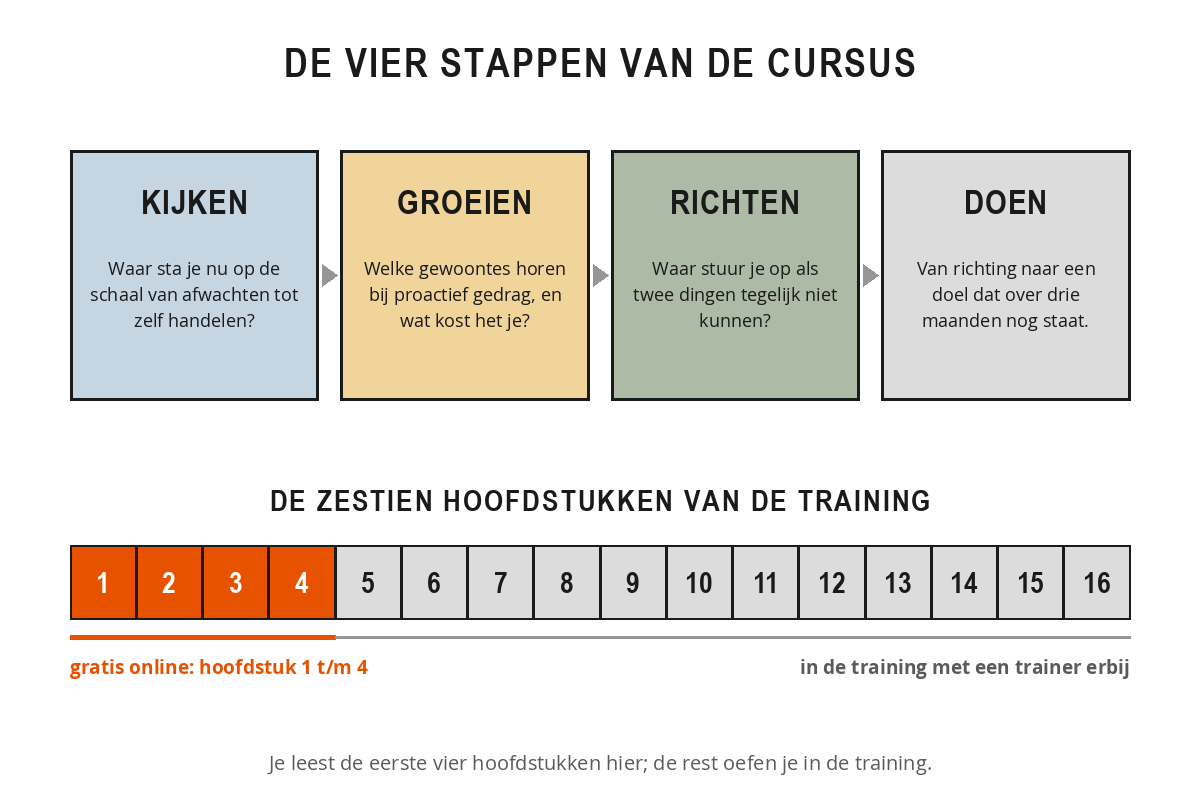
This free course consists of four chapters: the orange part of the bar above. At the bottom of chapter 4 you will find the full course.
What you will learn
You start with the difference between proactive and reactive behaviour. Not as a label, but as a scale on which you stand somewhere different for each topic: from waiting and seeing to acting yourself. You then look at the four characteristics that proactive people have in common and at six ways to work on these yourself, including the price that taking the initiative inevitably demands. In the third chapter you reduce your core values to a top three that still works under pressure, and translate these into behaviour that a colleague can see. Finally, you turn a vague intention into a goal you can check, using BE SMARTIE and three time horizons.
The common thread: between what happens and what you do there is always a moment of choice. Acting proactively is nothing more than noticing that moment and using it.
How the course is structured
The four chapters follow a movement from the inside out. You start with looking: where do you stand now, and what does it cost you if you keep waiting? Then comes growing: which habits belong to proactive behaviour and which two will you take on first? Then focusing: what are you actually steering by when two things cannot both be done at once? And you finish with doing: how do you turn that direction into an agreement with yourself that still stands three months from now. Each chapter contains learning objectives, a model, examples from practice and an exercise you apply to your own working week.
Practical tips for use
- Keep a notepad or a blank document to hand. The exercises only work if you actually complete them.
- Don't read it all in one go. One chapter a week, with time to try it out, delivers more than reading through it in an afternoon.
- For each chapter, choose one situation from your own work to which you apply the content. Preferably a situation that has been irritating you for some time.
- Start small. In the first few weeks, new behaviour mainly costs energy, and you can only keep that up by taking one habit at a time.
- Say one of your intentions out loud to someone else. Intentions spoken aloud fail less often.
Each chapter ends with a short knowledge check of three questions: answer them correctly to mark the chapter as completed. Your progress is saved automatically in your browser.
Enjoy the reading, and above all: enjoy the first conversation you do have after this chapter.