


2. The STARR model
You now know what you are looking for: one clearly defined event in which the candidate himself takes action. The next question is how to get that event complete. A behavioural example only becomes usable once you know four things: where it took place, what the candidate had to do, what he himself did and what came out of it. STAR gives you exactly those four hooks, and the second R adds something valuable on top.
After this chapter:
- You can name the four letters of STAR and know what information each letter yields.
- For each step you ask a question that steers towards concrete behaviour.
- You can tell from an answer which step is still missing.
- You explain what the second R adds to a behavioural example.
- Make notes that are still of use to you a week later.
The five steps
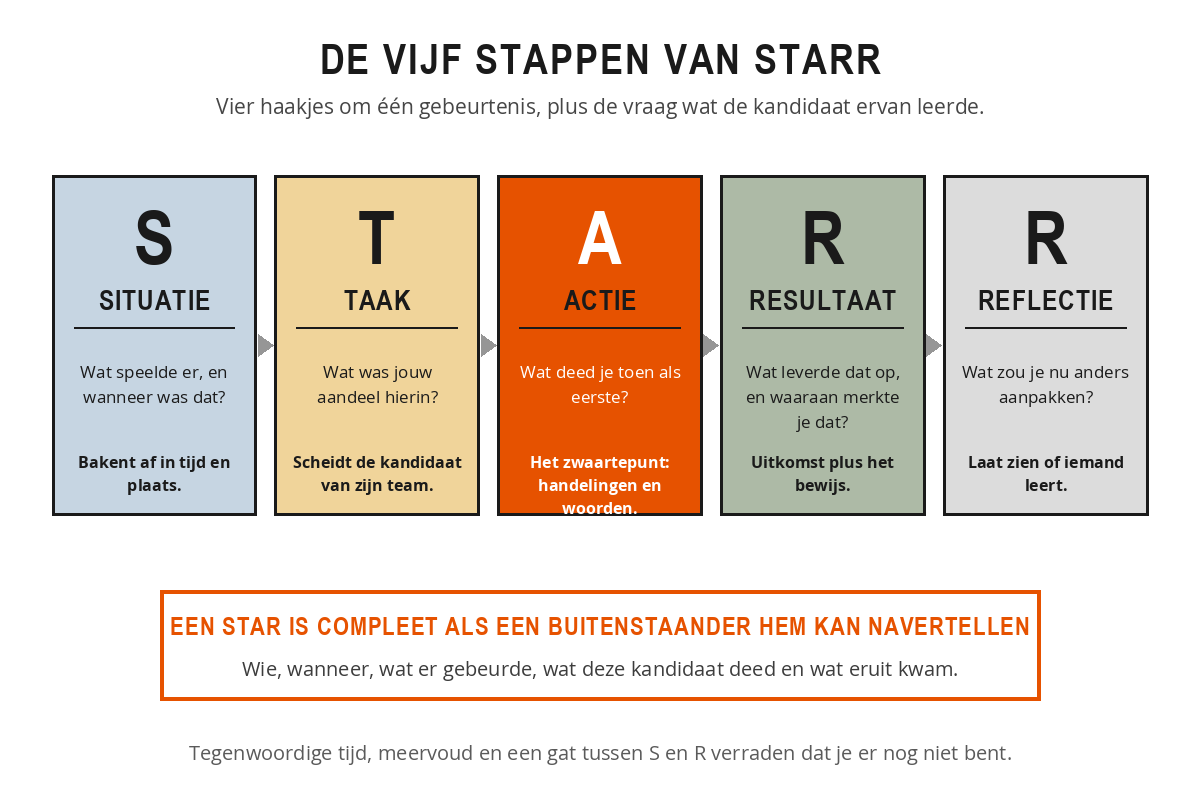
You work through the steps in a fixed order for every behavioural example the candidate puts forward. Together they produce a story with a beginning, a middle and an end.
The S for situation covers the circumstances in which the example took place: when, where, who was involved and what made it difficult. This step takes little time, but without the situation the rest hangs in the air. The T for task is about the candidate's role. Was he responsible or a helping hand, was he given the assignment or did he take it on himself? This is where you separate the candidate from their team. The A for action is the centre of gravity of the model and usually the longest part of the answer. You want to hear what the candidate actually did and said: which steps, in what order, and with what reasoning. The R for result covers the outcome and the reaction of those around. An example that turned out badly is usable too, as long as the result is clear.
The second R stands for reflection: what would the candidate do differently now, and where has he used that again since? That question shows whether someone learns from experience or merely collects it. Two candidates with the same number of years on their CV sometimes differ widely here.
The order is no accident. Situation and task set the boundaries, action produces the behaviour, and result tests whether that behaviour had any effect. If you go straight to the action, you will not know afterwards whether the candidate was the lead or an extra.
Competency: collaboration. Behavioural indicator: consults colleagues before taking a decision that affects them. The question: "Tell me about a time in the past year when you had to take a decision that also affected your colleagues."
Situation: "Last autumn, during the move to the new planning system. I was in a team of six." Task: "I was appointed to draw up the new rota for the whole department." Action: "First I called all six of them separately for ten minutes and asked which days were fixed for them. Then I drew up a draft and put it to the team meeting. Two people ended up in a bind; I swapped things around with them." Result: "The rota came into effect on 1 December and there have been no complaints. My manager then adopted the format for the other department as well."
Four steps about one clearly bounded event, with visible behaviour of his own. You hear six phone calls, a draft, a meeting and two swaps. That is material you can score on.
Questions for each step
The strength of the model lies in how you phrase your questions. A question beginning with "why" produces an explanation. A question beginning with "what" or "how" produces behaviour.
For the situation you ask about the circumstances and set a time frame: "What exactly was going on with that client?" and "When was that?" For the task you pull the we-story apart: "What was your part in it?" and "What were you accountable for?" As long as you only hear "we", you still know nothing about this person. On the action you spend the most time, and you ask about both deeds and words: "What was the first thing you did then?", "What did you say to him?", "And what happened next?" You stay inside the event and in the past tense. For the result you ask about the outcome and the evidence for it: "What did that achieve?" and "How could you tell?" And for the reflection you close with "What would you do differently now?" or "Where have you used that since?"
Ask one question at a time for each step. A double question such as "What was the situation and what did you do then?" invites the candidate to skip the hardest part. He answers the first half, and you forget the second.
Recognising a complete STAR
A STAR is complete when an outsider could retell the incident afterwards: who, when, what happened, what this candidate did and what came out of it. If one of those elements is missing, you have a story and not a behavioural example.
Three signals tell you straight away that you are not there yet. The first is the present tense: "That is always how I approach it" is a working method, not an event. As soon as the candidate switches to the past tense, you are in a real situation. The second is the plural: "We then decided" hides who did what. Keep asking until you hear what this candidate himself did or said. The third is the gap between S and R: the candidate outlines a problem and reports the good outcome, but skips the actions in between. That middle section is exactly what you are selecting on.
Asked about a time when he helped a client with a complaint, a candidate answers: "I always pick up complaints straight away, because otherwise they escalate. We had a difficult client last year and in the end she simply stayed with us."
What is in there? A fragment of situation ("a difficult client last year") and a result ("stayed with us"). What is missing? The task and the action, so precisely the two steps that matter. On top of that, the first sentence is in the present tense and the second in the plural: two of the three signals in two sentences. Here you probe further with: "What was your role with that client?" and then "What was the first thing you did when the complaint came in?" Start with the task, because as long as it is not established that he did it himself, the rest of the story tells you nothing.
Allow five to eight minutes per competency, including your follow-up questions. In a one-hour interview you can therefore test at most four competencies seriously. You choose those in advance; the rest you deliberately leave aside. Half-covering five competencies yields less than covering three in full.
Taking notes during the interview
After three interviews in one day, your memory is no longer a reliable source. So whatever you write down, you write down verbatim: the candidate's words, not your conclusion about them.
Three agreements with yourself keep your notes usable. Quote rather than summarise: note down "I called him back the same day" and not "customer-focused". The judgement comes later; the quote is the evidence on which you build that judgement. Tick off while listening: write the letters S, T, A and R in the margin and cross them off as soon as that step has been covered. At a glance you can then see which question is still outstanding. And only score afterwards: as long as the conversation is under way you are gathering material; the assessment comes afterwards. In chapter 4 you will see how to assign and weigh those scores.
Say in your opening that you will be making notes and why. A candidate who knows you are recording his words in order to weigh them fairly later will not experience your pen as distance.
Build a complete set of questions around one competency from your own job profile.
- Which behavioural indicator do you take as your starting point?
- Your opening question for the situation, including a time frame.
- Your task question, which pulls the we-story apart.
- Three action questions, all beginning with what or how.
- Your result question: the outcome plus the evidence for it.
- Your reflection question as a closing.
Then read the set out loud to a colleague who answers in the role of candidate. Afterwards, cross out the questions that produced nothing, and check whether you could have retold the answer.
Summary
- STARR gives you five steps that together make one event from someone's working past visible.
- Situation: when and where it took place, and what made it difficult. Task: what the candidate's own share was. Action: what he actually did and said, and in what order. Result: what came out of it, and how he could tell.
- The second R, reflection, shows whether someone learns from experience or merely collects it.
- Ask one thing at a time per step, and begin your questions with what or how rather than why.
- A STAR is complete when an outsider could retell it. The present tense, plural forms and a gap between situation and result all give away that you are not there yet.
- Allow five to eight minutes per competency: in an hour you can test at most four of them seriously.
- Note down quotes rather than judgements, tick off the steps as you listen and only score once the conversation is over.
A candidate talks at length about a project that ended well, but you keep hearing "we" and "the team". Which STAR step do you not have yet?
Why do you spend most of your follow-up questions on the A for action?
According to this chapter, what do you write down during the interview?