


3. Keep probing until you hear behaviour
A candidate who talks fluently does not automatically give you usable material. In fact, the more fluently someone talks, the sooner you are satisfied with an answer that, on closer inspection, was about nothing at all. Probing is the tool with which you reduce a general story to one identifiable event with identifiable behaviour. This chapter is about how to do that without the conversation turning into an interrogation.
After this chapter:
- You apply the probing funnel to move from a general answer to concrete behaviour.
- You recognise a socially desirable answer and probe on it specifically.
- Remove leading and other steering questions from your own repertoire.
- You identify the interview pitfalls you are most susceptible to yourself.
The probing funnel
The probing funnel is a series of questions with which you narrow an answer down step by step: you start broadly with the topic and end with a single sentence the candidate actually said. Each question makes the opening a little smaller, so that less and less room is left for generalities.
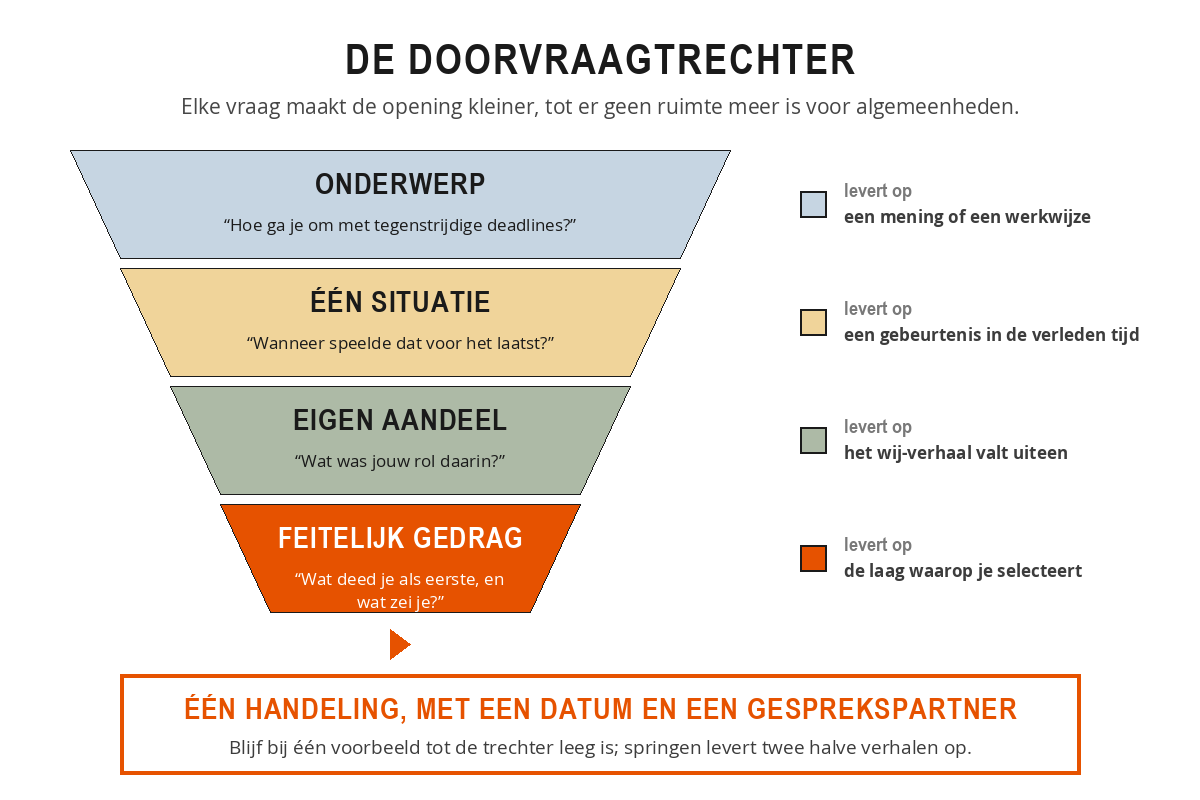
The funnel has four layers. The top layer is the topic: you name the competence or the theme and let the candidate talk. That often produces an opinion or a way of working, and that is fine as a starting point, because you hear which words the candidate uses. The second layer is one situation: you ask about one specific occasion, bounded in time. "When did that last happen?" As soon as the candidate switches to the past tense, you are in a real event. The third layer is the own contribution: you separate the candidate from the team with "What was your role in that?" and "Who ultimately decided that?" This is where the 'we' story disappears. The fourth layer is actual behaviour: you ask about words and actions. "What exactly did you say?", "What did you do first?", "How did he respond to that?" This is the layer on which you select.
If you work with STAR, the funnel is the way you get the four slots filled. The funnel determines how deep you go, STAR determines where you still have gaps.
Karin is conducting an interview for a role in the finance administration department.
Karin: "How do you deal with conflicting deadlines?" Candidate: "I'm someone who prioritises well. I then consult the people involved."
Karin: "When did that last come up?" Candidate: "Last month, when the annual accounts and an audit coincided."
Karin: "What was your role in that?" Candidate: "I was responsible for the annual accounts, my colleague did the audit."
Karin: "What did you do first when you saw that it was causing friction?" Candidate: "That same afternoon I called our controller and asked whether the audit could be moved back a week. It couldn't, so I proposed delivering two items later."
In four questions the answer moved from a self-image to an action with a date, a person spoken to and a decision. Karin can now score on what she heard, rather than on how pleasantly the conversation went.
Probing without interrogating
Four layers in a row can feel like a cross-examination. You keep the conversation pleasant by alternating the funnel with listening. A short summary along the way gives the candidate breathing space and gives you a checkpoint: is what you understood correct? A silence works too. After a thin answer the candidate will often add something unprompted, provided you keep quiet for two or three seconds.
It also helps to explain why you are probing. Say, for instance, that you want to get as clear a picture as possible of how someone works, and that this is why you are asking for details. A short explanation like that increases acceptance, and with it the yield of your questions. Also stay with one example until the funnel is empty. Jumping on to a second situation feels considerate, but it leaves you with two half stories instead of one complete one.
The socially desirable answer
A socially desirable answer is an answer tailored to what the candidate thinks you want to hear, rather than to what actually happened at the time. You can recognise it by a few signals: it comes quickly and smoothly, it contains the jargon from your own job advert, it is always positive, and it stays in generalities as soon as you ask for details. After two funnel questions it is usually clear whether there is a real event underneath.
Often it is your own questioning that invites that answer. Five question types do so most strongly. The leading question puts the answer in the candidate's mouth: "You're certainly good at handling deadlines?" After that you only hear confirmation. The multiple question asks three things in one breath; the candidate answers the easiest one and you forget the other two. The hypothetical question produces an invented answer instead of an event: you are testing insight, not behaviour. The why question sounds like a reproach and puts the candidate on the defensive; better to ask about the reasoning behind it with "What made you make that choice?" And the question with a judgement built in ("That got out of hand, didn't it?") sets the candidate to repairing rather than to telling the story.
Do you notice halfway through that your question is too leading? Say so out loud: "I'm asking that too leadingly. Let me try again." That costs three seconds and gives you a clean answer.
During an interview for an account manager role, Peter asks: "You're used to working independently, of course, aren't you?" The candidate says: "Yes, absolutely, I prefer to work independently." Peter notes down: independent, strong.
His colleague explores the same theme differently: "When did you last have to decide something without your manager being reachable?" The candidate thinks for a moment and comes up with a delivery that went wrong on a Friday afternoon. He called the client, offered a ten per cent discount and reported it on Monday. His manager thought the discount was too high, but the client stayed.
Two conversations about the same competence, two very different kinds of material. Peter has the candidate's agreement with his own assumption. His colleague has a decision, an amount and an outcome. Only the second can be discussed in the meeting afterwards.
Pitfalls for the interviewer
Interview pitfalls are the habits with which you yourself lower the quality of your information: behaviour that feels pleasant during the conversation, but leaves you with half a picture afterwards. Almost all of them stem from the wish to keep the conversation running smoothly.
- Talking too much yourself: you fill silences with explanations about the job. The twenty-eighty ratio tips over and you leave the interview with less material.
- Filling in the answer for the candidate: "You mean you mediated at that point?" You finish the answer off yourself and then note down your own words as evidence.
- Settling for half a STAR: situation and result are clear, the action is missing. You fill that gap in afterwards with whatever seems logical.
- Being swayed by likeability: a pleasant candidate gets fewer follow-up questions than an awkward one. You are then measuring ease of conversation rather than competence.
- Forgetting to take notes: after three interviews the examples start to blur. Without quotes, all you are left with is a feeling.
The correction is always the same: back to the funnel, one example, keep probing until you hear an action. In the next chapter you will see how to weigh those recorded examples against each other.
Choose a competency that is genuinely needed in your job profile.
- Write out the four funnel questions, from topic to actual behaviour.
- For each question, decide which answer you would not yet consider sufficient, and note down the follow-up question you would then ask.
- Test the sequence on a colleague and count how many questions you needed before you heard an action with a date and a person spoken to.
Then listen back to a recording of one of your own conversations, or have a colleague take notes. Tally how often you ask a leading, multiple or hypothetical question, mark every moment where you finish the answer for the other person, and estimate your own speaking time as a percentage.
Summary
- The probing funnel narrows an answer in four layers: topic, one situation, the candidate's own part, factual behaviour.
- The funnel determines how deep you go, STAR determines where you still have gaps.
- Stay with one example until the funnel is empty; jumping around gives you two half stories.
- Alternate your questions with summarising and with silence, and explain why you are probing further. That keeps the conversation pleasant.
- A socially desirable answer comes quickly and smoothly, uses your own jargon, is always positive and stays vague as soon as you ask for details.
- Leading, multiple, hypothetical, why- and judgemental questions invite that kind of answer. If you notice it, correct yourself out loud.
- Your own pitfalls: talking too much, filling in for the candidate, settling for half a STAR, being swayed by likeability and forgetting to take notes.
A candidate answers: "I'm someone who adapts quickly." Which question takes you one layer deeper into the funnel?
Why is "That got out of hand, didn't it?" a poor question in a selection interview?
You notice that you probe far less with a likeable candidate than you did with the previous one. Which pitfall is that?