


1. Asking about past behaviour
A candidate who tells you how he would tackle a conflict is describing his good intentions. A candidate who tells you how he tackled a conflict last month is describing his behaviour. That difference of a single verb tense is the whole basis of the selection interview you will learn to conduct in this course. This chapter deals with the question that comes before it: what are you actually asking about, and how do you know when you have got hold of it?
After this chapter:
- You know what a criterion-based interview is and how it differs from an unstructured job interview.
- You can explain why past behaviour has predictive value, and how far that value reaches.
- You will hear the difference between a behavioural example and an opinion, a habit or a we-story.
- You will build a criterion-based question from a behavioural indicator, set within a time limit.
- You know the four situations in which the method falls short and what to use alongside it.
The criterion-based interview
In a criterion-based interview you test criteria established in advance against the candidate's real work experiences. Those criteria are the competencies you consider important for the role. The test consists of situations the candidate has actually been through, not situations you have thought up.
This makes such an interview differ from a free-form conversation on three points. The first difference is that the content is fixed in advance. Before the interview you decide which competencies you will assess and in what order. The interview follows your list, not the candidate's CV. The second difference is that you ask about experiences rather than opinions. The question is not what someone thinks about collaboration, but what they did in a particular collaboration. The third difference is that every candidate gets the same core questions. That way you end up comparing like with like: your follow-up questions differ per candidate, your opening questions do not.
That last point is often skipped, and it is precisely the point at which selection falls apart. If you ask candidate A about a time he resolved a conflict and candidate B about his ambitions, then at the end of the week you have two accounts that you cannot possibly compare side by side.
Why the past predicts something
The assumption behind this method is a short one: past behaviour is the best predictor of future behaviour. Someone who has handled a difficult conversation with a client themselves three times before will probably do the same for you. Someone who passed it on to a colleague three times will probably do that again too.
That predictive value is not absolute. People change, and a different environment brings out different behaviour. Even so, a pattern you see recurring in three examples is more reliable than an intention the candidate formulates for you on the spot. That is why it is better to ask two or three follow-up questions on the same theme than one question on six themes.
Sanne is looking for a service employee and asks: "Suppose a colleague delivers their part of the report late. What would you do?" The candidate answers: "I would raise it with them straight away and look together at how we can still get it in on time." That answer is not wrong, but nor can it be disproved. Almost every candidate ends up here, because it is in every job application handbook.
Sanne asks the question again, now about the past: "When did a colleague last deliver something to you too late? Tell me what happened then." Now the candidate has to recall a real situation. Did she actually raise it? When was that, in what words and with what result? Sanne can probe further on this version; on the first one she cannot.
What a behavioural example is
A behavioural example is a delimited event from the candidate's working past, in which it becomes clear what they themselves did. Delimited means: one situation, with a beginning and an end, at an identifiable moment. Did themselves means: the candidate is the one acting, not their team.
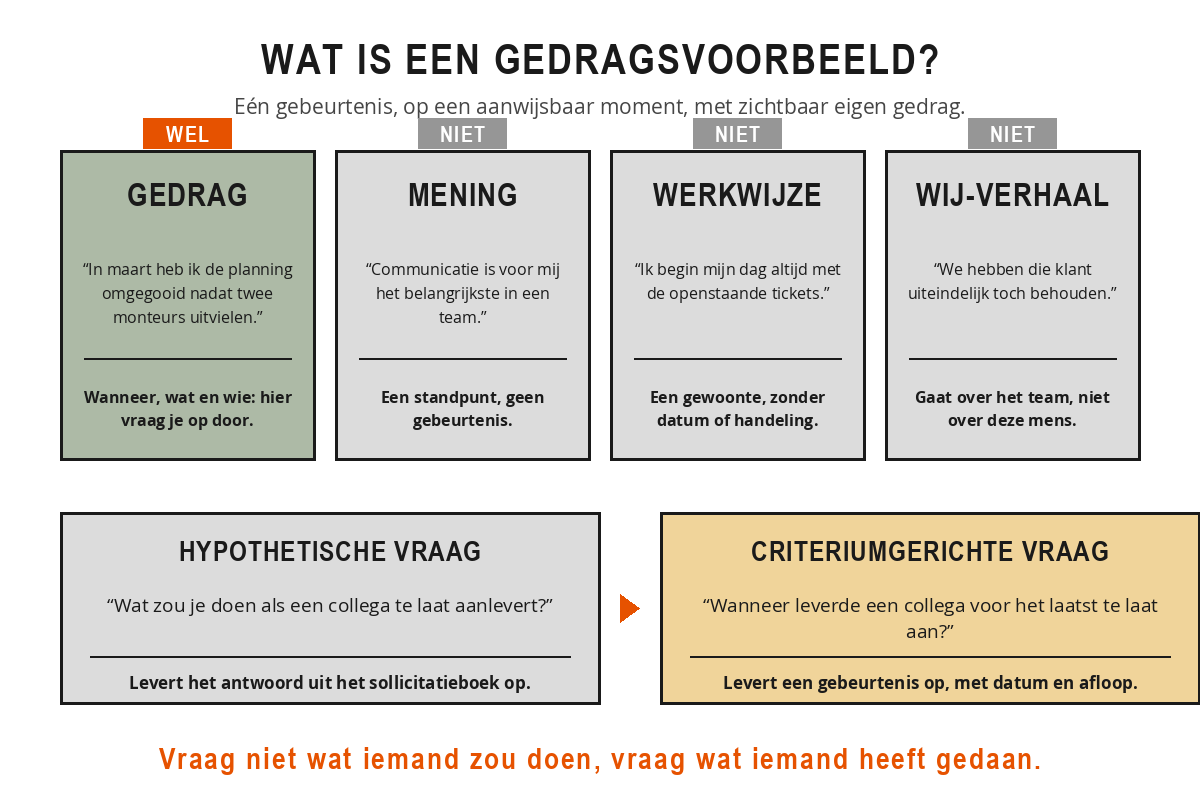
Three types of answer look like a behavioural example but are not. The first is the opinion: "I think you should always ring customers back within a day." That is a point of view, not an event. The second is the general approach: "Where I worked we always approached it by talking it through first." That describes a habit, with no date and no identifiable action. The third is the we-story: "We eventually completed that project within budget." That tells you something about the team, but nothing about this candidate.
Set against that is the behavioural example itself: "In March I reorganised the schedule after two engineers dropped out." That contains a moment, a trigger and an action by this person. You can build the rest of the interview on a sentence like that.
In an interview for a role as planning team leader, Rob asks about initiative. The candidate says: "Last year we brought the lead time for orders down from eleven to seven days." Rob notes that as strong and moves on to the next competency.
A week later he compares his notes with those of a colleague, who did ask follow-up questions. That second conversation revealed that the candidate was part of a project group of five, that the team leader wrote the proposal, and that the candidate typed up the new work instruction and circulated it. That is a perfectly respectable contribution, but it is not this person's initiative. The score went from a 4 to a 2. The difference lay in one word in the answer: "we".
How to build a criterion-based question
A criterion-based question does not start from a topic, but from a behavioural indicator: a concrete description of what you see someone doing when they have mastered the competency. You build it up in four steps.
First you choose one behavioural indicator. For initiative, for example: spots a problem and comes up with a proposal unprompted. Then you determine in which situation that indicator becomes visible: a process that grinds to a halt, a complaint that keeps recurring, a colleague who drops out. Next you ask about one specific occasion in the past: "Tell me about a time when you saw that something was not going well and you did something about it yourself." And finally you set a limit in time: "in your current role" or "over the past year". Without that limit you will get the finest example from fifteen years of a career, and that says little about how someone works now.
Write out your questions in advance and take them with you on paper. Two to three questions per competency is enough. During the interview itself you will rarely manage to formulate a sharp question on the spot, because your attention is with the answer you have just heard.
Where the method stops
The predictive value of behaviour is a statement of probability, not a guarantee. That value is highest when the new situation resembles the old one. The method runs into trouble on four points.
- Candidates without relevant work experience: school leavers and career switchers have not yet been through those situations. You then shift your question to a work placement, a part-time job, voluntary work or a study project, and you lower your expectations about the scale of the example.
- Behaviour depends on the environment: someone who took excellent initiative in a small team may grind to a halt in an organisation with four layers of management. So probe further into the circumstances in which the behaviour arose.
- People change: an example from five years ago says less than an example from last month. Recent behaviour carries more weight.
- Differences in storytelling ability: a fluent storyteller seems more competent than someone who struggles to put things into words. You are then measuring verbal skill, not the competency you were after.
That is why the criterion-based interview rarely stands alone. You combine it with a trial assignment, an assessment, a second interview with a different interviewer, or the checking of references. Each instrument covers the weakness of the other.
Take a job profile you will be working with soon and pick two competencies from it.
- For each competency, note down one behavioural indicator: what do you see someone doing when they have mastered this?
- Write down the criterion-based question that asks about one specific situation in the past.
- Add the period or role within which you are looking for that situation.
Then check whether the word "would" appears in your questions. If so, rewrite them in the past tense. Finally, read them aloud: if you hear a question that invites an opinion, it is not yet sharp enough.
Summary
- In a criterion-based interview you test competencies chosen in advance against real situations from the candidate's working past.
- It differs from a free-form conversation on three points: the content is fixed in advance, you ask about experiences rather than opinions, and every candidate gets the same core questions.
- Past behaviour is a better predictor than an intention, especially when the old situation resembles the new one.
- A behavioural example is one delimited event in which the candidate acts themselves. An opinion, a general way of working and a we-story are not.
- You build a criterion-based question in four steps: choose a behavioural indicator, determine the situation, ask about one occasion, and set a limit in time.
- Hypothetical questions produce opinions. Don't ask what someone would do, ask what someone has done.
- With starters, in a very different environment, with old examples and where storytelling ability differs, you need a second instrument.
A candidate says: "Where I worked, we always consulted the client before sending out a quotation." What kind of answer is this?
Why does the question "What would you do if a client was standing at the desk, angry?" tell you so little for your selection?
You are interviewing a school leaver with no relevant work experience. What do you do according to this chapter?