


Introduction
Plenty of people would happily see the day last a bit longer. The stack never gets any smaller, the inbox dictates the morning, and at the end of the day that one important job has once again come to nothing. Yet everyone has the same number of hours. Time management is not about getting more of them, but about consciously choosing where they go.
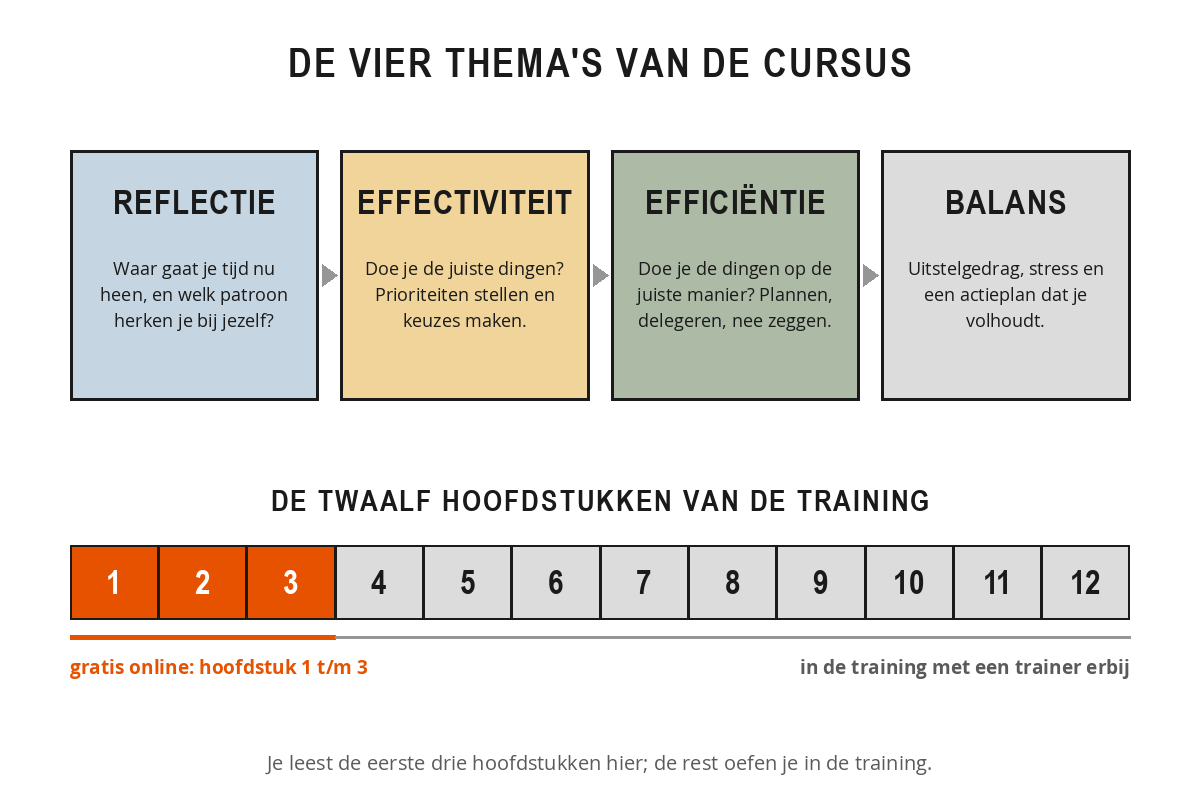
This free course contains the first three chapters: the orange part of the bar above. At the bottom of chapter 3 you will find the full course.
What you will learn
You will gain insight into where your time actually goes and which pattern you recognise in yourself. You will learn the difference between being busy and being effective, and you will be given two models for organising your task list: the ABC analysis and the Eisenhower model. The course then continues with planning, setting goals, your inbox, setting boundaries, delegating, procrastination and stress. The common thread: time management is self-management. It is not the clock that determines your day, it is your behaviour.
How the course is structured
The course follows four themes that build on one another. You start with reflection: where does your time go at the moment? Then comes effectiveness: are you actually doing the right things? After that comes efficiency: are you doing those things in a sensible way? And you finish with balance: how do you keep it up without it consuming you. Each chapter contains theory, a model, examples from practice and an exercise that you apply to your own working week.
Practical tips for use
- Keep a notepad or a blank document to hand. The exercises only work if you actually complete them.
- Don't read it all in one go. One chapter a week, with time to try it out, delivers more than reading through it in an afternoon.
- For each chapter, choose one concrete situation from your own work and apply the content to it.
- Start small. Sticking to one habit at a time works better than changing everything from Monday onwards.
- Go back over what you read earlier. Many insights only sink in on the second reading, once you have spent a week trying them out.
Each chapter ends with a short knowledge check of three questions: answer them correctly to mark the chapter as completed. Your progress is saved automatically in your browser.
Enjoy the reading, and above all: enjoy the hours you win back.