


1. Where your time goes
Time itself cannot be managed. An hour lasts sixty minutes, whether you meet a deadline or get stuck in your inbox. What you can steer is how you fill those hours: which tasks you take on and which you leave. This chapter is about the honest question that comes first: where does your time actually go at the moment?
After this chapter:
- You know why time management is, at its core, self-management.
- You recognise the difference between being busy and working effectively.
- You know the six time-wasters that drain most working days.
- You know which of the five types comes closest to you and which pitfall goes with it.
- You have a way of measuring where your hours actually go.
Time management is self-management
You can take the most important message of this course away with you already: time management is not about a clever calendar app or a new planning technique, however useful those may be. It is about knowing yourself and daring to steer yourself.
In practice you see that people who "have no time" usually do not have too few hours in their day. They spend those hours on the wrong things, or they let themselves be led by whatever happens to come their way. The inbox determines the diary. A colleague walking past determines the next half hour. And the important work is pushed forward to tomorrow.
That starts with self-knowledge. Are you someone who always says yes and then carries on working at home in the evening? Do you lose half an hour a day looking for files? Or do you put off big jobs until they can no longer be ignored? Self-knowledge requires honesty, and self-knowledge alone is not enough: you also need the discipline to keep up new behaviour. That becomes a good deal easier once you first understand where your time goes.
Being busy is not the same as being effective
Many people judge their working day by how busy they were. A full diary feels like a productive day. But being busy says nothing about what you have achieved, only about how much you have done.
Imagine two colleagues. One runs from meeting to meeting, answers email constantly and puts out small fires everywhere. By the end of the day she is exhausted, but if you ask her what she actually finished, there is silence. The other has calmly ticked off three important tasks, dealt with his email twice and gone home at five. Who was effective?
Marieke works as a policy officer. She always starts her day with her inbox, just to "see whether there's anything urgent in there". Before she knows it, it's half past ten and she has answered ten emails, dealt with three quick questions from colleagues and put a meeting in her diary. She hasn't touched the report she wanted to finish today. At the end of the day her feeling is: I've worked hard, but I haven't done anything that really mattered.
Six time-wasters that keep coming back
Before you start on techniques and methods, it helps to take an honest look at your own situation. These six come up in almost every working week:
- Working reactively: you let your diary be determined by email, phone calls and colleagues dropping in, instead of taking charge yourself.
- Being unable to say no: every request that comes in goes on your list, without you weighing up whether it will actually fit.
- No overview: you don't know exactly what's on your plate, so you react to whatever shouts loudest.
- Perfectionism: you spend two hours on a task that could have been finished in three quarters of an hour.
- Procrastination: you put off difficult jobs, which only makes them grow bigger in your head.
- Poor planning of energy: you do routine jobs at the moment when your mind is at its sharpest, and save the thinking work for the end of the afternoon.
Five types who get in their own way
Everyone has their own pattern that costs time. By recognising your own type you know where the gains are. The following five are the ones you come across most often in practice. They are not boxes you sit in for the rest of your life, they are a mirror: you will often recognise traits of several types, and usually there is one that takes over at tense moments.
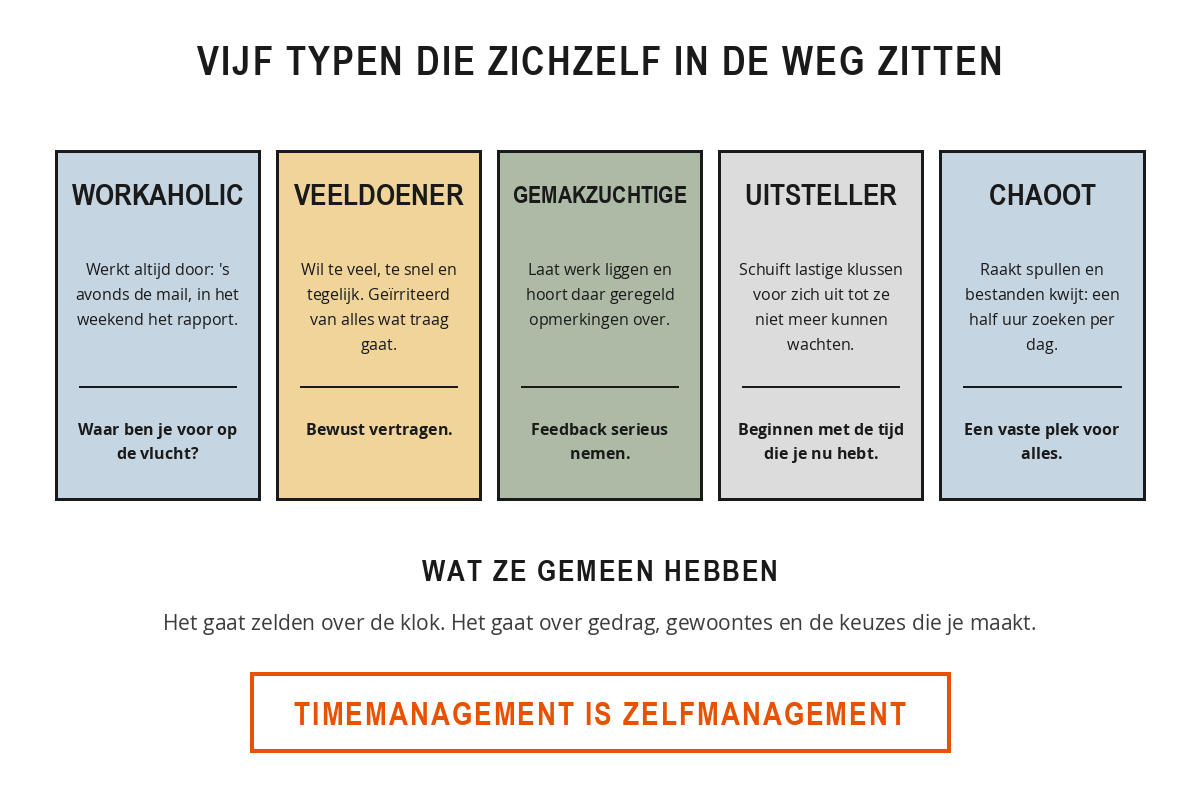
- The workaholic: work has taken over everything. Checking email in the evening, one more report at the weekend, logging in briefly while on holiday. You get a lot done, but rest, family and hobbies come second. The difficult question that goes with this: what are you actually running away from?
- The hurried multi-tasker: you want too much, too quickly and all at once. You jump from task to task and get irritated by people who speak slowly. In the short term that produces a lot; in the long term you pay with tension and a shorter fuse. The solution is not to run harder but to slow down deliberately.
- The easy-going type: you take things a little more easily and often think "it will be fine". Wonderfully relaxed, but when colleagues pull you up on work that is left undone, "it is not that bad, is it" is not a sustainable answer. The challenge is to take that feedback seriously, even if you do not agree with it.
- The procrastinator: you put work off, not because it is unimportant but because it looks like a mountain. The longer you wait, the bigger the mountain becomes in your head. The only way out is to start, with the time you have now.
- The chaotic type: you lose track of belongings, files and appointments and so spend half an hour a day searching. A fixed place for your things and a workable folder system immediately save time and frustration.
Not sure whether you have workaholic tendencies? Ask yourself this question: if I were given three weeks off tomorrow, with no email and no phone, how would that feel? Mainly like relief, or mainly like unease? That answer says a lot.
Measuring where your time goes
What you think you do with your time often differs from how you actually spend it. Ask someone how much time they spent on email yesterday and the estimate can be hours off. That is why measuring is the first step, and it can be done quite simply.
For three to five working days, record what you are doing every half hour. No essays, just keywords. Add three things: how long it took, whether it was planned, and what score between 1 and 5 you would give your energy at that moment. That second column is the most instructive. Many people only discover this way how much of their day consists of things they never scheduled themselves.
Maarten keeps track of what he does for four days. He discovers three things. He spends an average of one hour and forty minutes a day on email, spread across some twenty short moments. Between two and half past three his energy always drops to a 2, and it is precisely in that dip that he often tries to carry out complex analyses. And of his six planned tasks he completes an average of two a day. Before he tracked this, Maarten thought he simply had too much work. Now he sees that his diary is not the problem, but the way he organises his day.
When people look at their own week this way, a few patterns keep coming back. The fragmented day, in which you switch subject every twenty minutes and never get any uninterrupted work off the ground. The reactive mode, in which you mainly react and only get to your own work in the evening. The energy mismatch, in which your heaviest tasks fall on your worst moments. The pattern of putting things off, in which the same task gets pushed forward day after day. And the invisible time: the small interruptions that together easily add up to an hour and a half.
From self-knowledge to self-direction
Self-knowledge is the first step, but without action nothing changes. Most people want to do too much at once: stop hitting snooze, start exercising, clear out the inbox and take up meditation, all starting on Monday. Two weeks later everything is back to how it was. It works better to pick one habit and really embed it before you start on the next.
This week, track where your time goes for three working days, in blocks of half an hour. Then answer these questions for yourself:
- Which of the five types do you recognise most strongly in yourself, and what tells you that?
- Which pattern do you recognise in your own days: fragmented, reactive, energy mismatch, procrastination or invisible time?
- What does that pattern cost you in time, energy or results?
- What small experiment will you try next week to break it?
Keep that last answer small and concrete. Not "I'm going to work differently from now on", but "tomorrow I'll block out nine to ten for my report and close my email".
Summary
- Time cannot be managed, but you can. At its core, time management is self-management.
- Being busy says nothing about what you have achieved, only about how much you have done.
- Six time-wasters keep coming back: reactive working, not saying no, no overview, perfectionism, procrastination and scheduling your energy badly.
- Five types get in their own way: the workaholic, the over-doer, the easy-way-out type, the procrastinator and the disorganised type.
- Spend three to five days measuring what you do, how long it takes, whether it was planned and how much energy you had. Estimates made afterwards are not accurate.
- Change one habit at a time, and keep it small and concrete.
Why does this chapter call time management essentially self-management?
A colleague runs from meeting to meeting all day, answers email continuously and is worn out by the evening, but cannot name what she has finished. What does this example show?
You want to know where your time actually goes. According to this chapter, what is the best approach?