


2. Efficient versus effective
Working hard is not the same as working smart. Anyone who rushes about all day and still feels behind is often stuck in efficiency without effectiveness. This chapter is about that difference, and about the model you can use to review your task list.
After this chapter:
- You know the difference between efficiency and effectiveness.
- You understand why effectiveness always comes before efficiency.
- You recognise the pattern in which you do a lot but achieve little.
- You can sort your own tasks into A, B and C.
- You know in what order to spread those tasks across your day.
Doing the work well, or doing the right work
Imagine: you work on a report for two hours with full concentration. No coffee break, no distractions, no email in between. You work quickly, make hardly any mistakes and deliver a polished document. Efficient? Absolutely. But if a colleague asks afterwards why you were making that report in the first place, and the answer turns out to be "because it was made last year too", then all that efficiency was for nothing. You did the work well, but you did not do the right work.
Efficiency and effectiveness are two different things, even though they are often confused. Each answers a different question.
- Effectiveness is about: am I doing the right things? It looks at your goal and your result. Does this task contribute to what I want to achieve? Does this meeting deliver anything?
- Efficiency is about: am I doing things the right way? It looks at execution. How much time and energy does it cost me, and could it be done more smartly?
In short: effectiveness is about what, efficiency about how. Effectiveness is goal-oriented, efficiency is method-oriented.
Why the order matters
Here lies a mistake many people make: they start with efficiency. Emailing faster, planning more cleverly, switching more smoothly. All well and good, but if you start there, you may be optimising something you would have been better off not doing at all.
The order is always: effectiveness first, then efficiency. First you determine what the right things are to work on, and only then do you look at how to carry them out as smartly as possible. The other way round achieves nothing. Being highly efficient at pointless tasks feels productive, but it does not bring you a single step closer to your goal.
Karin works as a team leader and is proud of the way she manages her email. She has keyboard shortcuts, smart filters and standard reply templates, and answers her email twice as fast as her colleagues. Very efficient. Until her manager asks why the quarterly plan is not finished yet. Karin realises that she spends two hours in her inbox every morning, because it feels concrete and gives her the sense that she is completing something. But the quarterly plan, the one thing her team really benefits from, is left undone. Only when she starts her day with that plan and moves her email to the afternoon does she also become effective.
Working hard is not a mark of quality
The fuller the diary, the more items ticked off, the later you get home, the better the day: that is how it feels, but it is a misleading yardstick. The question at the end of your day is not how much you have cleared, but whether you have done the things that really mattered. Sometimes that is one conversation, one decision or one well-considered note. A short day with three crucial tasks can deliver more than a long day with thirty small ones.
At the end of every working day, ask yourself two short questions. What did I achieve today? And: what took me a lot of time without delivering much? Write down your answers for a week. You will see patterns you would otherwise never notice, and you will naturally develop a feel for the difference between busy and productive.
The ABC analysis
Not every task on your list carries the same weight. Some jobs deliver a great deal, others mainly cost time. The ABC analysis makes that distinction clear, even before you start planning. You divide your tasks into three categories, with each letter standing for a combination of the share of your time and the share of your result.
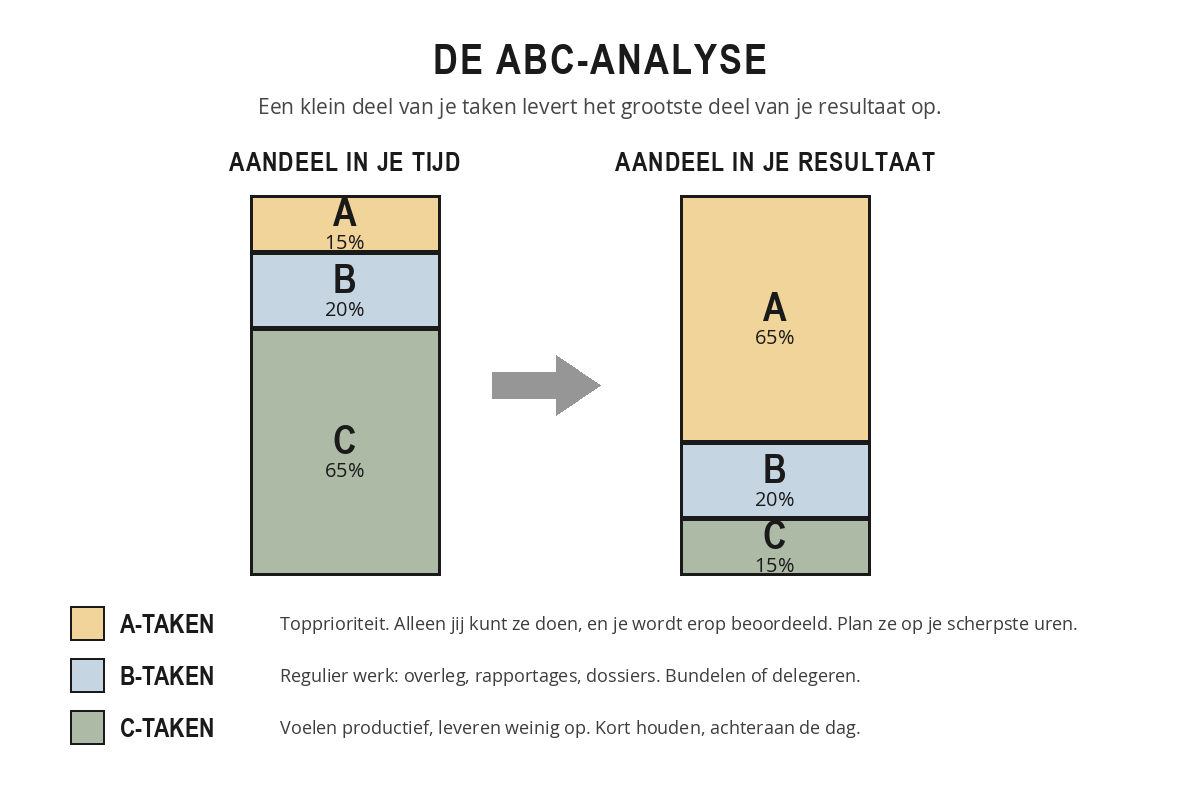
A tasks are your top priorities. They take up about 15 per cent of your time and account for around 65 per cent of your result. These are the tasks you are judged on, where your expertise makes the difference and which only you can do: the client meeting you want to prepare for properly, the quotation that a large assignment hinges on, that one decision you have been putting off for weeks. They are often the harder jobs, because they require thinking. That is precisely why they deserve your best hours.
B tasks sit in the middle: roughly 20 per cent of your time, roughly 20 per cent of your result. This is regular work. Consulting colleagues, standard reporting, recurring appointments, updating files. It is simply part of the job. The only question is whether you should be the one doing it. Some of it can be delegated perfectly well, and the rest goes faster if you bundle it: ten emails in one block takes less time than switching ten times.
C tasks are the silent time-eaters. They sometimes take up as much as 65 per cent of your time, while delivering only 15 per cent of your result. The colleague who just wants to ask something, an email that was not meant for you, a meeting where you add nothing, tidying up what has already been tidied. C tasks feel pleasant: they are small, manageable and give you the sense that you are making progress. That is why many people take refuge in them when an A task is actually waiting for them.
Sander is a team leader and has a busy Monday. On his list: preparing an appraisal meeting with someone who wants to leave, answering 32 emails, ordering a coffee machine for the department, finishing the quarterly report for the board, reading through the minutes of the last meeting and tidying his desk. With the ABC analysis he sees it straight away: the appraisal meeting and the quarterly report are A, that is what he will be held to account for. The emails and the minutes are B. The coffee machine and the tidying are C. Yet last week he started with the tidying, because that is easier than preparing a difficult conversation.
The order is where the gain is
The power of the analysis lies in that skewed ratio: your biggest result comes from your smallest investment of time, provided you spend that time on the right tasks. In practice it often works the other way round. You start with C because it is simple, you do some B because colleagues ask for it, and by the end of the day you have no time, energy or focus left for A.
The shift lies in the order. Schedule your A tasks for the time of day when you are sharpest, usually the morning. Set aside a fixed block for B work, after lunch for example. And make an agreement with yourself that C tasks may only be done in between, or in a short block at the end of the day.
Take your task list for today or tomorrow.
- Put an A, a B or a C after each task.
- Estimate how much time you spend on each category.
- Compare your distribution with 15, 20 and 65 per cent. Is most of your time going into C?
- Choose one A task to start with first thing tomorrow morning, before you open your email.
Keep your list. Check at the end of the day whether you managed it, and if you did not: what held you back?
Summary
- Effectiveness is about what you do, efficiency about how you do it.
- The order is always effectiveness first, then efficiency. Being fast at pointless work gets you nowhere.
- Being busy is not a measure. The question is what you have achieved, not how much you have cleared away.
- A tasks: about 15 per cent of your time, 65 per cent of your result. Only you can do them.
- B tasks: roughly 20 to 20. Regular work, partly to be delegated or bundled.
- C tasks: up to 65 per cent of your time, 15 per cent of your result. They feel productive but deliver little.
- Schedule A for your sharpest hours, B in a fixed block and keep C short.
Someone works for two hours, focused and without errors, on a report that in the end nobody needed. How would you describe that?
According to the ABC analysis, which ratio applies to A tasks?
Why do many people start their day with C tasks, even though these deliver little?