


3. Setting priorities with the Eisenhower model
Dwight D. Eisenhower once put it like this: what is important is seldom urgent, and what is urgent is seldom important. That single observation is the basis of one of the best-known prioritisation models in the world, and it still works.
After this chapter:
- You know how the Eisenhower model is structured and which two questions come together in it.
- You can place any given task in one of the four quadrants.
- You recognise which quadrant you habitually spend too much time in.
- You understand why quadrant II is the heart of good time management.
- You know exactly what to do with a task in each quadrant.
Important versus urgent
The model works with two simple questions you can ask about every task. Is this task important? And is this task urgent? You combine those answers in a two-by-two matrix, and out come four quadrants, each calling for different behaviour.
The difficulty lies in the distinction between those two concepts, because they often feel the same. A task is important if it contributes to your goals, your results or your longer-term responsibilities. Important tasks have a lasting effect: writing a strategic plan, having a proper conversation with a member of staff, investing in your own development. A task is urgent if it is demanding attention right now. There is a deadline, the phone rings, an email pings in, someone is standing at your desk. Urgency shouts, and you feel it in your body.
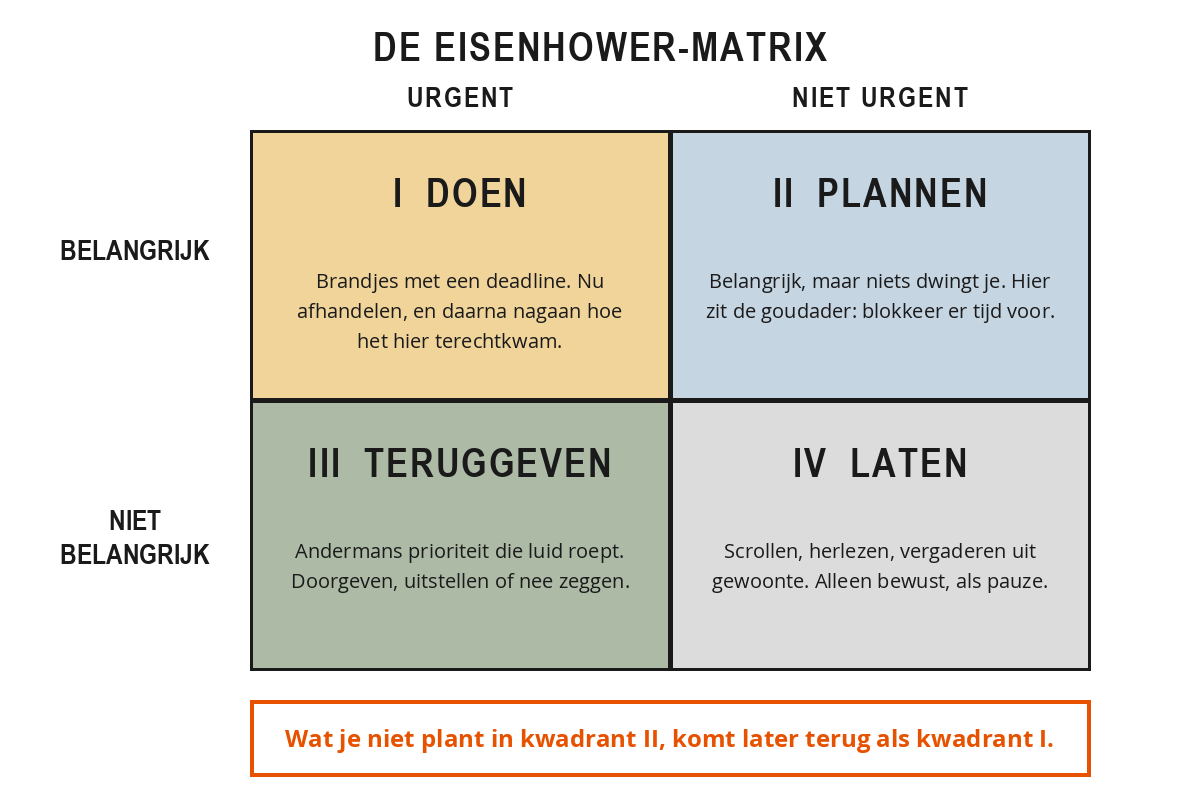
Quadrant I, important and urgent. This is the quadrant of the fires. A client with an urgent problem, a report that has to be on the table tomorrow, a fault you have to fix right now. You cannot postpone these tasks and they have to be done by you. A bit of quadrant I is part of any job. But if your whole day consists of it, you are living in permanent crisis mode: you run from fire to fire, feel productive because you are doing a lot, and by the end of the week you have made no headway on what really matters.
Quadrant II, important but not urgent. This is where the gold lies. Making plans, building relationships, thinking about your work process, taking a course, coaching a colleague, getting your admin in order before it becomes a problem. Quadrant II is where growth is, and quality, and the prevention of problems. But precisely because the urgency is missing, most people push these tasks aside as soon as something comes in that squeaks. You say "tomorrow", and tomorrow something else gets in the way.
Quadrant III, urgent but not important. This quadrant is the biggest pitfall. Tasks that present themselves with urgency but do not contribute to your goals. Usually they are someone else's priorities: the colleague with a quick question, the email marked "by the end of the day please", the meeting you have no real business attending. The treacherous part is that it feels like quadrant I. The urgency is real. But if you take a step back and ask yourself whether this contributes to what you want to achieve today, the answer is often no.
Quadrant IV, not urgent and not important. This quadrant has no winners. Endless scrolling, rereading emails you have already answered, meetings that exist only because they have always existed. A bit of quadrant IV is fine, as a break, but then do it deliberately. Not as an escape route from I or II.
Sanne is a team leader and goes through her list at the end of the day. The response to a complaint that has to go out within 24 hours: quadrant I. Preparing for next week's progress review: quadrant II. A colleague's question about a file she is not responsible for: quadrant III. Scrolling through her inbox once more to see whether anything new has come in: quadrant IV. She sees straight away that she spent two hours in III that morning because she helped that colleague immediately, while her preparation time in II remained untouched.
A simple test: if you consistently spend little time in quadrant II, you will consistently spend a lot of time in quadrant I. What you do not plan comes back later as a crisis.
From model to working day
Understanding the model is one thing, applying it on a busy day is another. Start with your task list, whether it is in an app, on a note or in your head. Write down everything that is going on today or this week. Do not filter, do not sort, just empty it out.
Then go through each task with the two questions, and answer them separately. Is this important? That is: does it contribute to a goal or responsibility you are held accountable for. Not: does someone else think this is important. And: is this urgent? That is: does this really have to be finished today or tomorrow, or does it only feel urgent because someone just asked for it. The pitfall is that you lump the two together, so that everything that shouts loudest automatically takes priority.
A fixed moment in the day
Eisenhower only works if you do it routinely. Sorting once a week has little effect, because things change too quickly. Two moments work well for most people. At the start of the day, ten minutes: you go through your list, decide what falls where, and choose one or two tasks from quadrant II that you will genuinely tackle today, alongside the unavoidable items from I. And at the end of the day, five minutes: you look back. What did you do, and which quadrants were you mainly in? An hour in quadrant IV is no disaster, but it is a useful insight for tomorrow.
Put that morning slot in your diary as an appointment with yourself and give it a colour. Otherwise it disappears into the first email that arrives, and before you know it you are reacting again instead of planning.
What do you do in each quadrant?
Sorting is step one. After that you also have to act on each quadrant, otherwise it remains administration.
- Quadrant I: do. Block out time, shut out distractions and finish the task. Afterwards, do look into how that task ended up here. Was it always urgent and did you leave it lying around? In that case it was really in II and something went wrong in your planning.
- Quadrant II: plan. This is the hardest quadrant, because nothing forces you. Set fixed blocks in your week for preparation, thinking and development, and treat them just as seriously as an appointment with your manager. That is what they are, in fact, only with yourself.
- Quadrant III: hand it back. This is where assertiveness comes in. Can you hand the task on? Can you say that today will not work but tomorrow will? Many III tasks are someone else's quadrant I, thrown over the fence to you. You are entitled to have an opinion about that.
- Quadrant IV: drop it. Cutting out what can go, and taking a deliberate break instead of sinking into it.
Take this week's task list and divide it across the four quadrants.
- Count how many tasks are in each quadrant and estimate how much time they take.
- Which quadrant takes up most of your time? And which quadrant would you like it to be in?
- Choose one task from quadrant II and block out an hour for it in your diary this week.
- Choose one task from quadrant III and work out how to hand it back, postpone it or decline it.
At the end of the week, check whether that quadrant II block was still there, and if not: what got in the way, and which quadrant did it come from?
Summary
- Important is about contributing to your goals over time, urgent is about demanding attention right now. Assess them separately.
- Quadrant I is important and urgent: do it, and then work out how it ended up there.
- Quadrant II is important but not urgent: plan. This is where growth, quality and the prevention of problems are found.
- Quadrant III is urgent but not important: usually someone else's priority. Hand it back, postpone it or decline it.
- Quadrant IV is neither: cut it, or use it deliberately as a break.
- Whatever you do not plan in quadrant II comes back later as quadrant I.
- Sort for ten minutes at the start of your day and look back for five minutes at the end.
A colleague comes in with a question about a file you are not responsible for, and he wants the answer today. Which quadrant does that fall into?
Why does this chapter call quadrant II the gold seam of the model?
You notice that your days consist almost entirely of quadrant I: one fire after another. According to this chapter, what does that tell you?
Ready for the next step?
You have completed the free starter of Time Management. The next chapter in the full course is Other methods for setting priorities: The zoom-out method, the Ivy Lee method, the two-minute rule, timeboxing and the weekly review.
Take the 2-day course →From €1250,- excl. VAT · with an experienced trainer included