


3. Choosing activating formats
A group that only listens remembers little. Those who do the work learn the most. Learning activities are the tools with which you determine what the participants do, and in doing so you also determine what sticks. Every minute in which you are talking is a minute in which the group produces nothing. Activating is therefore not a decoration of your programme, it is its engine.
After this chapter:
- You assess the activation level of an activity and deliberately raise or lower it.
- You choose a format that fits the phase of the learning cycle your group is in.
- You work with eight families of formats instead of three favourites.
- You recognise a learning activity that is in your programme for its own sake.
- You can set up a statement and a subgroup assignment that do what you want them to do.
Four levels of activation
Formats differ in how much they ask of a participant. That difference is called the activation level. The higher the level, the more the participant has to choose, formulate, make or carry out with others watching.
At level one, receiving, the participant listens, watches or reads. That is necessary in order to take in something new, but nobody is practising. At level two, responding, the participant answers a question, chooses a position or notes something down for themselves. Things start to move, with little risk. At step three, producing, the participant makes something: a rewritten email, a completed analysis, a case from their own work. There is material on the table that belongs to them. At step four, carrying out, they perform the behaviour themselves, in a conversation, a role play or a presentation. That is where the return is highest and the tension is highest.
A session that only operates at levels one and two often feels pleasant and yields little. A session that starts straight at level four drives a group that has not yet experienced any safety up the wall. So you build up: responding before producing, producing before performing.
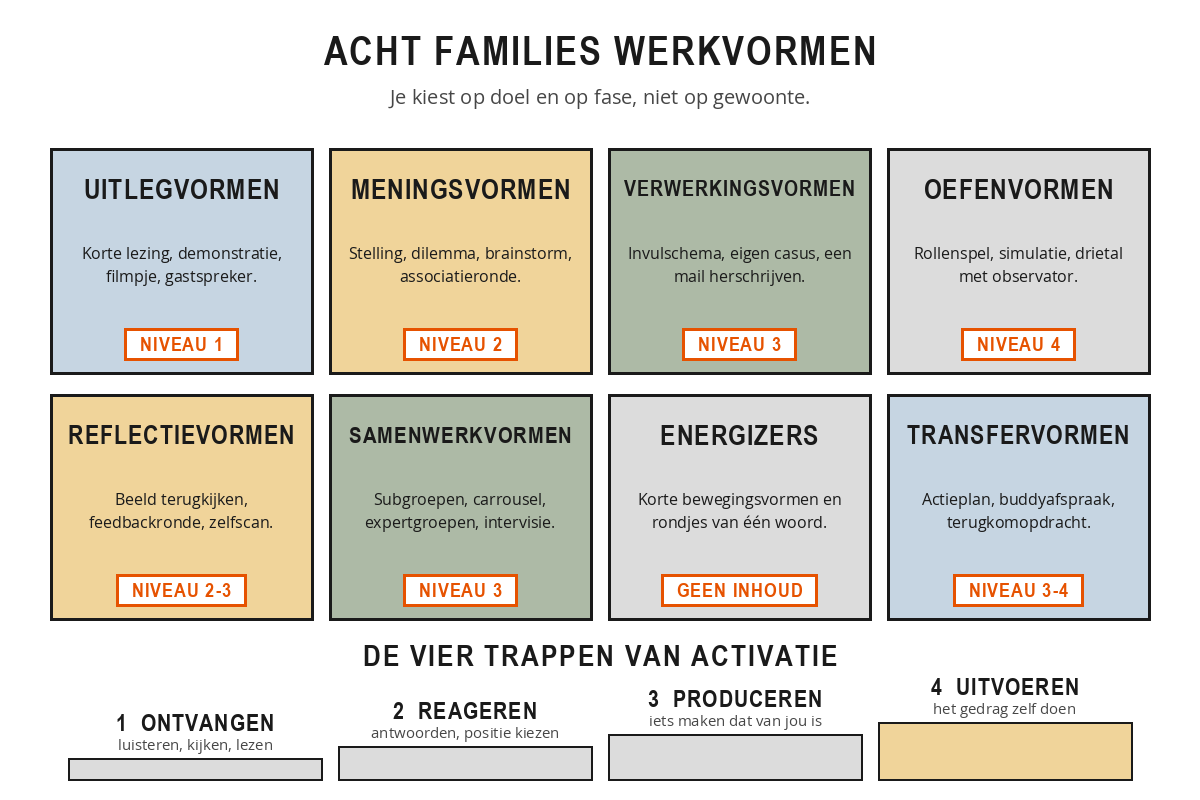
Eight families to choose from
Many trainers work with three or four formats they know well. That is comfortable, and by the third day predictable. A repertoire is the collection of categories you choose from, so that for each element you look for the format that fits your goal rather than your habit. Eight families cover virtually everything you need.
- Explanation and presentation formats: short lecture, demonstration, video, guest speaker. Level 1, intended to bring in something new, in blocks of no more than ten minutes.
- Discussion and opinion formats: statement, dilemma, brainstorm, association round. Level 2, and the quickest way to get the group's experience out in the open before you explain anything.
- Processing activities: a fill-in template, describing your own case, rewriting an email, applying a model to your own situation. Level 3, and the cheapest way to make your explanation land.
- Practice activities: role play, simulation, a conversation in threes with an observer, working with a training actor. Level 4, and the place where behavioural change begins.
- Reflection and feedback formats: reviewing footage, feedback round, self-scan, learning log. Level 2 to 3, the bridge between experience and understanding.
- Collaboration activities: subgroups, a carousel along flip charts, expert groups teaching each other, peer consultation. Level 3, with a lot of output per participant.
- Energisers and group-forming activities: short movement exercises, ice-breakers, rounds with one word. No content-related aim, but a function in the energy and the safety.
- Transfer activities: action plan, Monday-morning scenario, buddy agreement, follow-up assignment. Levels 3 and 4, because this is where the course lands in the job.
A family is not yet a choice. Four questions take you from the eight families to the format that belongs in your session plan. What objective applies to this part, and at what level does the participant have to work to achieve it? Which phase of the learning cycle is the group in now, and which phase do you want to reach next? What can this group handle in terms of safety, and how much time do you really have? And what do you need in terms of space, materials and helping hands to run the format?
The pitfall of fun without a purpose
Learning activities are tempting. A game with cards runs nicely, the energy goes up and the group laughs. The question you ask yourself afterwards is a strict one: which objective from my session plan has come closer as a result? If you cannot answer that question, you have bought twenty minutes of atmosphere. Three signals give away an activity that is in the programme for its own sake. The debrief is a problem, because you do not quite know what to draw out and so you just ask how it went. The substance is in the format and not in the outcome, because the participants remember the game and not the insight. And it fits anywhere: the same format would work just as well in a course on a completely different subject.
Sanne wants her group to see the difference between observation and interpretation. In version A she gives ten minutes of explanation with two examples. In version B she shows a forty-second clip, everyone writes down five sentences in three minutes about what happened, and the group then crosses out in pairs which sentences contain an interpretation. Only then does her explanation follow, in four minutes. Version B takes twelve minutes instead of ten, the explanation is shorter, the activation level goes from 1 to 3, and everyone has their own mistake down on paper. Of the eight participants, seven had written down at least three interpretations without realising it. That experience is stronger than any example Sanne could have come up with.
A statement that opens up the conversation
A statement is an assertion on which participants take a position, agree or disagree, and then justify why. The format takes little preparation, activates the whole group within a minute and brings practical experience to the surface before you have explained anything. It only works if both sides are defensible. If it contains a grain of truth and a misconception at the same time, within two minutes you will hear where the group really stands.
Four characteristics make the difference. A statement claims, it does not ask: "a trainer must master the subject themselves" forces a choice, whereas "must a trainer master the subject?" produces a discussion. It is short and absolute, because words like always, never and must create friction; nuance in the statement itself takes the tension out, because then everyone agrees. It is about behaviour and not about definitions: "resistance means you are going too fast" is about practice, "resistance is a psychological phenomenon" is about words. And it is close to the participant, so that they defend their own choice rather than a position.
You can use the same statement in different ways. With a statement line, one wall is agree and the other disagree, and participants stand where they belong; you interview two people at the extremes and then ask who would like to move. With red and green, everyone gets two cards and holds one up, so that you see the ratio within twenty seconds. With four corners, each corner holds a position, the corners confer for two minutes and put forward their best argument. When facilitating, one rule outweighs all others: you do not ask for the right answer. As soon as the group notices that there is a preferred position, everyone shifts towards it and the discussion is dead. Let people choose individually first and only then talk, because a position that has been stated out loud is harder to withdraw than a thought.
Subgroups and instructions that hold up
In a ten-minute plenary discussion with twelve people, one participant has less than a minute of speaking time, and in practice half of them say nothing. If you split that group into four groups of three, everyone is speaking for minutes on end. That is where the gain lies: more output per participant in the same clock minutes.
The quality of that subgroup work is determined almost entirely by your instruction. Messy assignments produce groups that spend five minutes discussing what was meant. Six elements should always be included. You state the product: what is on the table at the end, three formulated questions, a completed chart, a scene performed? You state the end time as clock time, because "at 14.35 everyone is back here" works better than "you have twelve minutes". You arrange the group composition yourself, because having them sort themselves into groups takes time and produces fixed pairs. You divide two roles, someone who keeps time and someone who will report back afterwards, so that the report back does not end up with the loudest voice. You make the assignment visible on the flip chart or on a card, because spoken instructions have half disappeared after thirty seconds. And you finish with a comprehension check: "who can say in one sentence what you will be delivering?" is sharper than "is that clear?".
Walk past all the groups in the first two minutes. If you do not, you will only discover when they report back that one group has carried out a different assignment. And when they report back, do not ask every group for everything: the first group presents, the rest add what has not yet been mentioned. That saves ten minutes and keeps the attention up.
Online and hybrid
Online, your non-verbal channel largely falls away and the attention span dips more quickly. What is a forty-minute block in a classroom, you cut into chunks of ten to fifteen minutes online, each time with a moment at which the participants do something themselves. Most activities have a digital twin. A line of opinion becomes a poll or a dot on a line on the whiteboard. Red and green becomes an emoji or one word in the chat, with everyone pressing enter at the same time. Subgroups become separate rooms, with the assignment in the chat so that it is there in writing as well. A flipchart round becomes a shared document in which each group has its own heading.
In hybrid set-ups the same problem always arises: the people in the room talk to each other and the online participants look on. Two measures help. You pair each online participant with a buddy in the room who brings them in, or you put everyone on an equal footing by having all participants dial in on their own laptop, including those who are physically present. Also ask someone else to handle the technology, because keeping time, reading the chat and opening rooms cannot be done alongside facilitating a discussion.
Take a half-day session you are about to deliver, or the last one you delivered.
- List all the components one below the other with the planned time next to each, and note the activation level from 1 to 4 for every component.
- Add up how many minutes you spend at level 1 and how many at levels 3 and 4.
- Choose one element at level 1 that takes longer than ten minutes and rewrite it to level 3. Note down what the participants then make.
- Formulate one statement about your subject and write underneath which kernel of truth and which misconception it contains. Test it: does it assert something, is it short, is it about behaviour, and are both sides defensible?
- Write an instruction card for a subgroup assignment containing all six elements.
Finally, note down which phase of the learning cycle you address with the statement and which with the subgroup assignment.
Summary
- The activation level runs from receiving to responding, producing and performing. You build it up and do not let a half-day session stay at levels 1 and 2.
- An activity is not good or bad; it fits a phase of the learning cycle. Four activities in the same phase leave the cycle open.
- Your repertoire consists of eight families, from explanation activities to transfer activities. You choose on the basis of objective, phase, group and resources.
- An activity without a demonstrable purpose in your session plan produces atmosphere and no learning.
- A good statement asserts something, is short and absolute, is about behaviour and can be defended from both sides. Never ask for the right answer.
- A subgroup instruction states the product, the end time, the grouping and the roles, is displayed visibly and ends with a comprehension check.
- Online you work in blocks of ten to fifteen minutes; in hybrid settings you give online participants a buddy or have everyone dial in separately.
Participants rewrite an email from their own inbox using a model you have just explained. Which level of activation does this activity sit at?
According to this chapter, which statement is the most useful for getting a discussion going in the group?
You send four small groups off and, during the feedback, notice that two groups did something other than what you asked. What would have been the best way to prevent this?