


4. Dealing with resistance in the group
Eight participants in a room are never eight separate individuals. Who speaks up and who holds back depends on processes that nobody has put on the programme. A participant who stays silent rarely does so because the subject does not interest him. More often he is weighing the costs: what happens to me in this group if I say that I don't understand this? As long as that calculation comes out unfavourably, your exercise will fall flat, however well you have designed it.
After this chapter:
- You recognise from concrete behaviour which phase a group is in.
- You know which role you take on in each phase and what the group needs from you at that point.
- Read resistance as a signal of an unmet need rather than as an attack.
- You choose an intervention that matches the seriousness of the situation.
- You work with three tracks when the differences in level in your group are large.
The second layer in your room
Group dynamics are the whole of the mutual processes within a group: who has influence, who feels safe, which unwritten rules apply and how the group relates to you. These processes are always there, even if no one names them, and they largely determine what comes of your content. Group dynamics are therefore not a separate topic alongside your programme, but the ground on which your programme rests.
Three things are visible as soon as you look for them. You see the positions: who speaks first, and who does the group look at as soon as something sensitive comes up? You hear the norms: how honestly do people talk, are you allowed to get something wrong here, how strictly is time kept? And you notice the relationship with you: are you seen as an expert, as a resource, as an assessor or as an intruder hired by management?
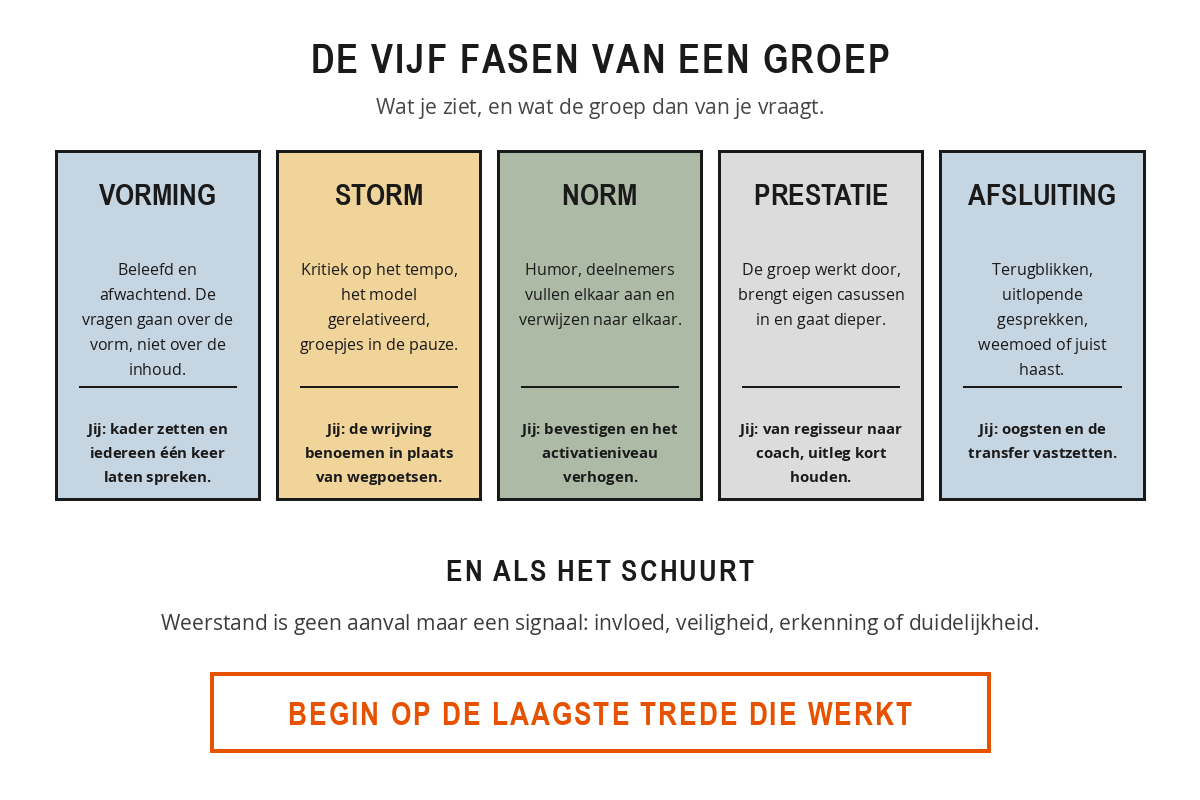
The five group phases
Group phases are the stages a group goes through as it gets used to one another and to the task. They come in a fixed order, but not at a fixed pace: a group whose members already know each other gets through the first phase in ten minutes, while a group drawn from four departments takes half a morning. With a new day or a change in composition the cycle starts again, usually more briefly.
In the forming phase the group is getting its bearings. Participants are polite, hold back and mainly look to you: how strict is this trainer, what will be asked of me? The questions are about the format rather than the content, for example whether they will be filmed later on. This is where you set the framework, say out loud how mistakes will be handled, and get everyone to say something once within ten minutes. Anyone who has heard their own voice in the room once will find it easier the second time.
In the storming phase the group looks for its position, in relation to one another and in relation to you. You notice it in criticism of the pace, in a participant who plays down the model, in someone who checks their phone just a bit too often, in small groups forming their own opinion during the break. This is the most uncomfortable phase and at the same time the most necessary. What the group needs here is for you not to smooth over the friction: you probe the objection, you separate what you can and cannot change, and you state the mutual expectations out loud.
In the norming phase the rules between people have been settled. Humour appears, participants build on each other and refer back to what someone else said earlier. The risk of saying something has dropped. Here you confirm what is going well and raise the activation level of your working formats: this is the place for exercises that were still too threatening in the first phase.
In the performing phase the group works. You hardly need to manage order and time any more, participants bring in their own cases and go deeper in the exercise than your assignment asked for. You shift from director to coach: you walk around, ask questions and keep your explanations short. The biggest pitfall is that you keep leading out of habit and thereby push the group back into their seats. In the closing phase finally the group says goodbye to the temporary safety. You see people looking back, conversations running on and sometimes a touch of wistfulness or, conversely, haste. This is where you harvest the results with the participants and secure the transfer.
The phases are not a straitjacket but a pair of reading glasses. If a group suddenly falls quiet and critical after lunch, that is rarely a judgement on your programme. Often it is the storming phase that only now dares to show itself. It then helps to name the friction out loud, rather than talking faster.
The intervention ladder
The intervention ladder is a series of means for correcting disruptive behaviour, ordered from light to heavy. Light means unobtrusive, without the group experiencing it as a correction. Heavy means explicit, visible to everyone, with consequences for the agreements. The ladder is not an escalation script that you work through from top to bottom, but a menu of options in which you deliberately start on the lowest usable rung. Every rung higher directs more attention to the behaviour and less to the content, and that costs safety. A participant whom you address publicly on rung five when rung two would have sufficed will not open his mouth again for the rest of the day.
- 1 Ignore it and carry on: you let a single side remark or a brief glance at a phone pass. Much behaviour disappears of its own accord, and giving it attention only makes it bigger.
- 2 Non-verbal intervention: you make eye contact, allow a silence to fall or walk calmly towards the two who are whispering. You say nothing and the content continues.
- 3 Changing the working method or pace: you move from your own explanation to an assignment in pairs. Behaviour that stems from boredom is more often resolved here than by any conversation.
- 4 Naming it with the group: you state your observation out loud and without names. "I notice that the energy has gone. What is needed to be able to continue?" The group is given the responsibility, not one individual.
- 5 Naming it with the individual: you address someone directly, in terms of behaviour and without reproach. "Kees, you have now said three times that you already know this. What would you like to do with this hour instead?"
- 6 Conversation during the break: you take it out of the group and approach the person separately. Anything to do with someone's position, motivation or enforced attendance belongs here and not in the room.
- 7 Setting a limit and revising agreements: you stop the programme, make the consequence clear and, if necessary, revise the agreements with the group or with the client.
Before you move up a rung, ask yourself one question: is this behaviour blocking the learning, or do I simply find it annoying? Only in the first case is climbing worthwhile. In the second, the intervention lies with you and not with the participant.
During Marein's explanation of the learning cycle, two participants are quietly talking to each other. She stops mid-sentence and looks in their direction: rung 2. It stops, and two minutes later it starts again. Then she says: "After this slide I'm going to put you to work in pairs, so this is a good moment to start collecting what you recognise." That is rung 3. While walking around, it turns out the two have been discussing their own case for twenty minutes, precisely the material she will need shortly. Had Marein gone straight to rung 5, nothing would have been solved and something would have been broken.
The need beneath the resistance
Resistance is behaviour with which a participant withdraws from what you are asking of them, or openly opposes it. It feels like obstruction, but it is almost always a signal that a need is not being met: influence, safety, recognition or clarity. Address the need and the behaviour disappears. Fight the behaviour and it comes back in a new form.
Resistance rarely arrives as "I don't want this". It arrives as a joke, a question about the agenda or as conspicuous silence. Five translations keep coming up. Behind "that's not how it works where we are" there is usually a need for recognition of one's own practice, and then probing into that situation and taking on the case works. Behind staying silent there is safety, and then you first have people work in pairs and only afterwards in plenary. Behind questions about time and the programme there is a need for overview, so you put the programme up where it can be seen and confirm the anchor times. Behind jokes about the course there is often the wish to retain influence and avoid losing face; laughing along and then asking what he would want differently does more than ignoring it. And behind "I was sent here" there is autonomy: you have that conversation during the break, and together you look for one goal that is his own.
In a group of nine production workers, Karel says twice within the first quarter of an hour that he has been doing it this way for twenty years. The trainer feels the urge to contradict him, but reads it as a need for recognition. He asks whether Karel would describe a situation from last week, and after the break uses that situation as a case for the whole group. Karel is given the role of observer, so that his experience does something instead of getting in the way. In the second round he is the first to volunteer to practise himself. What came in as resistance has become the engine of the session.
Three tracks for differences in level
If your group contains someone with fifteen years' experience sitting next to someone who started last month, your programme is wrong for both: too slow or too fast. Differentiating means keeping the content the same and letting the assignment shift along. You have three tools for this. You varies in difficulty: the advanced participant is given an extra variable or a more difficult conversation partner, the beginner works with a ready-made case. You use experience as a source by giving the advanced participant the role of observer, which makes them look more sharply than a third role-play would. And you directs within the pairs: mixed if you want knowledge to be passed on, equal levels if you want no one to feel small. All tracks then come together in the same debrief, so it remains one group.
Think of one participant you experienced as difficult.
- Describe the behaviour in observable terms: what exactly did he do or say, without your interpretation added?
- Which need do you think lay underneath it: influence, safety, recognition or clarity?
- Which rung of the intervention ladder did you use to intervene?
- Which lower rung had you not yet tried, and what would you have done there in concrete terms?
- Which phase was the group in at that moment, and what role did that phase ask of you?
Finally, formulate one sentence with which you would be the first to name this behaviour in a next group. Write it down word for word, because in the room you have no time to think it up.
Summary
- Group dynamics are the ground your programme rests on: positions, norms and the relationship with you.
- A group goes through five phases, and each phase asks a different role of you: framework setter, conversation partner, confirmer, coach and harvester.
- The storming phase is the most uncomfortable and the most necessary. Smoothing over friction costs you the rest of the day.
- The intervention ladder runs from ignoring, via non-verbal intervention and a change of working method, to naming it, a conversation during the break and only as a last resort a boundary.
- Start on the lowest usable rung and first ask yourself whether the behaviour is blocking the learning or merely bothering you.
- Resistance is a signal of an unmet need: influence, safety, recognition or clarity.
- Where levels differ, keep the topic the same, let the assignment vary and bring everyone back together for a single review.
An hour after the start, criticism of your pace arises, someone plays down your model and small groups form during the break. What is happening here?
Two participants are quietly talking during your explanation. According to the intervention ladder, what is a sensible first step?
A participant repeatedly says: "That does not work that way where we are." According to this chapter, what works best here?
Ready for the next step?
You have completed the free starter of Train the trainer. The next chapter in the full course is From subject expert to trainer: What changes when you move from specialist to trainer, the five success factors of a training course and your own style.
Take the 3-day course →From €1875,- excl. VAT · with an experienced trainer