


2. How people learn according to Kolb
Learning does not happen because you explain something. It happens because someone experiences something, thinks about it, gets a name for it and then does it differently. David Kolb mapped out that movement as a circle of four phases. That model is not theory for the bookshelf: it is the sharpest test you can apply to your own programme, because it shows exactly where your course gets stuck halfway.
After this chapter:
- You describe the four phases of the learning cycle and recognise them in your own programme.
- You will see which phase is usually skipped in your course, and what that costs.
- You will distinguish the four learning styles and the signals by which you recognise them in a group.
- You use the attention span and the power of repetition when structuring a half-day session.
- You design a closing session that increases the chance that something really changes on Monday.
The four phases of the learning circle
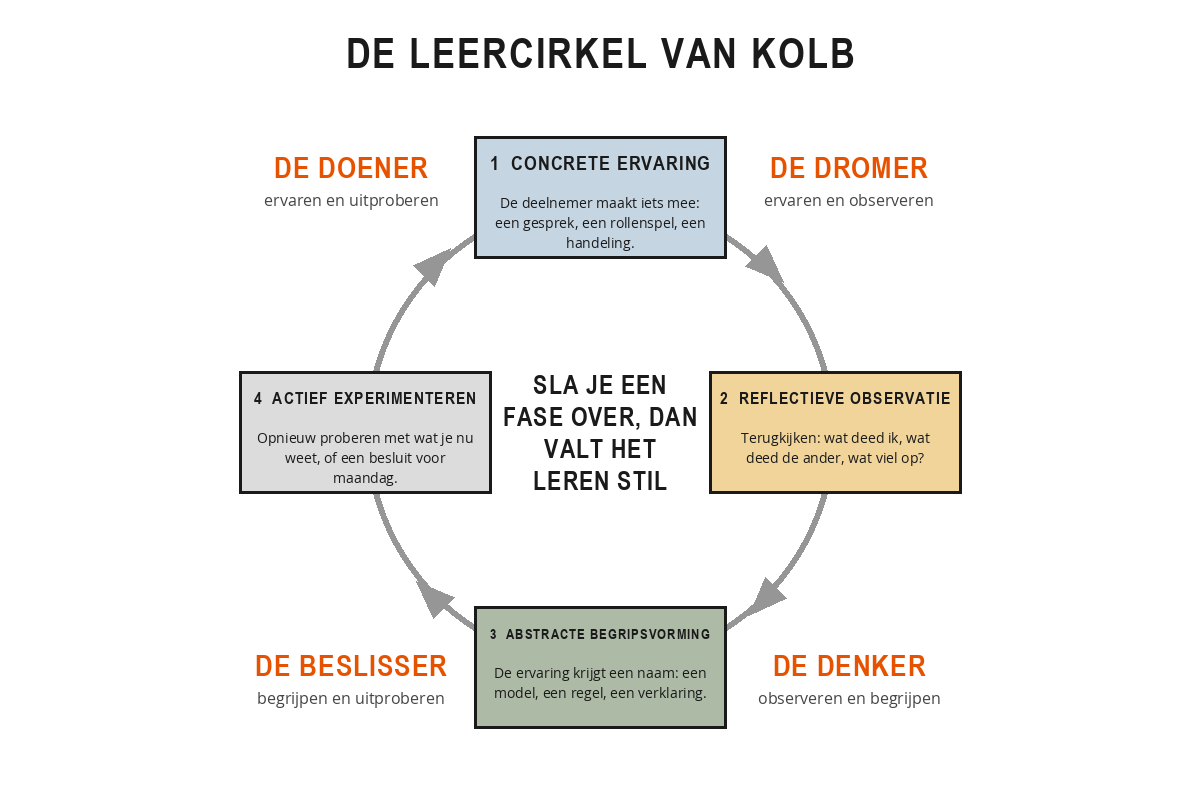
Kolb sees learning as a circle that you go round again and again. Each phase produces something the next phase needs. Skip one and the learning grinds to a halt.
In the concrete experience the participant experiences something: a role play, a conversation, an action he tries out. There is material to think about. In the reflective observation he looks back. What did he do, what did the other person do, what stood out, what felt uncomfortable? This is where the debrief and reviewing the video footage belong. In the abstract conceptualisation the experience is given a name: you link what the group saw to a model or a rule, and that makes it transferable to other situations. In the active experimentation the participant tries again with what he now knows: a second round of the exercise, a sharpened approach, or a concrete plan for Monday. That experiment produces a new experience, and the circle starts all over again.
Where your course breaks the circle
Most courses come unstuck at phases three and four. There is practice, there is a brief chat afterwards, and then the trainer moves on to the next item because the clock is pressing. The experience never gets a name and the participant never gets a second chance to do it better. What remains is a pleasant afternoon without any change in behaviour.
The reverse happens just as often. You explain three models, the group nods, and nothing gets tried out. Without an experience of their own, participants have nothing to hang the model on. It stays in your head instead of theirs. You don't always have to start at phase one, by the way. With a group that already knows the subject, starting with reflection on their own practical experience works fine, and with a technical subject you sometimes start with the theory. The requirement is not where you step in, but that the group completes the circle before you move on.
Two set-ups for the same module on "delivering bad news", both forty-five minutes. In set-up A the trainer spends twenty minutes explaining the model, then has two participants hold a conversation in front of the group and finally asks: "So, how did that go?" There is a short experience for two people and half a piece of reflection. Phase four never comes up. In set-up B the group starts straight away with a conversation in pairs, twelve minutes, so everyone takes part. Each pair then spends five minutes describing exactly what happened at the moment it became difficult. The trainer then takes eight minutes to put the model on the flipchart and asks the group to place their own moments within it. In the final fifteen minutes everyone holds the conversation again, with one deliberately different choice. Same subject, same time, and in set-up B everyone has been round the whole cycle.
The four learning styles in your room
Participants go through the same cycle, but not with the same ease. One phase feels like coming home, another like an obligatory exercise. Kolb calls this preference for two adjacent phases a learning style. For you it explains why the same exercise makes half your group shine and the other half switch off.
The doer sits between experiencing and experimenting. He is the first on his feet for a role play, wants to know what happens if he tackles it differently and has little patience with introductions. You will hear him say: can't we just get started? He would rather skip the reflection, and that is exactly why he needs your questions.
The dreamer sits between experiencing and observing. He takes the situation in, senses the atmosphere and needs time before he says anything. He often comes up with the sharpest observation of the day, but only if you allow a silence to fall or let people confer in pairs first. Under time pressure he fades into the background.
The thinker sits between observation and conceptualisation. He wants to know where the model comes from, how the concepts relate to one another and what the exceptions are. He asks the question that puts your framework under pressure. An exercise without a framework feels to him like muddling through, so he needs the theory before he feels safe enough to practise.
The decider sits between conceptualisation and experimentation. He translates the model straight into his own work and tests whether it holds up in practice. He asks: and how do I do this with an employee who has worked that way for twenty years? With too much theory and no application he loses interest, and with an exercise and no model he finds it too vague.
You are not going to run four programmes side by side. A course that works through the whole circle properly serves all four styles by itself: everyone gets their favourite phase and the phase they would normally avoid. The growth is in that second one, because the doer learns to look back and the thinker learns to try things out. What you do consciously, though, is announce the transitions. If you say there will first be ten minutes of theory and then half an hour of practice, the doer will hold out and the thinker knows the framework will come in time.
In your session plan, put a number from 1 to 4 after each programme element for the phase it serves. If you see only ones and threes, you know where you need to build something in. And with a new group, ask in the opening round: what helps you to learn something, doing it yourself first, watching first, understanding first, or first knowing what it leads to? In five minutes you have a picture of the mix in the room.
Working with the attention curve
The attention curve is the way a group's concentration develops over time. At the start of a block attention is high, then it drops away, and towards the end it picks up a little because the close is in sight. With passive listening the usable peak is short: after fifteen to twenty minutes, retention visibly declines. Whatever comes up in the middle of a long block sticks the least well. This is not a matter of motivation, and it will not be solved by telling a better story.
Every change in working format, position or pace restarts the curve. It can be small: a question to the group, two minutes of discussion with the person next to you, a move to the flip chart, a short assignment on paper. You do not have to change the content for this, only the form in which it arrives. A useful rule of thumb is that every twenty minutes something happens in which the participants have to do something themselves. Note in the margin of your session plan the clock minutes at which such a switch falls; if you see a gap of forty minutes, you know where the dip is going to come.
On top of that, your working memory only processes a few units at a time. Anything you stack on top of that pushes out what was just in there. Three models one after another on a single slide do not produce three models, but at most one plus a vague sense of a great deal. Four things help against this. You chunks: you cut the material into chunks of three to five points and give each chunk a name, because a group remembers "the four G's" more easily than twelve separate instructions. You connects to what is already there by asking about a personal experience before you give the model. You repeats with spacing: what you explained in the morning comes back briefly at the end of the day and once again the next morning. And you add emotion or movement in, because whatever surprises, moves or physically happens takes priority in the memory. An arrangement in the room stays with people longer than the same information in bullet points.
From learning to transfer
Transfer is the moment at which someone starts doing things differently in their own work, in the way they practised during the course. That is the only point at which a course delivers a return, and at the same time the point where things usually go wrong. The energy in the room was fine, and on Monday everyone falls back into the old pattern. There are three causes for this that you will see almost every time: the situation practised did not resemble the real one closely enough, the participant has not recorded anywhere when they are going to do it, and at the workplace nobody notices the new behaviour.
You cannot change that workplace, but you have more influence than it seems. The material you practise with comes from these participants' own practice and not from a standard case. And the fourth phase of the circle is not planned as a closing summary, but as a decision: what are you going to do, with whom, and when. The more specific that decision, the greater the chance it will actually happen.
Two ways of closing the same block on giving feedback, with a group of ten. Closing A takes five minutes: "Does anyone want to share anything else about today?" Four people mention what they found interesting, everyone goes home feeling good. Closing B takes seven minutes: everyone writes down one name, one behaviour they want to raise with that person and one day in the coming week. The group then shares it in pairs, and the pairs agree to message each other on Friday about how it went. At the follow-up morning three weeks later, it turns out that in group B seven out of ten have had the conversation. Two extra minutes, and an entirely different result.
Take a section of forty-five to sixty minutes from a course you have already delivered or will be delivering soon.
- What do the participants do themselves, and how many minutes does that take (phase 1)?
- Where do they look back on what happened (phase 2)?
- Where does that experience get a name or a model (phase 3)?
- Where are they allowed to try again or try differently (phase 4)?
- Which phase stays empty or gets less than five minutes?
Write down in two or three sentences what you are going to cut to make room for that phase. Cutting is part of it: completing the circle takes time that you have to take from somewhere else. Then set side by side how many minutes you are talking and how many minutes the group is actually doing something itself.
Summary
- The learning circle has four phases: concrete experience, reflective observation, abstract conceptualisation and active experimentation.
- Most courses skip phases three and four: there is practice and a brief chat afterwards, but the experience never gets a name or a second round.
- You can step in anywhere; the requirement is that the group completes the circle before you move on.
- The four learning styles are the doer, the dreamer, the thinker and the decider. A full circle serves all four.
- Announce your transitions, and the doer will sit through the theory and the thinker will know his framework is coming.
- Reckon on a change of pace every twenty minutes, chunk your material, connect to what is already there and repeat with spacing.
- Transfer is arranged in the design: participants' own case material, a concrete first moment with who and when, and a repetition after the course.
A trainer explains a model, has the group practise and then briefly asks how it went. Which phases of the learning circle are falling short here?
A participant wants to know where your model comes from and what the exceptions are, and hesitates at an exercise without a framework. Which learning style do you recognise?
You want to increase the chance that participants actually do something differently on Monday. What works best for that?