


Introduction
Selling has a reputation for being a matter of smooth talking. In practice it works exactly the other way round. The salespeople who hit their numbers month after month are rarely the ones doing most of the talking. They are the people who ask good questions, who really listen to the answer, and who only come up with a proposal once they know what lies beneath the customer's question. That is not an innate talent. It is behaviour, and behaviour can be learned.
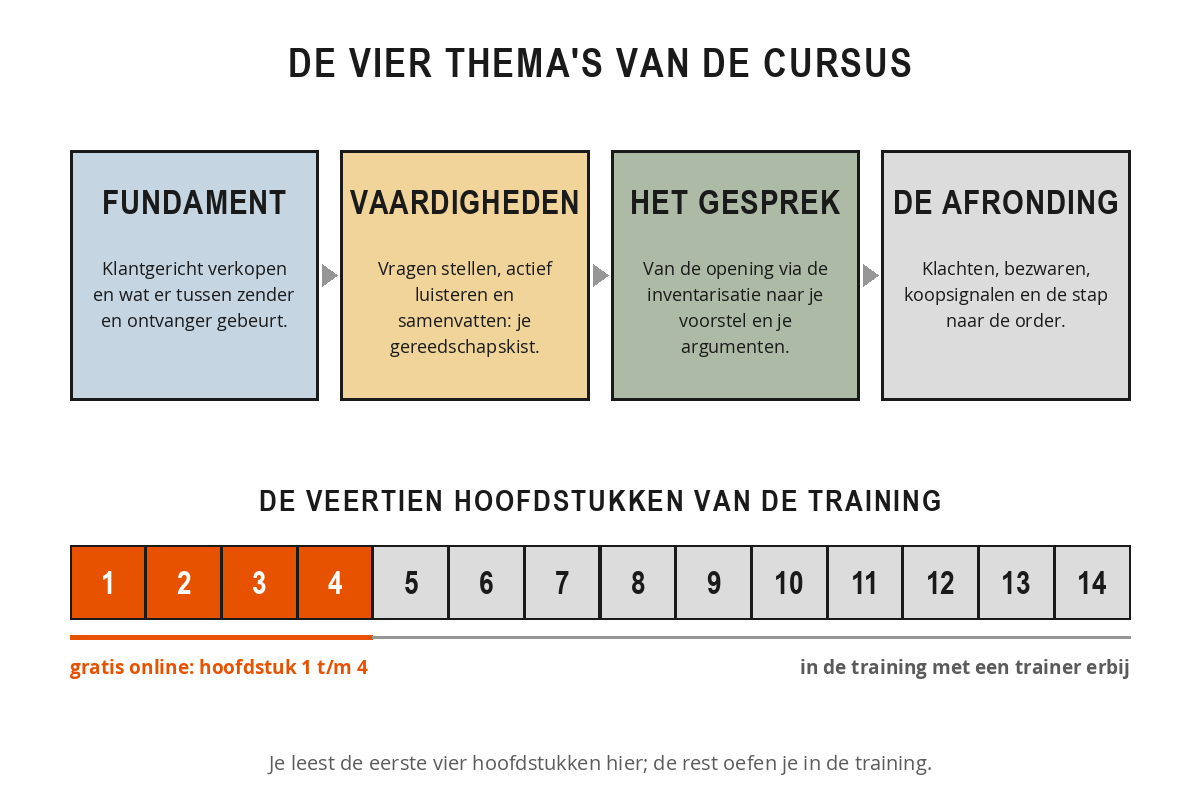
This free course contains the first four chapters: the orange part of the bar above. At the bottom of chapter 4 you will find the full course.
What you will learn
You start with the customer. You learn what customer-focused selling means in concrete behaviour, why a fixed approach gets stuck and how to weigh up the customer's interest against that of your own company in each situation. You then pick up the tools: questioning and listening. You learn to ask an open question that gets the customer talking, you get to know the four closed question forms and you learn the difference between listening that the customer notices and listening that only happens in your head. In the final chapter you bring those elements together in a complete conversation: seven phases, from the preparation to the follow-up, with a ninety-second opening and a sales message that starts from what the customer has told you.
How the course is structured
The course follows four themes that build on one another. You start with the foundation: what customer focus looks like in practice and what happens between sender and receiver. Then come the conversation skills: questioning, listening and summarising, the three techniques that together form your toolkit. You then bring those elements together in the conversation: from the opening through the needs analysis to your proposal. And you finish with the closing: complaints, objections, buying signals and the order. Each chapter contains theory, a model, examples from everyday practice and an exercise that you apply to your own customers.
Practical tips for use
- Keep one specific customer or prospect in mind while you read. With each model, ask yourself how that conversation would have gone if you had approached it this way.
- Keep a notepad or a blank document to hand. The exercises only pay off if you actually complete them, with your own product and your own words.
- Do not read it all in one go. One chapter a week, with a few conversations in between to try it out, works better than reading through it in an afternoon.
- Take two minutes after every conversation to look back. What percentage of the time were you talking, and which question produced the most?
- Start small. Changing one thing at a time is something you can keep up; doing everything differently from Monday onwards is something nobody keeps up.
Each chapter ends with a short knowledge check of three questions: answer them correctly to mark the chapter as completed. Your progress is saved automatically in your browser.
Before you start chapter 1, map out your own starting point. Write down three things.
- Your strongest area: where in the sales conversation do you feel most confident?
- Your weakest element: at which moment do things most often get stuck for you?
- Your goal: what do you specifically want to do differently after this course?
Put those three answers aside and pick them up again after chapter 4.
Enjoy the read, and above all: good luck with your next meeting.