


1. Customer-focused selling
Customers notice within thirty seconds whether the person on the line is thinking along with them. That first impression often determines the rest of the conversation, and sometimes the whole relationship. The odd thing is that at that point nothing has been sold at all. There has only been behaviour.
After this chapter:
- You can explain what customer-focused thinking and acting means concretely in terms of behaviour.
- You know why there is no standard client and therefore no standard approach either.
- You recognise the four sources from which you draw information in every conversation.
- You can weigh up the client's interest against that of your own organisation in each situation.
- You are able to reach a choice in four steps that gives both sides something.
To the client, you are the company
Every time you speak to a customer, at that moment you are the entire organisation. The customer makes no distinction between you, your department and the company on the sign outside. A conversation in which you think along with them strengthens the picture of the whole. A promised call-back that you forget does exactly the opposite, and that applies even if all your colleagues do everything right.
Words like service, customer focus and optimal service delivery sound good, but they mean nothing until you translate them into behaviour. In practice, customer-focused thinking and acting comes down to four things you do. You ask further questions before you advise, so you hold back your solution until you know what the customer is really looking for. You make agreements specific, so you set out who does what and when, and you note it down straight away. You report back, even when the answer takes a while longer. And you put yourself in the customer's situation: you consider what this problem means in their daily work, not what it means for your quotation.
There is no such thing as a standard customer
Clients differ in what they want and in the way they show it. One gets straight to the point, another talks around it at length. One wants to see figures, another mainly wants the feeling that you understand them. So you choose the approach that fits, for each client and each situation. That does not mean giving up your principles. It means adjusting your pace, your tone and your choice of words to the person in front of you.
A fixed approach breaks down in three ways. You miss information, because as soon as you are the one doing the talking the client stops telling you things, and exactly what you needed for a suitable proposal never comes out. You lose the pace, because one client wants to be done in two minutes while another wants to think things through with you first; anyone who imposes the same pace on everyone drives half their clients away. And you lose trust, because a client who notices that a script is being read out to them starts comparing on price. That is the only thing left to compare.
An IT service provider receives two enquiries on the same day for the same maintenance contract of around 18,000 euros per year. The first comes from a facilities manager who writes: "Please send price and lead time." He receives a one-page quotation with the amount at the top and signs within a week. The second comes from the director of a twelve-person agency, who adds: "Things went badly wrong with our previous supplier last year." In his case the account manager calls first. Twenty minutes later it turns out that price is not the issue at all, but availability when there are faults. The content of the quotation is the same, but the order and the emphasis differ completely. Both customers sign. Had the account manager sent both of them the same letter, one would have dropped out.
Four sources in every conversation
To tailor your approach you need information, and you get it from four sources that are available in every conversation. The first is what the client says: the literal question or remark. That is the surface of the conversation and usually not the whole story. The second is how they say it: pace, tone, hesitation, volume. Someone who talks fast and swallows their sentences is in a hurry or under strain. The third is what they do not say. Topics that are conspicuously avoided, such as the budget or a colleague's role, often say more than the rest of the conversation. And the fourth is the context: sector, role, time of year, previous contacts. A buyer in December has different concerns from the same buyer in March.
If you are unsure whether a client wants speed or attention, you can simply ask: "Would you like me to come straight to a proposal, or shall we take some time over it first?" Clients appreciate that question, because they notice that you are adapting to them.
The cost-benefit trade-off
Working in a customer-focused way does not mean the customer always gets their way. In every situation you weigh the customer's interest against that of your own organisation. Those two by no means always coincide, and they do not have to. The point is that you choose deliberately instead of automatically going along with things.
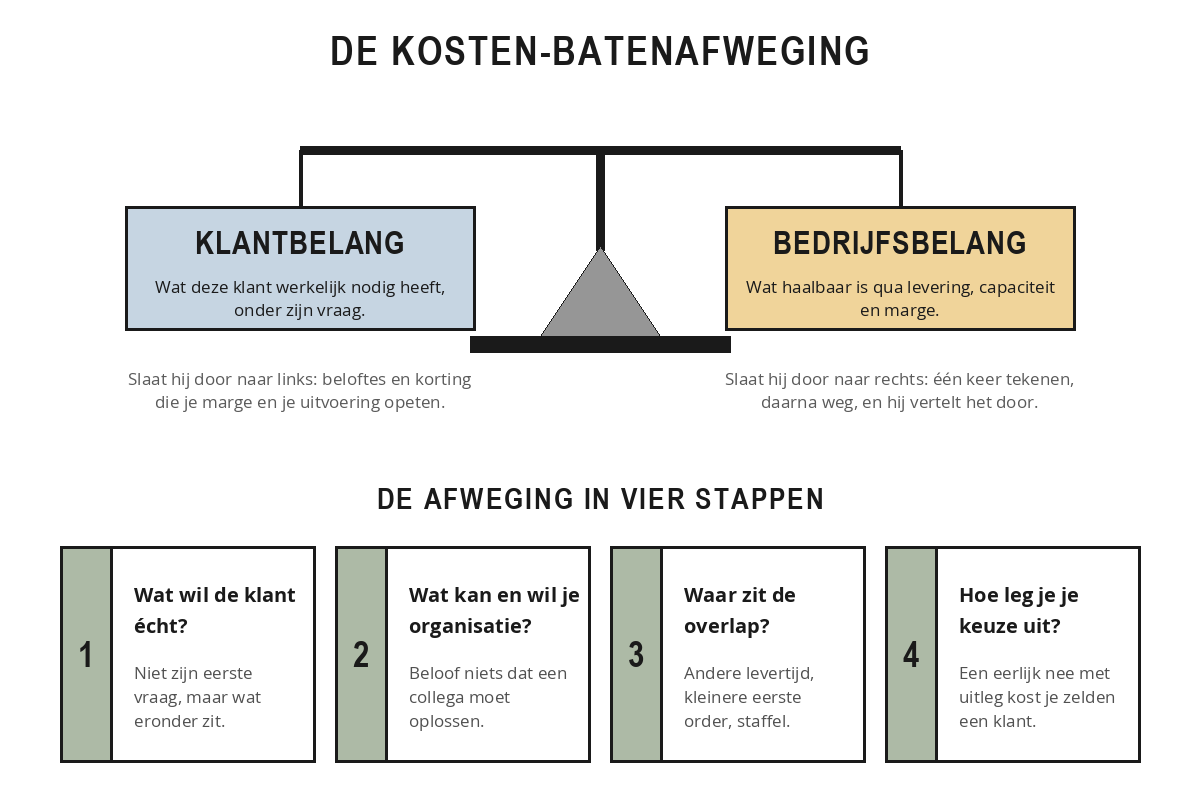
If the scales tip towards the client, you promise delivery times you cannot meet, give discounts that eat into your margin and say yes to work that does not suit you. In the short term the client is happy. In the longer term you deliver poorly, lose money and damage the very relationship you wanted to protect. If the scales tip towards your own company, you push the client towards the product that suits you best. That client may sign once. After that they leave, and they tell others.
That last point is not a soft argument but a calculation. You are rarely the only supplier. Only a satisfied customer stays a customer, and a satisfied customer brings in new customers without costing you any acquisition time. Dissatisfaction also spreads faster than satisfaction: someone who feels short-changed tells more people than someone who has been helped properly.
The four-step assessment
Weighing it up needn't take minutes. In practice you run through this list in a couple of seconds. Step one: determine what the customer really wants. Not what they ask for first, but what lies beneath it. In chapter 2 you will see which questions bring that to the surface. Step two: determine what your organisation can and will do. What is feasible in terms of delivery, capacity and margin? Do not promise anything that you already know a colleague will have to sort out. Step three: look for the overlap. In most cases there is a variant that works for both sides: a later delivery time in exchange for a better price, or a smaller first order. Step four: explain the choice. If you cannot give the customer what they ask for, you explain why. An honest no with an explanation damages the relationship far less than a yes you have to reverse later.
Marleen sells packaging materials. A regular client asks for a ten per cent discount on an order of 40,000 euros, otherwise they will go to the competition. Her margin is eighteen per cent, so a ten per cent discount almost halves her earnings. She works through the four steps. What does the client really want? She asks further questions and hears that they are not so much looking for a lower price, but that their own purchasing budget has been cut per quarter. What can her company do? Hardly any discount, but staged delivery and invoicing is possible. The overlap: the same annual volume, in four quarterly parts, with a three per cent volume discount on the final delivery. The explanation: she says honestly that ten per cent means she will earn nothing at all on this contract. The client signs for a year instead of for a single order, and Marleen is left with fifteen per cent margin instead of eight.
Choose a customer situation in which you recently promised something or in fact refused it.
- What exactly did the client ask for, in their own words?
- What was their real interest, as far as you know?
- What was your own organisation's interest?
- Which way did the scales tip, and why?
- Which overlap option could you have proposed?
Then look at what you now notice, in hindsight, of that choice in the relationship. Is there still contact, and who takes the initiative?
Summary
- To the client, you are the company. They judge the whole organisation by your behaviour.
- You make customer focus concrete in four behaviours: asking further questions before you advise, making agreements specific, reporting back and putting yourself in the customer's situation.
- There is no standard client and therefore no standard approach. A fixed script costs you information, pace and trust.
- You tune in to four sources: what the client says, how they say it, what they do not say and the context they are in.
- In every situation you weigh the customer's interest against the company's interest. Tipping too far one way will cost you either the margin or the relationship in the long run.
- You make the trade-off in four steps: what does the client really want, what can your organisation do, where is the overlap, and how do you explain your choice.
A client conspicuously and consistently avoids the subject of budget. Which of the four sources does that signal come from?
Why, according to this chapter, does a fixed approach end up stuck on price?
You genuinely cannot meet the requested delivery time. What do you do, following the four steps of the trade-off?