


2. Questions that get results
The quality of your information depends on the quality of your questions. If you always ask the same questions, you will always get the same answers. The form of your question determines how broadly or how narrowly the customer may answer, and therefore how much you find out.
After this chapter:
- Can you formulate an open question that gets the customer talking.
- You know the four closed question forms and you know what each form produces.
- Do you know why it is better to avoid the leading question.
- You build a questioning funnel for each topic, from broad to concrete.
- You can tell from the answer that your question was too narrow, too leading or too early.
The open question
An open question is a question the customer cannot answer with yes or no. It forces the other person to formulate something themselves, in their own words and with their own emphases. That makes the open question the most important tool you have for as long as you are still exploring.
You can recognise an open question by its first word. What asks about content and facts: "What happens at the moment when an order comes in late?" How asks about the process: "How does the application work at the moment?" Who asks about the people involved: "Who in the organisation notices it most?" When asks about timing and urgency: "When does this become a problem for you?" And which asks about priority within a list: "Which of those three costs you the most time at the moment?" The word why is an open question too, and a powerful one, but it easily puts people on the defensive. "What made you choose that?" asks the same thing and lands more gently.
With an open question you hear more than just the answer. You also hear where the customer starts, which word he uses three times and which topic he skips. That is information you would never have got from a closed question, because there you decide in advance what it is about. You also hear the language in which the customer thinks about his problem, and you can use that language later in your proposal.
An account manager visits a manufacturing company. He opens with: "I take it you're looking for a faster supplier?" The customer answers: "Yes, that would help." And there he stands, with four words.
The same situation, a different opening: "What do you notice on the shop floor about the current lead times?" The customer replies: "Our planner spends half a day on it every Monday, and last month we sent two shifts home." The second question produces a time investment, a frequency and a cost item. The first question produces one word, and that word came from the salesperson in the first place.
Four closed question types
Closed questions have a bad name in sales training courses, and that is undeserved. They are only unsuitable when you want to explore. As soon as you want to pin something down, choose or confirm, the closed question is exactly the right instrument. There are four forms and all four do something different.
The yes/no question is the shortest. You put forward a statement and the customer confirms or denies it: "Have you received the proposal?" "Do you currently work with a fixed supplier?" The answer is a fact you need in order to move on. The pitfall is that you ask four in a row and turn the conversation into an interrogation. You ask one to pin something down and then carry on with open questions.
With the choice question you give two or three options and the customer picks one: "Would you like the quotation by email, or shall we go through it together?" "Shall we meet on Tuesday morning or Thursday afternoon?" The choice question helps someone make a decision without having to survey the whole field. That works well for scheduling, variants and appointments. It does not work if the customer does not yet know what he wants: you then force him to choose between two things that neither of them fit, and he says no to both.
The leading question already contains the answer: "You think fast delivery is important too, don't you?" "That's a good offer, isn't it?" The customer hears what you want to hear and dutifully says yes, because contradicting you takes effort. After that you know nothing. You have had your own assumption confirmed, not the customer's reality. What is more, many people sense that steering unerringly, and then your credibility takes a knock as well, even though you meant well.
With the checking question you test whether your picture matches the customer's: "Do I understand correctly that delivery time weighs more heavily for you than price?" "So you're saying the decision lies with the board and not with purchasing?" The difference from the leading question lies in your intention and your tone. With a checking question you are genuinely prepared to be told you are wrong; you invite the customer to correct you. That yields two things: your information becomes sharper, and the customer notices that you have listened. The checking question is therefore your most important tool just before you come up with a proposal.
Two sales reps finish the same exploratory conversation with the same customer.
Salesperson A asks: "What you really want is more certainty about delivery, isn't it?" The customer says: "Yes, yes, I suppose so."
Salesperson B asks: "So to summarise: your planner spends half a day every Monday rescheduling, and the cost of downtime weighs more heavily than a few per cent on the price. Is that right, or am I overlooking something?" The customer says: "Price does play a part, but only once we get below four weeks. Above that it doesn't make much difference to us."
Salesperson B gains a condition that changes his whole proposal. Salesperson A gets a shrug and goes home with an assumption.
The questioning funnel
The form of your question is half the work. The other half lies in the order. Within a single subject you always move from broad to concrete, never the other way round.
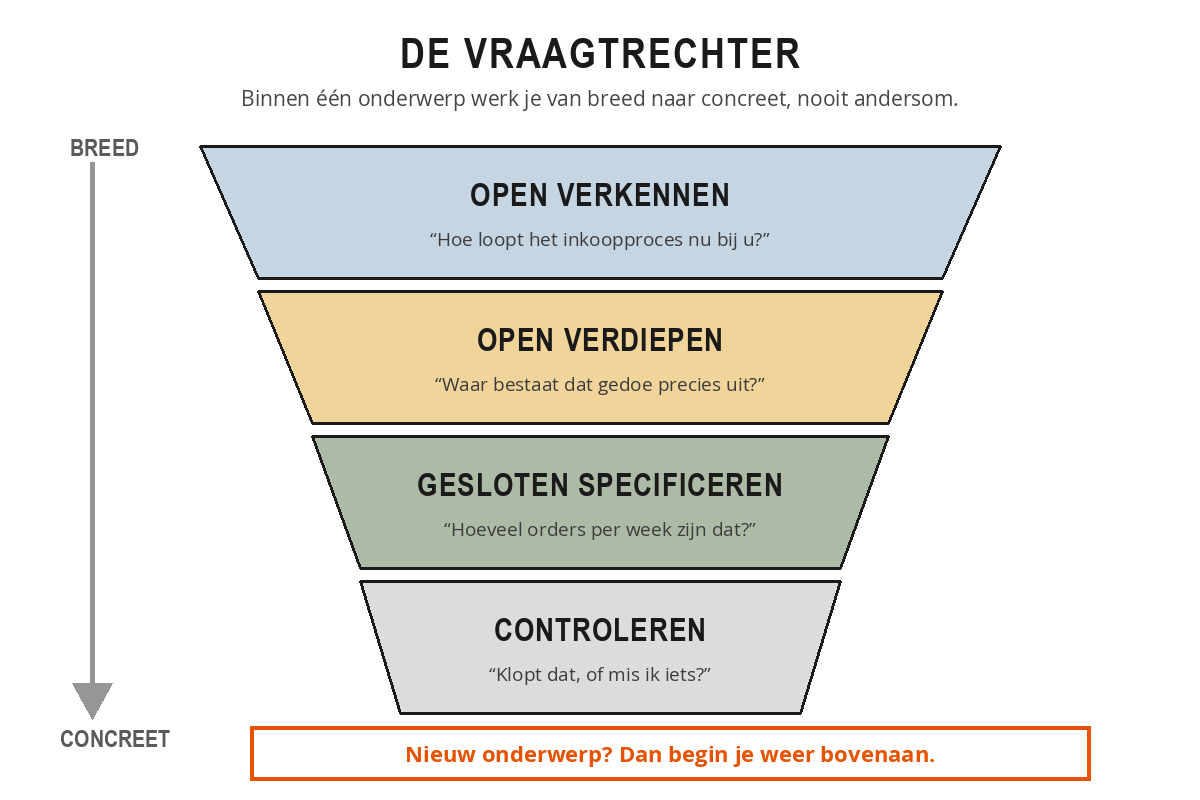
At the top of the funnel sits the open exploring: you put the subject on the table and let the customer choose where to start. "How does your purchasing process work at the moment?" Below that comes the open deepening: you take a word from his answer and dig deeper. If he says "hassle", you ask what exactly that hassle consists of. One layer deeper you go to closed specifying: you record the facts you need in order to do the sums. "How many orders a week is that?" "Does that all go through one supplier?" And at the bottom you find the checking question, with which you test your summary before moving on.
The funnel is not one-way traffic. As soon as a new subject comes up, you start at the top again. A conversation of three quarters of an hour can easily contain three or four funnels in a row.
Seven rules that make the difference
- One question at a time. Two questions in one breath let the customer choose which one to answer, and that is usually the easiest one. You have lost the other one.
- Let the silence stand. After a good open question there is a silence of three to five seconds. That feels long, but in that silence the customer is thinking. If you fill it in yourself, you get your own answer back instead of the customer's.
- Build on the answer. Your next question picks up a word the customer has just used. That shows you are following along and not just working through your list.
- Be careful with why. "Why do you do it that way?" sounds like demanding justification. "What led you to choose that?" produces an explanation instead of an excuse.
- Signal sensitive questions in advance. With turnover, budget or internal relationships, a short run-up helps: "To see what's realistic, I'd like to know something about the budget. What sort of figure do you have in mind?"
- Ask in the customer's own language. Jargon from your world falls outside his frame of reference. He then says yes without knowing what he is saying yes to.
- Record the answers. What you write down you can give back later in your proposal, and the fact that you are taking notes is visible proof that you take the answer seriously.
A simple self-test afterwards: what percentage of the time were you the one talking? If you are above forty per cent in an exploratory conversation, you have asked too little and told too much.
Build a question funnel in advance for a conversation you will actually be having soon.
- Two open exploratory questions with which you open up the subject.
- Two open probing questions for once the topic is on the table.
- Two closed questions with which you establish the facts.
- One choice question for the next step: appointment, variant or approach.
- One check question with which to test your summary.
Then go through your list once more and cross out every leading question. Rewrite it as an open question or as a checking question.
Summary
- Open questions explore, closed questions pin things down. You need both, but not at the same time.
- Open questions begin with what, how, who, when or which. Why works too, but it puts people on the defensive more quickly.
- The four closed forms are the yes/no question for facts, the choice question for a decision, the leading question you avoid, and the checking question that tests whether your picture is right.
- In the funnel you work through each subject from open exploring via open deepening and closed specifying to a single checking question.
- With a new subject you start at the top of the funnel again.
- One question at a time, let the silence stand, build on the answer and write everything down.
You have questioned a topic thoroughly and want to test your picture before making a proposal. Which form of question fits here?
What is the real problem with "You think fast delivery is important too, don't you?"
Halfway through the conversation the customer raises a new topic. What do you do with the questioning funnel?