


3. Active listening
Customers notice within thirty seconds whether you are following their story or simply waiting your turn. That difference lies not in what you think, but in what you audibly and visibly do. You can be listening with the best of intentions and still send out the signal that you are not interested.
After this chapter:
- You know the difference between passive and active listening, and you notice it in yourself.
- Use your audible and visible listening signals deliberately.
- You know why an active listener obtains more information than a passive one.
- You can apply the ten commandments of listening to your own conversations.
- You hear which message lies beneath the customer's words.
Listening that the customer notices
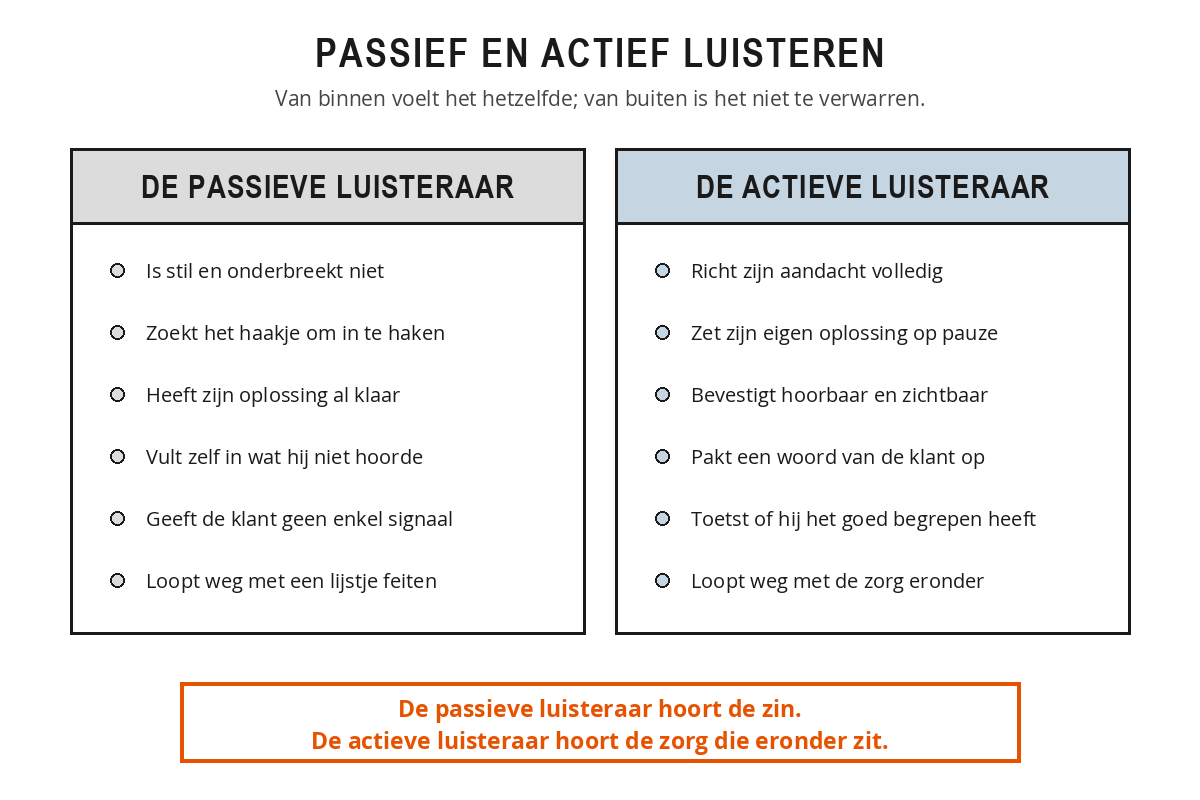
Passive listening is hearing without intervening. You are quiet, you do not interrupt and you let the customer tell their story. From the outside that looks perfectly polite, but the customer gets no signal back at all. They have no idea whether you are following, or whether you will still remember it later. Often, in that silence, you are busy with your own answer or with the next question on your list. The information comes in, but nothing is done with it.
Active listening is listening in which you respond visibly and audibly. You direct your attention fully to the other person, you show that the message is getting through and you check whether you have understood it correctly. That takes effort: you put your own opinion on hold, you step into the customer's world and you build your follow-up questions on what they have just said. The effect is twofold. You get more and better information, because someone who notices they are genuinely being listened to will tell you more. And you build trust, because for the customer, listening is the proof that you are taking their situation seriously.
Audible signals
On the telephone you have nothing but sound. If a silence falls on your side, the client thinks the connection has dropped and starts saying "hello?". You show that you are still there with short acknowledgements such as "yes", "hm-hm", "I see" or "that makes sense". You move with the emotion: "that is annoying", "I understand". You repeat one of the client's words: if they say "tight", you say "tight?" and they carry on. You invite them with "do tell" or "how exactly do you mean that?". And you say audibly that you are taking notes: "one moment, I am just writing this down." Moderation remains important. An acknowledgement at every breath sounds like a machine and has the opposite effect.
Visible signals
If you are sitting opposite the customer, or you have video, the non-verbal side comes into play as well. Your body tells the other person whether they may carry on or need to hurry up. You maintain eye contact without staring. You lean forward slightly at the moment the conversation turns to substance. You nod at the moments that matter to the customer, not at every sentence. You put your phone face down and half close your laptop. And you take notes, putting the pen down for a moment when someone tells you something personal.
Your screen gives away where your attention is. A salesperson who types in the customer system during the conversation is looking at the screen and not at the customer. Make notes on paper and update the system afterwards. You lose two minutes and you win a conversation.
Why the active listener hears more
Two salespeople can have exactly the same conversation and come out of it completely differently. One knows after twenty minutes what keeps the customer awake at night, the other has a list of facts and nothing more.
The passive listener searches the customer's account for the hook they can latch on to. As soon as that hook comes along, they stop listening and wait for the customer to finish. On the inside it feels like listening, and that is what makes it so persistent. The active listener does three things at once. They direct their attention to the customer and put their own solution on pause. They give signals from which the customer can tell they are still there. And they check what they have understood, instead of assuming they have got it right.
That last point is the crux of it. A passive listener hears "we're running up against our capacity" and thinks: they need more room, I'll offer the large version. An active listener asks where that pressure on capacity comes from, since when, and what happens if it stays that way. Only then does it become clear whether this is about growth, about staff absence or about a process that is not running properly. Three completely different problems behind the same sentence, with three completely different proposals.
A customer says: "Your lead time is actually rather long for us."
The passive response: "We can deliver at short notice, at a surcharge of ten per cent." The customer thinks it over and says they will get back to you.
The active response: "Rather long, I hear you say. What do you run into when it takes four weeks?" The customer then explains that their own client has a deadline every quarter, and that only the first delivery really has to be fast. That is a completely different conversation and a completely different proposal: priority delivery on one shipment per quarter instead of a ten per cent surcharge on everything. The customer pays less and the salesperson earns more.
Bram rings an existing customer about a renewal worth 9,000 euros. Halfway through, the customer says: "This year we're looking at this kind of contract rather more critically anyway." Bram is already thinking about his room for discount and replies that he can take five per cent off. The customer does not bite and the conversation ends without an appointment.
Her colleague Ilse gets the same sentence from a different customer. She writes down one word, "more critically", and says: "More critically, what does that look like for you?" What follows is a story about a new controller who wants to know what every contract delivers. Ilse does not send a discount but an overview of the number of reports and the handling times over the past year. The controller signs, at the full price.
The ten commandments for listening
The ten commandments are easy to read and hard to keep to. They all ask the same thing of you: that you move yourself into the background for a moment.
- Stop talking. As long as you are the one talking, you will not learn anything new.
- Put the customer at ease. A calm opening yields more than a sharp first question.
- Show that you are listening. The customer cannot read your mind and needs your signals in order to continue.
- Remove distractions. Phone out of sight, laptop closed, door closed. Distraction literally costs you sentences.
- Put yourself in the customer's shoes. Look at the situation from the perspective of their role and their agenda, not from the perspective of your offering.
- Be patient. Anyone who becomes impatient starts finishing sentences and filling in gaps.
- Keep your emotions in check. If you become irritated, you only hear the criticism and not the reason behind it.
- Do not get into a discussion. You can always respond later; you cannot retrieve what the client has not said.
- Ask questions. Open questions keep the client talking and keep you listening.
- Stop talking. The other nine only work if you take this commandment seriously twice over.
Do you notice that you are already formulating your reply while the client is talking? Then write down the one word you wanted to say. Your thought is parked and your attention returns to the client. Once they have finished, you look at your paper and decide whether that word still matters. Often it does not.
Choose a sales conversation you will be having this week and score yourself immediately afterwards.
- Your estimated own speaking time, as a percentage. Above forty and this was a presentation.
- Which audible signals you used, and how often.
- How often you interrupted the customer, and why.
- Which signal you used least, and what got in the way.
- One concrete commitment to yourself for the next conversation.
Then choose two commandments that you recognisably stumble over and keep to them for three conversations. Afterwards, look at which commandment stuck and which did not.
Summary
- Passive listening is hearing without processing: you wait your turn and fill in the gaps yourself.
- Active listening means directing your attention, giving signals and checking whether you have understood correctly.
- Audible signals are short acknowledgements, moving with the emotion, repeating a word and saying that you are taking notes.
- Visible signals are eye contact, leaning forward, nodding at the moments that matter and putting your screen aside.
- The passive listener hears the sentence, the active listener hears the concern underneath it.
- The ten commandments begin and end with the same thing: stop talking.
Why is passive listening so persistent, according to this chapter?
A customer says: "We are running up against our capacity." What does the active listener do?
You notice that you are already formulating your answer while the customer is still talking. What is the tip from this chapter?