


4. The structure of the sales conversation
A sales conversation that bounces off in all directions rarely produces an order. Structure gives you a grip: you know where you are, what you are still missing and when you can move on to the next step. In this chapter you bring everything from the previous chapters together into a single conversation.
After this chapter:
- You recognise the seven stages of a sales conversation and know the purpose of each stage.
- You know why you only leave a phase once its objective has been achieved.
- You build an opening with a greeting, an agenda, a time agreement and a transition.
- You translate a feature of your product into the advantage and the benefit for this customer.
- You put your arguments in an order that takes the customer with you rather than overwhelming them.
The seven stages
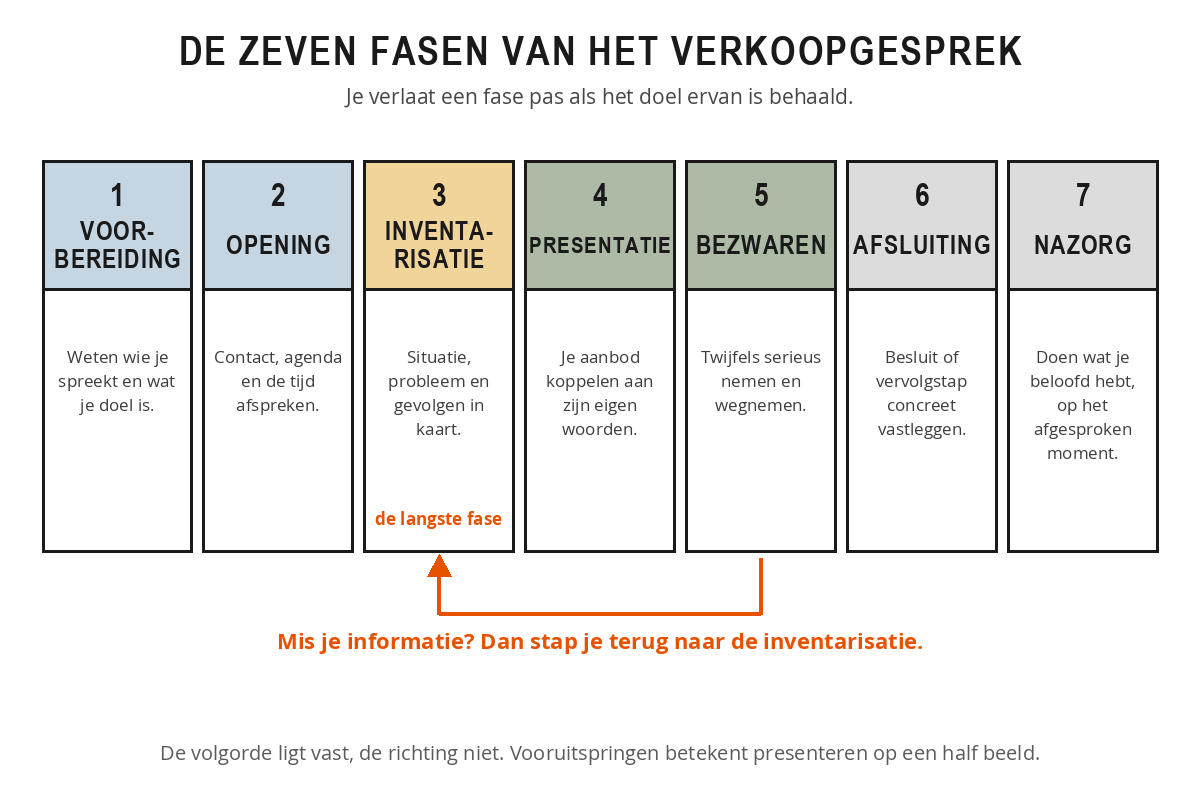
Each phase has its own objective, and as long as that objective has not been achieved there is little point in continuing. In the preparation you gather what you can know in advance: the organisation, the sector, previous contacts and the role of the person you will be speaking to. You determine your objective and your fallback objective. In the opening you make contact, state why you are there and agree how much time is available; that takes two to five minutes and sets the tone for the rest. In the fact-finding you map out the situation, the problem and the consequences with the questions from chapter 2, and you test your picture with a summary. This is the longest phase, and in a good conversation by far the longest.
Then follows the presentation: you link your offer to what the customer has just told you, and you select as you do so, because you do not mention everything you have. In the phase of the objections the customer voices his doubts and you take them seriously. At the closing you set down the decision or the next step in concrete terms. And in the follow-up you do what you promised, at the moment you promised it. That is where the next order begins.
Each stage provides the material with which you can build the next. Without a needs analysis you have none of the client's own words to fill your presentation with. Without a clear opening, the person you are speaking to does not know why they are being asked questions, and keeps their answers short. Jumping ahead is the most common mistake: the client mentions a problem, you recognise it and within two seconds you have a solution ready. At that moment you are presenting on half a picture. The reverse also exists. You keep asking questions while the client has long been ready to hear your proposal.
The order is fixed, the direction is not. If it turns out at the objections stage that the customer has doubts about something you had not picked up on, you step back to the needs analysis. You ask open questions again, you summarise, and then you return to your proposal. That is not a loss of pace, but the repair of a gap in your information.
During the conversation, note in the margin of your notes which stage you are in. Two letters are enough: NA for needs analysis, PR for presentation. If you catch yourself at PR while there are not yet three lines of answers from the client underneath, you are going too fast.
The opening: four building blocks in ninety seconds
The opening is short and carries a lot of weight. In those first minutes the person you are speaking to decides whether to open up or simply sit the conversation out. Four building blocks do the work.
The first is the greeting. You introduce yourself with your name, your company and the reason for your visit, briefly and without any run-up. Your posture, your pace and your eye contact say more than your words do. At the same time you read how much room there is: a customer who stays on his feet and glances at his watch is asking for a short opening. Someone who first fetches coffee and asks about your journey gives you a few minutes to make contact.
The second is the agenda. You explain why you are there, what you want to achieve and what you need from the other person. That gives the client something to hold on to: they now know why you are going to ask so many questions. You state the reason for the meeting in one sentence, in the words of the client or of whoever referred you. You say what you want to achieve in this conversation and what the client gets out of it. And you ask whether there is any subject from their side that should be on the table.
The third is the time agreement: "We have three quarters of an hour, is that still right?" That one sentence stops you from hearing halfway through your presentation that someone else is in the diary in five minutes. And the fourth is the transition. You ask permission to start asking questions and then put your first open question about the client's situation. From that moment on, the client talks more than you do.
"Good morning, Sander de Wit from Verhoef Techniek. Glad this worked out. Your colleague Anja mentioned that the breakdowns on line two have been increasing in recent months. Above all I want to understand how that works out for you, and after that I will show you what we have done for comparable companies. We agreed on three quarters of an hour, is that still right? Good. May I start with a few questions about how things are running now? What does a week with a breakdown look like for you?"
That is forty-five seconds, and all four building blocks are in there: greeting, agenda, time and transition. The last sentence is an open question, and after that Sander says nothing.
From feature via benefit to relevance
Many salespeople tell the customer what their product is and hope that the customer will make the translation to his own situation himself. He does not make that translation. It is your job to take that step for him, and for that you use the chain of feature, advantage, benefit.
A feature is an objective property of your product, service or organisation. It is on your product sheet and is the same for every customer: four branches, a response time of 24 hours, twenty years of experience in a particular sector. An benefit is what that feature does. A response time of 24 hours means a fault is picked up within one working day; that still applies to every client. A benefit is what that benefit is worth to this one client, in their own words, figures and situation. This is where what you gathered in the needs analysis comes back. Without that information you cannot formulate relevance, only a benefit that you throw hopefully into the room.
So you build the sentence from back to front. You know from the conversation that downtime costs this customer 14,000 euros a day. You then look for the advantage that limits that damage, and for the feature that delivers that advantage.
If you are unsure whether you have reached the relevance, use the "and so" test. You add "and so?" after your sentence and see whether an answer still follows. "We have four branches in the Netherlands, and so?" Something still follows. "Our engineer will be with you in Venlo within two hours, and so?" Again, something follows. "You don't have to reschedule any production that day, and so?" Now there is silence. That is when you have reached the relevance.
The order of your arguments
People remember the beginning and the end of a series; whatever is in the middle disappears. Three rules follow from that. Use no more than three arguments per proposal: at four or more the client starts sorting, and they begin with the weakest. You choose the three that come closest to their own words. Put the strongest argument first, because that buys you attention for the rest. And save the second-strongest for the close, so that you end on a high. Your weakest argument goes in the middle, or you leave it out.
Weak: "We have our own engineers on the payroll, four branches and a response time of 24 hours. We also carry out preventive maintenance every year." Four features, not a single benefit, and the customer is left to work out for himself what he gains from it.
Strong: "You told me that a day of downtime costs you around 14.000 euro and that last year you were out of action three times for two days. We set a response time of 24 hours in the contract. Our engineer from Eindhoven will then be with you within two hours, because he is on our payroll and is not in the schedule of an external party. In the worst case you are down for half a day instead of two days. On top of that we come by twice a year for preventive maintenance, so that some of those breakdowns no longer occur."
The same four features, but now in the customer's own sums: three times two days of downtime comes to 84.000 euros, and in the worst case that becomes 21.000 euros. At that point nobody needs telling that the contract is worth having.
Take one product or service that you sell regularly and work it out for a customer you will be speaking to soon.
- Three features, as they appear on your product sheet.
- The advantage per feature: what this feature does, in one sentence.
- The relevance per feature: what it delivers for this client, with their own figure or their own words in it.
- The "and so" test for every benefit.
- The order: which argument opens, which closes, which you leave out.
If you cannot formulate a benefit for one of the three, you are missing information about the customer. In that case, note down which question you still need to ask during the conversation.
Ten tips for the road
- Prepare for the person, not just for the company. Five minutes of searching gives you an opening question nobody else asks.
- Talk less than the client. Thirty per cent of the airtime for yourself is a good guideline.
- Ask the question you would rather not ask: about budget, about the competition, about who else is involved in the decision.
- Summarise before you make a proposal. As long as the customer has not confirmed your summary, you are building on assumptions.
- Sell the benefit, not the feature. Your product sheet is evidence, not a story.
- State your price without hesitating. Anyone who mumbles their own price signals that the amount is too high.
- Be honest about what you cannot do. A limit with an explanation rarely costs you a client; a promise you have to withdraw does.
- Turn every appointment into a next appointment. Before you get up, the date of the follow-up is fixed.
- Write up your notes and your commitment within 24 hours. The customer judges your reliability by what happens after the meeting.
- After a lost order, ask what tipped the balance. That conversation takes five minutes and delivers more than three new leads.
Summary
- A sales conversation follows seven stages: preparation, opening, fact-finding, presentation, objections, closing and follow-up.
- You only leave a stage once its purpose has been achieved. Jumping ahead means presenting on half a picture.
- Stepping back is allowed: you repair missing information with new open questions and a summary.
- The opening consists of a greeting, an agenda, a time agreement and a transition, and fits into ninety seconds.
- A feature is the same for everyone, an advantage is what it does, a benefit is what it delivers for this customer.
- Use no more than three arguments, open with the strongest and close with the second strongest.
You are in the presentation stage and the client raises a doubt about something you had not heard before. What do you do?
"Our engineer will be with you in Venlo within two hours." Where does this sentence sit in the chain of feature, benefit, relevance?
You have five good arguments for your proposal. What do you do with them?
Ready for the next step?
You have completed the free starter of Selling. The next chapter in the full course is The communication model: Sender and receiver, encoding and decoding, noise in the message and the client's frame of reference.
Take the 2-day course →From €1250,- excl. VAT · with an experienced trainer included