


3. Assessing what comes out
An AI answer sounds confident, even when it is wrong. That is the biggest risk in this whole subject: the form suggests authority, while the content may be a guess. Anyone who learns to read as an editor rather than as a reader takes out the errors before someone else finds them.
After this chapter:
- You can explain why an assistant sounds confident when giving a fabricated answer.
- You know which types of questions fabricated facts crop up in most often.
- You recognise skew and know which tasks call for extra attention.
- You can carry out the five checks before you forward anything.
- You know what ownership means when a text has been produced with the help of AI.
Fabricated facts
A fabricated fact is an answer that is incorrect but is delivered in exactly the same fluent tone as a correct answer. The model invents a book title that does not exist, a legal provision that has been repealed, a quotation that was never spoken, a web address that leads nowhere or a figure that rests on nothing.
It does not happen out of ill will. The model predicts word by word what is likely, and where there is a gap in its material, it fills that gap plausibly. It has no mechanism for noticing that it does not know something. That is why no warning comes with it: the model cannot see the difference itself.
There are five places where this goes wrong more often than average. For specific facts: years, names, amounts, article numbers. For source citations: references to books, articles, laws and websites, a category in which the form is very easy to imitate and the content is not. With recent events, which fell after the model's training date. For niche questions, which little has been written about, so the model has little to go on. And with calculations in running text, where the model does not really calculate but writes down a plausible number.
With a factual answer, ask: indicate for each fact where it comes from and how certain you are of that source. In this way you force the assistant to show uncertainty instead of bluffing on. If a source cannot be found or turns out not to exist, you know enough about the rest of the answer.
Policy officer Ilse is preparing a memo on absenteeism. She asks the assistant for figures and is told that absenteeism in her sector "stood at 6.1 per cent in 2024, according to the industry association's annual absenteeism survey". It sounds precise enough to copy across. Ilse checks it: the industry association does not run an annual absenteeism survey. Both the figure and the source are invented, and they are phrased in such a way that nobody in a meeting would question them. She then uses the real figure from the statistics office, which was slightly different. Had she not checked, the board would have been discussing a made-up figure.
Bias
The second problem runs deeper and is less noticeable. A model is trained on texts from the world as it has been written down, with all the prejudices and blind spots those contain. That bias seeps through into the answers.
It works on three levels. In the source: the training material reflects how subjects are written about, not how things ought to be. In the model: patterns that occur frequently are reinforced during training. In the output: your question activates those patterns, and the answer can repeat the bias or even magnify it.
You notice it above all in tasks involving choices between people, groups or points of view: job adverts, appraisals, examples in course material, the cases an assistant invents of its own accord. If you ask for three sample profiles for a role, pay attention to who is mentioned first, which qualities are attributed to whom, and what kind of person does not appear at all.
An important difference from fabricated facts: you cannot look up bias. There is no source stating that the answer is skewed. You only see it by asking yourself who or what is missing.
The five checks
Every output deserves a brief check before you send it on or publish it. Not half a day, but five targeted questions. They are set out below in the order in which you ask them.
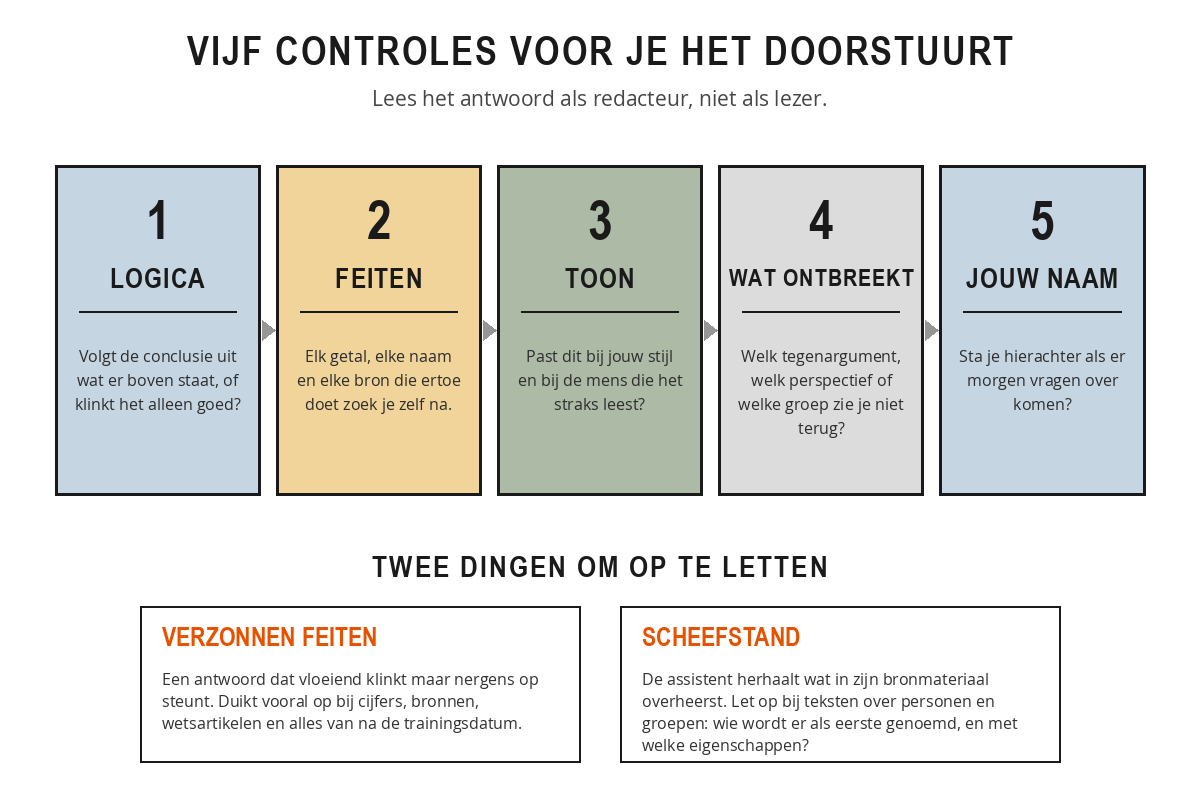
1. Logic. Does the conclusion follow from what comes above it, or does it merely sound good? A model is so strong on form that a text feels coherent while the reasoning is shaky. Read the arguments and the conclusion separately and see whether they belong together.
2. Facts. Every figure, every name and every source that matters, you check yourself. "That matters" is the limit: you do not have to verify everything, but you do have to verify anything someone might rely on. If a figure ends up in a decision, you check it.
3. Tone. Does this fit your style and the person who will be reading it? Assistants tend towards smooth, mildly promotional language with plenty of adjectives. That rarely suits a letter about a rejection, a breakdown or a complaint.
4. What is missing. Which counterargument, which point of view or which group is absent? This is the check people skip, because you have to look for something that is not there. It is also the only check that catches bias.
5. Your name. Would you stand behind this if questions come up tomorrow? If not, it is not finished yet. This question replaces all the others when you are in a hurry.
Team leader Bart has the assistant draw up a job advert for a role in his department. The text reads well. At check 4 something strikes him: three times it says something about "an energetic team player who thrives in a dynamic environment", and nowhere does it say what the person will actually be doing. On top of that, all three example sentences about career progression are aimed at someone at the start of their career, whereas Bart is specifically looking for someone with experience. He cuts the atmospheric words, puts in five concrete tasks and removes the references to age. The assistant had saved him half an hour of writing and handed him back half an hour of editing. Still a net gain, but not because he simply took the text as it was.
You remain the owner
One principle applies to everything you do with AI: you are responsible for what goes out of the organisation under your name. The assistant is a tool, not a colleague and not an expert. "The AI said so" is no defence, not to a client, not to a regulator and not to a colleague who acts on it.
That has a practical consequence that is often overlooked. If you immediately fill up the time you save, the checking never happens. Count the checking as part of the job. A summary that is ready in two minutes and takes five minutes to check is still an excellent trade against the hour it used to take.
There is also a development side to this. This attitude, being able to deal critically with what a model produces, is called AI literacy. It has become as much a basic skill as media literacy or digital skills: something you do not have automatically and that you build up through practice.
Take a text you have had AI produce, or produce one now.
- Go through the five checks and write down what you find for each one. Even if you find nothing.
- For check 2, actually verify at least one fact in a reliable source. Was it correct?
- At check 4, ask yourself who does not appear in the text and what would change if they did.
- Measure how much time the five checks cost you. Compare that with the time you saved.
Do this with every text for a week. After a few times, the first four checks become almost automatic and only the fact-checking still takes conscious effort.
Summary
- A fabricated fact is an inaccuracy delivered in the same convincing tone as a correct answer; the model cannot see the difference itself.
- It happens mainly with specific facts, source references, recent events, niche questions and calculations in running text.
- Ask for sources and for the degree of certainty. A source that does not exist tells you something about the rest of the answer.
- Bias works through the source, the model and the output, and you see it above all in texts about people and groups.
- You cannot look up bias. You only catch it by asking what is missing.
- The five checks: logic, facts, tone, what is missing, and whether you would put your name to it.
- Count the checking as part of the job, otherwise the time you gain disappears into new work.
- "The AI said so" is not a defence. You are and remain the final editor.
Why doesn't an assistant warn you when it makes something up?
What is the essential difference between a fabricated fact and bias?
You are in a hurry and can only carry out one of the five checks. Which question replaces the rest?