


3. Special clauses
Two arrangements cause the most discussion after someone leaves: the non-competition clause and the non-solicitation clause. They only take effect once the employment has ended, and that is precisely when it becomes clear how sharply they were worded. In addition, this chapter covers three clauses that apply during the employment: the secondary employment clause, the penalty clause and the study costs clause.
After this chapter:
- You know the requirements a non-competition clause must meet in order to be valid.
- You recognise when a clause holds up in a fixed-term contract and when it does not.
- You will be able to explain how a court reviews, moderates or annuls a non-competition clause.
- See the difference between a non-competition clause and a non-solicitation clause, and why they fall under the same legal rule.
- Assess whether a secondary employment clause, a penalty clause and a study costs clause will hold up.
This chapter gives a general explanation of the requirements the law sets for these clauses. It is not legal advice. Whether a clause holds up in a specific case depends on the wording, the role and all the circumstances, and a court weighs those itself. A collective labour agreement may also set its own rules. If you want to invoke or rewrite a clause, put it to a lawyer first.
The non-competition clause
A non-competition clause is a written agreement restricting an employee's freedom to work elsewhere after the employment relationship has ended. Usually it involves a ban on working for a competitor, and sometimes also on starting a competing business of one's own. The basis for it is set out in Article 7:653 of the Dutch Civil Code.
The clause conflicts with a fundamental right: the free choice of employment. That is why the legislator imposes strict conditions.
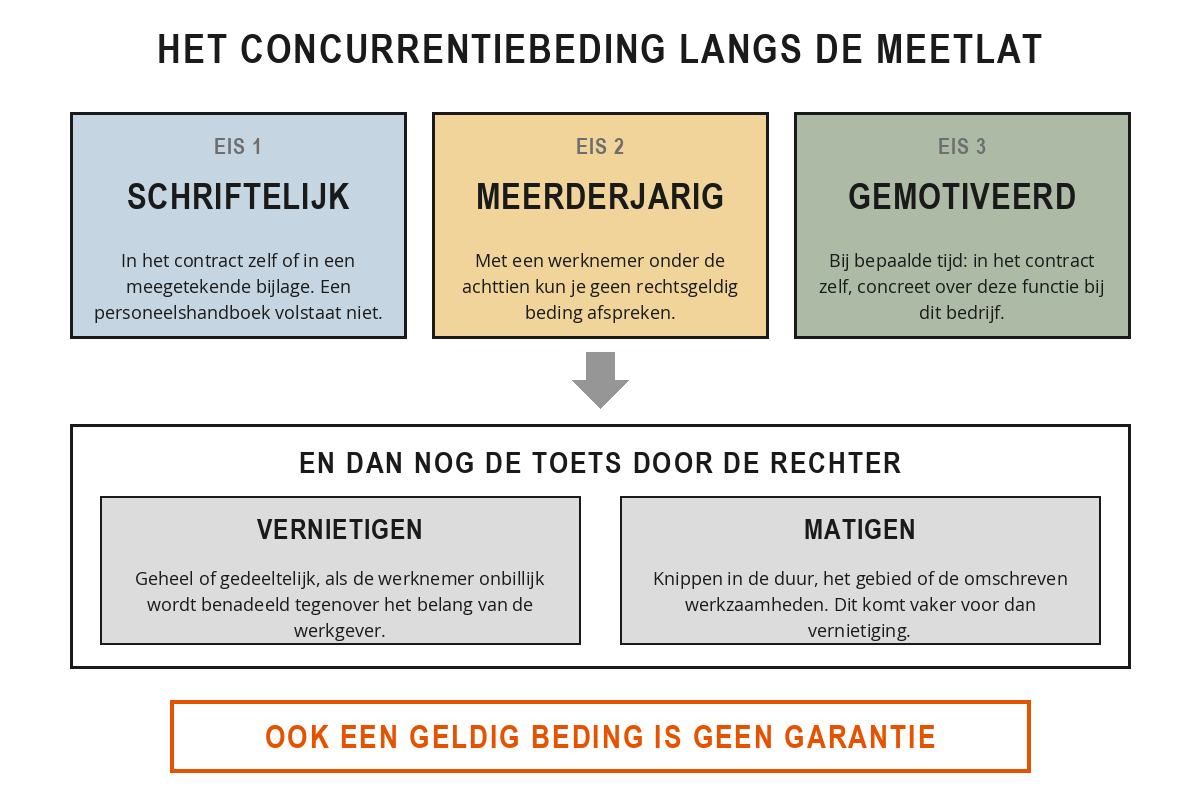
The first requirement is that the clause has been agreed in writing. The written form requirement from Chapter 2 applies in full here: a reference in a staff handbook is not sufficient. The second requirement is that it must concern an employee of full age. You cannot validly agree a non-compete clause with someone under eighteen. The third requirement applies only to a fixed-term contract: in that case a non-compete clause is only permitted if you sets out its reasons in the contract itself which substantial business or service interests make the clause necessary.
That third requirement is most often underestimated in practice. The reasoning must be concrete and must relate to this role at this company. A standard phrase such as "in view of the business interests of the employer" will not do. If the reasoning is missing or too vague, the clause is void and you cannot repair it by sending an explanation afterwards.
What the court does with the clause
Even a valid clause is no guarantee. The court may annul it in whole or in part if the employee is unfairly disadvantaged in relation to the employer's interest to be protected. In doing so, it weighs the employer's interest, such as the client base, pricing information or technical knowledge, against the employee's interest in their new job.
More often than full annulment, you see moderation. The court then cuts back the duration, the area or the activities described. A clause of two years covering the whole of the Netherlands is, for example, reduced to six months within a radius of fifty kilometres.
Two additional rules are important. If the court upholds the clause, it can rule that the employer must pay a compensation pays for as long as the employee is restricted. And if the end of the employment relationship is the result of seriously culpable acts or omissions on the part of the employer, they can no longer rely on the clause.
A change of role calls for extra attention. If an employee takes on a substantially different role, the original clause may become more onerous than was foreseen when it was signed. The clause then loses its effect to the extent that this added burden was not foreseen. So when someone is promoted or moves to another department, you record the clause again.
Sanne signs a one-year contract as an account manager. The contract states: "During the twelve months following the end of the contract, the employee shall not work for a competing business. The employer has a substantial business interest in this." When the contract ends, Sanne moves to a company in the same sector. The employer invokes the clause. The subdistrict court judge rules that the reasoning says nothing about Sanne's role, about what knowledge she is taking with her or about why protection is needed in her case specifically. The clause is void and Sanne can simply start. Had the contract described that Sanne has access to the complete purchase calculations and margin arrangements of the fifteen largest clients, and that this information could be used immediately at a competitor, the outcome might have been different.
The non-solicitation clause
A non-solicitation clause does not prohibit an employer, but certain contacts. After leaving, the employee is free to start work at a competitor, but may not do business with clients, suppliers or other business relations of their former employer. Sometimes a ban on approaching former colleagues is added to this.
Important for your practice: a non-solicitation clause is legally simply a non-competition clause within the meaning of Article 7:653 of the Dutch Civil Code. After all, it restricts the employee's freedom to work in a certain way after the employment has ended. All the requirements above therefore apply in full, including the duty to give reasons in a fixed-term contract. Because the restriction is lighter, a non-solicitation clause does hold up in court more often than a full non-competition clause: the employee can continue to practise his profession and only a defined group of clients is out of reach for a period.
Define the circle of relations as precisely as possible. "All of the employer's relations" is too broad and invites moderation by the courts. A workable formulation is, for example: clients with whom the employee has had business contact during the final twelve months of employment. That wording can be verified and matches the interest you want to protect.
The secondary employment clause
An employee works at another company at the weekend, runs a webshop or takes on jobs as a self-employed contractor. Until 2022, an employer could almost always prohibit this with a single sentence in the contract. Since 1 August 2022 that freedom has gone. Article 7:653a of the Dutch Civil Code provides that a clause prohibiting ancillary activities is void unless there is an objective justification. That rule stems from the European directive on transparent and predictable working conditions, the starting point of which is that what an employee does outside working hours is in principle his own business.
The law does not give an exhaustive list, but four categories apply most often in practice. The first is health and safety: the Working Hours Act sets limits on total working time across all jobs combined. The second is the protecting confidential company information, for example if someone also works for a party with an interest in your client data or pricing. The third is avoiding conflicts of interest: a buyer who spends their evenings working for one of the suppliers is in a position you do not want. The fourth is the integrity of public services, for which additional independence requirements apply in certain public-sector roles.
What is unusual about Article 7:653a of the Dutch Civil Code is the timing of the justification. You do not have to set the justification out in the contract. You may give it at the moment the employee comes forward with a specific secondary activity and you object to it. Even so, it is sensible to include that justification in the clause straight away, because then everyone knows where they stand in advance.
Nadia works 32 hours a week as an application manager. She reports that in the evenings she is starting a small business of her own, building websites for sports clubs. Her employer points to the secondary employment clause and prohibits it. The subdistrict court does not uphold that prohibition. The sports clubs are neither clients nor competitors, no confidential information is involved, and with 32 hours plus a few evening hours Nadia remains well within the Working Hours Act. There is no objective justification, so the clause is void. Had Nadia been an ambulance nurse working 40 hours a week who wanted to add two night shifts a week at a nursing home, the outcome would probably have been the other way round.
An absolute ban is rarely necessary and is legally vulnerable. A notification requirement works better: the employee reports secondary work in writing in advance, and the employer can object if one of the grounds applies. Make that notification requirement complete with a response period, for example two weeks, after which the notification is deemed accepted. That prevents the discussion from only flaring up once the employee has been at it for months.
The penalty clause
A penalty clause attaches a fixed sum of money to the breach of a provision in the employment contract. It is the deterrent behind confidentiality obligations, behind non-competition and non-solicitation clauses and sometimes behind house rules on safety. Its appeal is that in the event of a breach you do not have to prove any loss: the amount is fixed and immediately payable. That is precisely why the legislator has set strict limits on it in Article 7:650 of the Dutch Civil Code.
There are five requirements. The clause must in writing be laid down in writing, both the conduct and the amount. The breach must be described precisely be: "failure to comply with company rules" is too vague, because the employee must be able to know in advance which conduct will result in a fine. The employment contract must state an destination to specify for the money, and this may not serve the personal benefit of the employer or of the manager imposing the penalty; a staff fund or a charity are common. It must be a amount in euros, not a percentage of the salary or an amount at the discretion of management. And there is a maximum per week: within any one week the total of the fines may not exceed the wage in money for half a day, and an individual fine may not exceed that amount either.
The last three requirements are not absolute. If the employee earns more than the statutory minimum wage, you may depart from them in writing. That is why in practice you see clauses of five thousand euros per breach plus five hundred euros for each day the breach continues. For an employee at minimum wage level, those three requirements are mandatory. What you can never exclude is the court's power to reduce the penalty: it may always set the penalty lower, and regularly does so when the amount is out of proportion to the seriousness of the breach or to the employee's income.
Article 7:651 of the Dutch Civil Code also forces a choice. For the same breach you can either claim the penalty or claim the damage actually suffered, but not both at once. Even so, many contracts contain a sentence such as "without prejudice to the employer's right to claim full compensation". That combination conflicts with the law. The solution is an election clause: for each breach, the employer decides whether to invoke the penalty or claim the damage.
The study costs clause
An employee takes a two-year programme costing eight thousand euros at the company's expense and leaves three months after obtaining the diploma. The study costs clause is intended to cover this: the employee repays the training costs in full or in part if they leave within an agreed period. Since August 2022 the scope for this has become considerably smaller.
Article 7:611a of the Dutch Civil Code provides that training the employer is required to offer under the law or the collective agreement (CAO) must be free of charge for the employee. Such training also counts as working time and takes place during working hours as far as possible. A study costs clause covering this type of training is void, even if the employee has duly signed it. Compulsory training includes, for example, safety training, compulsory professional competence under a CAO, and training needed to continue the work if the role changes or ceases to exist. Falling outside this free-of-charge rule are courses someone needs in order to practise a regulated profession, such as the professional training for trainee lawyers.
If the training is not compulsory, you may agree on repayment. In 1983, in the Muller/Van Opzeeland judgment, the Supreme Court set out three conditions for this that remain the standard today. There must be a specified benefit period be: the period during which the employer is deemed to benefit from the training, in practice between one and three years after completion. There must be a sliding scale be: the repayment obligation decreases proportionally as that period elapses. A clause under which the employee still pays the full amount after 23 months and nothing after 24 months will not hold up. And the employee must informed in advance be: before the training starts, they know which costs they may have to repay and under what circumstances.
Even a clause that meets all three conditions may still fail. If the employment ends on the employer's initiative, for example due to a reorganisation, reclaiming the costs is often unacceptable by standards of reasonableness and fairness. After all, the employee did not cause the departure themselves.
State precisely in the clause which costs count: tuition fees, examination fees, study materials, travel expenses. Leave wages for study hours out of the amount to be recovered, because for mandatory training that time counts as working time and for voluntary training it almost always leads to the amount being reduced.
Take three employment contracts or contract templates from your own organisation and go through the clauses.
- Non-competition or non-solicitation: fixed-term or permanent, is there a justification and how specific is it, what duration and what geographical area?
- Ancillary activities: an absolute ban or a duty to report with the option to object? Which objective justification would you cite if someone reported something tomorrow?
- Penalty: is the breach described precisely, is a destination stated, is the amount in euros, and does it contain the prohibited combination of a penalty and full damages?
- Study costs: is there a benefit period, does the repayment taper off over time, and could the training fall under the free training of Article 7:611a of the Dutch Civil Code?
For each clause, note whether it is enforceable, doubtful or almost certainly void. For the weakest clause, draft an improved text of no more than five sentences, and put it to a lawyer before it ends up in the model contract.
Summary
- A non-compete or non-solicitation clause is only valid if it has been agreed in writing with an employee of full age and, in the case of a fixed-term contract, is specifically substantiated in the contract itself.
- The court can annul such a clause or limit it in duration, geographical area and scope of work, can impose compensation for the period of the restriction, and the clause lapses if the employer has acted in a seriously culpable manner.
- A non-solicitation clause falls under the same rule legally, but holds up more often because the restriction is lighter. Define the group of clients precisely.
- A ban on ancillary activities is void without an objective justification. The four grounds that apply are health and safety, confidential information, conflicts of interest and the integrity of public services. A duty to report is stronger than a ban.
- A penalty clause must be recorded in writing, must describe the breach precisely, must name a destination for the money other than the employer, must state an amount in euros and must observe a weekly maximum of half a day's wage. Above the minimum wage you may depart from the last three requirements, but the court can always reduce the amount.
- For the same breach you choose between a penalty and damages, never both.
- As an employer you pay for mandatory training yourself and you cannot reclaim those costs. For non-mandatory training, a defined benefit period, a gradually decreasing repayment obligation and information provided in advance all apply.
- This is general information and not legal advice. A collective labour agreement (CAO) may take precedence, and whether a clause holds up in your case is ultimately for the court to decide. Put a specific case to a lawyer.
A fixed-term contract contains a non-competition clause justified by the words "in view of the employer's business interests". What is the consequence of this?
An employee reports that at the weekend they will be working for a company that has nothing to do with your market. What has been the starting point since August 2022?
An employer pays for a mandatory safety training course required by the collective labour agreement and wants to recover those costs if the employee leaves within a year. Is that possible?
Ready for the next step?
You have completed the free starter of Employment Contract: Rights and Obligations. The next chapter in the full course is The playing field of employment law: Where the rules come from, the hierarchy of the sources of law and the life cycle of an employment relationship.
Take the 1-day training course →From €625,- excl. VAT · with an experienced trainer alongside you