


3. The Roman Room method
You lose track of a shopping list of ten items, yet you could find your way to the copier room blindfolded. The Roman Room method uses precisely that difference. You place information in a room you already know, and retrieve it by walking through that room in your mind.
After this chapter:
- You know where the method comes from and why a space makes a good carrier.
- You can divide a room in your own surroundings into ten fixed memory places.
- You establish a walking route that you always follow in the same direction.
- You know the five rules for a location you can find again without hesitation.
- You can use the six surfaces of a room to remember names.
Where the method comes from
The technique is about two and a half thousand years old. Roman and Greek orators delivered long speeches without any paper. Their solution: they walked in their minds through a building they knew well and placed a part of their argument at each fixed point. While speaking they walked that route again, and the arguments came out in the right order.
Cicero describes the technique and credits its invention to the poet Simonides, who after the collapse of a banqueting hall was able to identify all the victims because he remembered who had been sitting where. It was not the names that were in his head, but the places.
That is also why it works. Without thinking, you know which side of your living room the sofa is on and where the light switch is. A loose list of ten concepts has nothing to hang on to; the same ten concepts spread around a room you have walked into a thousand times inherit the solidity of that room. The collective name for this family of techniques is the memory palace: any space or route you know inside out. The Roman Room is the compact variant, one room with a fixed number of locations in it.
A room with ten memory locations
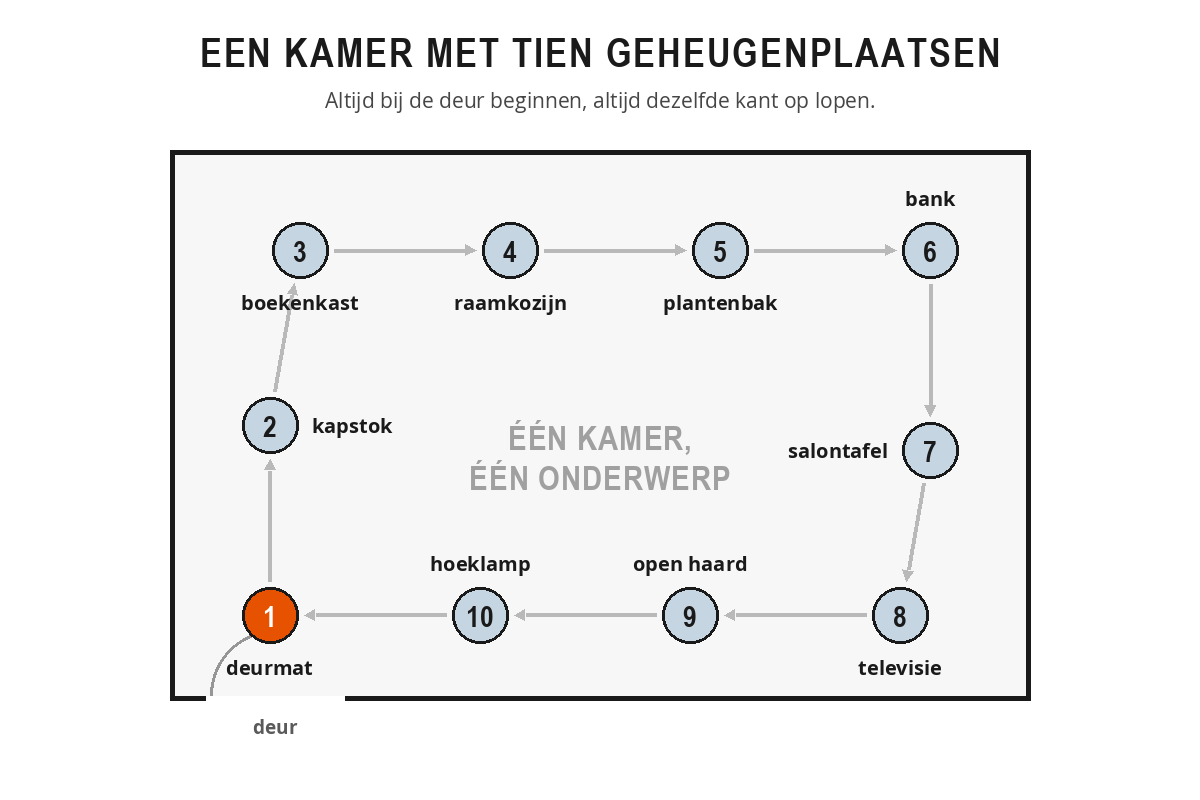
A memory place is a fixed, recognisable spot where you put exactly one piece of information. When looking for places, it helps to divide the room into surfaces first and to choose one or two places per surface: the floor (a rug, the doormat, the skirting board), the ceiling (the light, the smoke alarm, a beam), the door wall (the door itself, the coat rack, the switch), the window wall (the frame, the curtains, the windowsill), the left-hand wall (the bookcase, a painting) and the right-hand wall (the television, the mirror). Within those you add loose furniture: the sofa, the coffee table, the chair.
The route in the drawing above runs as follows: 1 the doormat, 2 the coat rack, 3 the bookcase, 4 the window frame, 5 the plant pot, 6 the sofa, 7 the coffee table, 8 the television, 9 the fireplace, 10 the corner lamp. Ten is a convenient number, because most lists in your work contain between five and ten points.
The order matters at least as much as the places themselves. You always start at the doorway and always walk in the same direction, for instance anticlockwise. That way place 7 gives you the same piece of furniture every time, and you can also recite a list backwards by walking the route in reverse.
Walk the route through the real room three times before you put any information in it, saying the ten places out loud in order as you go. Tap each one with your hand once while you say the number. Movement and touch provide extra ways in besides the image alone, and the route will then be so firmly fixed that you will keep using it for years.
Five rules for a strong location
Almost every failed Roman Room comes to grief on one of these five.
- Immovable. A window frame, a radiator or a fitted cupboard stays where it is. A chair that gets moved every week or a fruit bowl that is sometimes empty loses its place and takes your image with it.
- Distinctive. Two identical locations lead to a mix-up. Four identical dining chairs are therefore not four locations. Choose the chair by the window and leave the other three out.
- Roomy enough for an image. You have to be able to put something on or in the place. A tabletop, a drawer and a lampshade have room. A seam in the carpet does not, and your image literally falls off it.
- Evenly distributed. The distance between any two locations should be roughly the same. If four locations are by the door and six on the other side of the room, those first four will start to shift into one another.
- Imaginable at a glance. You should be able to see the place without thinking. If you have to hesitate over the colour of your own bookcase, the room is not familiar enough.
Another rule that stands on its own: one room carries one subject. Your living room might carry the ten steps of your customer process, your kitchen the agenda for the team meeting. If you mix two subjects in the same room, the images attached to the same location will compete for priority and you'll retrieve the wrong one.
Images that stick
The quickest way to notice that it works is with a list you would normally forget. Two things determine whether an image sticks: exaggeration and interaction. A carton of milk standing neatly on the doormat is too tame to stand out. A carton of milk leaking all over the mat, so that your socks soak it up, does. The image should do something with the location.
Ten items of shopping along the route from the drawing. 1 Doormat: milk is flooding over the mat. 2 Coat rack: bananas hang from the hooks like a curtain and sway. 3 Bookcase: the books have been replaced by bags of rice that are splitting open. 4 Window frame: a toothbrush squeaks as it scrubs the glass. 5 Planter: a gigantic head of broccoli is growing out of the soil. 6 Sofa: the cushions are full of eggs that crack when you sit down. 7 Coffee table: a mound of coffee beans is rolling over the edge. 8 Television: the screen is a melted piece of cheese, dripping. 9 Fireplace: a loaf of bread is baking in the flames. 10 Corner lamp: the shade is a lemon giving off yellow light. Then walk the route twice, once forwards and once backwards. Backwards works just as well, because the places carry the order, not the list of words.
If an image doesn't come back, it is almost always too static or too logical. Cheese on the worktop is logical and therefore disappears. Cheese dripping off your television clashes with what ought to be there, and that friction is what you remember.
First fix your own room: the name of the room, the ten locations in the direction you walk, clockwise or anti-clockwise, and the topic this room is going to carry. Then recite the ten locations three times without looking at your list, and note down the number where you hesitated. That location isn't clear enough yet, so replace it with something more striking.
Then test it like this:
- Have someone write down ten random nouns for you, or take the first ten items from a shopping list.
- Put each word in its corresponding location and turn it into an action: something breaks, flows, grows, smells or makes a noise.
- Walk the route calmly once, in about thirty seconds.
- Do something else for five minutes.
- Write down the ten words in the correct order, and then again in reverse.
For every word you missed, note whether the location was unclear or the image too tame. That distinction tells you what you need to adjust.
Names on six surfaces
Forgetting names almost always happens on arrival, for the reason given in chapter 1: you hear the name while you are still busy with your own introductory line. For a group of five or six people you don't need a whole room. Every room has six surfaces: a floor, a ceiling and four walls. Set a fixed order, for example floor, left wall, back wall, right wall, front wall, ceiling, and always stick to it.
In a round of introductions it works like this. You hear the name and say it straight back in your reply ("Hello Karin"). You turn the name into something visible: Karin becomes a cart, De Bruin becomes a brown bear, Vermeulen becomes a windmill. You stick that image on the next free surface, in your fixed order. You link it to a striking feature of the person: the cart rolls across the floor with her red glasses on the driver's seat. After the round you walk through the six surfaces once and say the names to yourself.
Thijs starts at a new client and on day one is sitting at a table with six people. He uses the meeting room itself as a memory location. Floor: a cart with red glasses (Karin). Left wall: a brown bear leaning against the wall (De Bruin). Back wall: a mill with turning sails (Vermeulen). Right wall: a gigantic key (Sleutjes). Front wall: a bunch of flowers growing out of the whiteboard (Bloem). Ceiling: an anchor hanging from the light (Anker). The next morning he walks through the six surfaces and has five out of six. At the sixth, Sleutjes, he hesitates: the key wasn't attached to anything and wasn't doing anything. He turns it into a key being turned in the wall with a squeak, and the following week he has all six.
With larger groups you divide the table up. The first six names go in the meeting room, the next six in the corridor next to it. That way you stick to the rule of one space for one set, and no two images compete for the same location.
Summary
- Your spatial memory is strong and takes little effort. Information that you place in a familiar room inherits that solidity.
- The Roman Room is a single room with ten fixed locations, walked from the door, always in the same direction.
- A strong location is immovable, distinctive, spacious enough for an image, evenly distributed and imaginable at a glance.
- One room carries one subject, otherwise images compete for the same location.
- Images stick through exaggeration and interaction: the image does something to the location.
- For names you use the six surfaces of the room you are in, in an order that you always keep to.
Why does it work to place a list in a room you know well?
Someone chooses the fruit bowl on the table as their fourth memory location, which is sometimes empty and sometimes standing somewhere else. Which rule is he breaking?
You place cheese on your kitchen worktop and notice that the image has gone the next day. According to this chapter, what is the best adjustment?
Ready for the next step?
You have completed the free starter of Braintraining. The next chapter in the full course is Cognitive fitness: The six dimensions of cognitive fitness and how the load develops over a working day.
Take the 1-day training course →From €625,- excl. VAT · with an experienced trainer alongside you