


2. Steering until it is usable
Many people try to write the perfect prompt in one go, see that the answer is wrong, and then start again. That is the slowest way to get anywhere. Those who work in rounds are usually finished within three messages with something that would never have worked in one go.
After this chapter:
- You know why steering in rounds works faster than starting over.
- You write a follow-up prompt that changes exactly one thing.
- State what should stay as it is, so that you don't lose the good part.
- You understand why a long conversation can let go of earlier agreements.
- You recognise the moment when starting over really is the quickest route.
Working in rounds
Steering in rounds means that you build up a result in steps rather than in one go. You give a prompt, read what comes out, name the difference between what you got and what you wanted, and send a new instruction based on that. That second and any further instruction is called a follow-up prompt: it builds on the answer that is already there and does not start again from scratch.
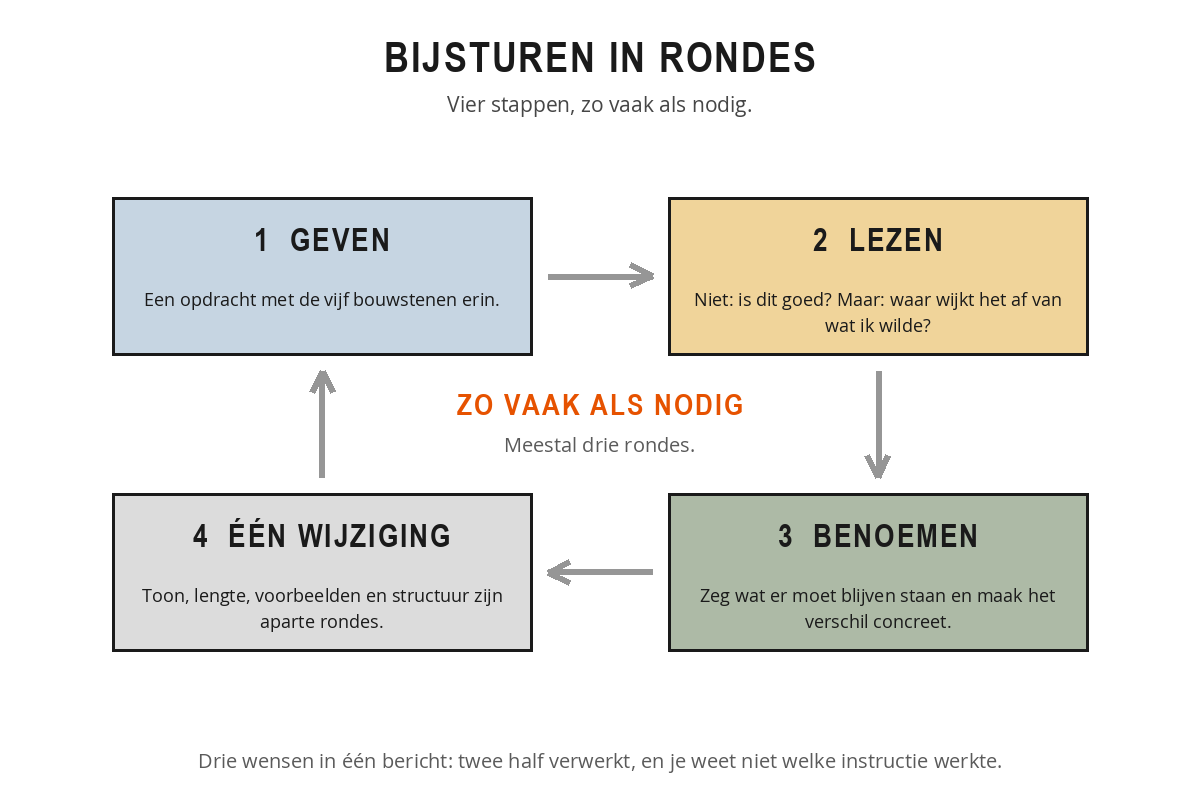
The cycle has four steps. You give an instruction with the five building blocks from the previous chapter. You read the answer, but not to judge whether it is good or bad: you are looking for the difference between it and what you had in mind. You name that difference in words the model can act on, and that is the step most people skip. And then you ask one change, not three. Then you start the cycle again, until it's right.
What makes a follow-up prompt strong
A good follow-up prompt refers to what is already there and changes one thing. Three wishes at once usually produce an answer in which two have been half implemented, and then you cannot tell afterwards which instruction made the difference. Four things help.
- State what you want to keep. "The structure and the first paragraph are right." Without that sentence the model often rewrites everything and you lose the good parts.
- Make the difference concrete. Not "make it better", but "replace the three examples with examples from healthcare" or "remove all sentences over twenty words".
- Change one thing per round. Tone, length, examples and structure are separate rounds.
- Use the answer as a clue. "Paragraph three is exactly the tone I'm after. Apply that to the rest."
Marijke is an account manager and has an email written to a client about a delivery that will arrive two weeks late. The first answer is tidy but limp: three paragraphs of apologies and not a date in sight.
Her first instinct is: "Can you make it a bit more businesslike and shorter, and maybe say something about the new delivery date?" That's three requests in one sentence, and what comes back is shorter, still limp, and the date is only half in there.
What does work, round 1: "Keep the structure. Remove all the apologies after the first sentence and instead state the new delivery date of 14 March as an established fact." Round 2: "Good. Now back to a maximum of 120 words, without losing the delivery date or the name of the contact person." Round 3: "The last sentence sounds like a sales pitch. Replace it with one sentence asking whether 14 March works for them." Three messages, three minutes, done.
Why a long conversation drifts
Everything the model can take in at this moment fits into one window: your fixed settings, all earlier messages in this conversation, the text from any files you sent along and the answer it is currently producing. That window has an upper limit. Whatever does not fit into it simply does not exist for the model.
In short conversations you notice nothing of this. In long ones you do: as soon as the limit comes into view, the window shifts along. The oldest part drops away or is replaced by a brief summary, and the model carries on with a battered picture of what you had agreed. On top of that, every round shifts the emphasis a little. You ask for shorter, then for a more concrete example, then for a friendlier closing. After eight rounds you are reading something that no longer resembles round one in terms of audience, length or tone. That is called drift, and it is not a fault of yours or of the model, it is simply what happens.
The signals
- The tone shifts. The tight style you agreed on in message three loosens up again halfway through and turns enthusiastic.
- The format slips back. You asked for five points of no more than one line each and suddenly you get flowing paragraphs.
- Earlier facts disappear. The model asks for information you have already given twice, or fills it in incorrectly.
- Repetition creeps in. Passages from earlier answers come back almost word for word, because the model can no longer see that it already gave them.
- Forbidden words come back. Terms you explicitly ruled out at the start have crept back in.
If you see those signals, do not stack another correction on top of the previous one, but repeat the framework: "As a reminder: the target group is the team leader, maximum 120 words, no English loanwords. Adjust the latest version accordingly." That is one message and it puts the conversation back on track.
When you should start over
If things keep going wrong after you have repeated the framework, a new conversation is quicker than pushing on. You don't have to lose everything in the process. First ask for an interim position: "Summarise in ten points what we have decided so far about audience, tone and structure." You paste that summary into a new conversation. You then start with a clean window and keep the agreements.
Peter is writing an eight-page grant application and, after an hour and a half, is on message 23. He asks for a tighter summary and gets back a text in which the target group is suddenly "entrepreneurs", whereas in message four they were talking about care institutions. The word "innovative", which he had explicitly forbidden, also appears twice.
Instead of sending yet another correction, he asks: "Summarise in ten points what we have decided about audience, structure, tone and forbidden words." He pastes those ten points into a new conversation with the latest version of the text below them. The next summary is right first time. All in all it took him four minutes; he could just as well have kept pushing on for another hour.
Choose a text that ChatGPT produced for you earlier and that you found half usable at the time.
- Round 1: note what you want to keep and write one follow-up prompt with exactly one change.
- Round 2: assess the result and formulate one change again.
- Round 3: do the same again.
Then note which round produced the biggest leap, and whether you noticed anywhere that the conversation was starting to drift.
Summary
- Steering in rounds is quicker than writing one perfect instruction or starting over again and again.
- The cycle is: give, read, name the difference, change one thing.
- Always say what should stay as it is, otherwise the model rewrites everything.
- One change per round, because otherwise you won't know which instruction worked.
- The model sees only one window; whatever falls outside it does not exist as far as it is concerned.
- You recognise drift by a shifting tone, a format that has slipped back, facts that have disappeared, repetition and forbidden words that have returned.
- Then repeat the framework in a single message. If that does not help, ask for an interim summary and start a new conversation with that summary.
Why do you begin a follow-up instruction with what you want to keep?
After twenty messages the tone is off and there are words in the text that you had forbidden. What do you do?
You have to start a new conversation anyway. How do you hold on to the agreements?