


2. The blueprint of a promotional text
For almost a century, four letters have determined the order of commercial texts: first attention, then interest, then desire, then action. AIDA comes from the advertising world and describes not a type of text but a psychological order. You cannot skip a step, because each step is the condition for the next. Someone who does not look does not read. Someone who does not read does not want. Someone who does not want does not act.
After this chapter:
- You can name the four steps of AIDA and recognise them in an existing text.
- You can see at once which step is missing from a weak text.
- Write an opening that makes a promise instead of taking a run-up.
- You know when AIDA fits and when the model works against you.
- Build a closing that refers back, lowers the threshold and only then asks for action.
The four steps
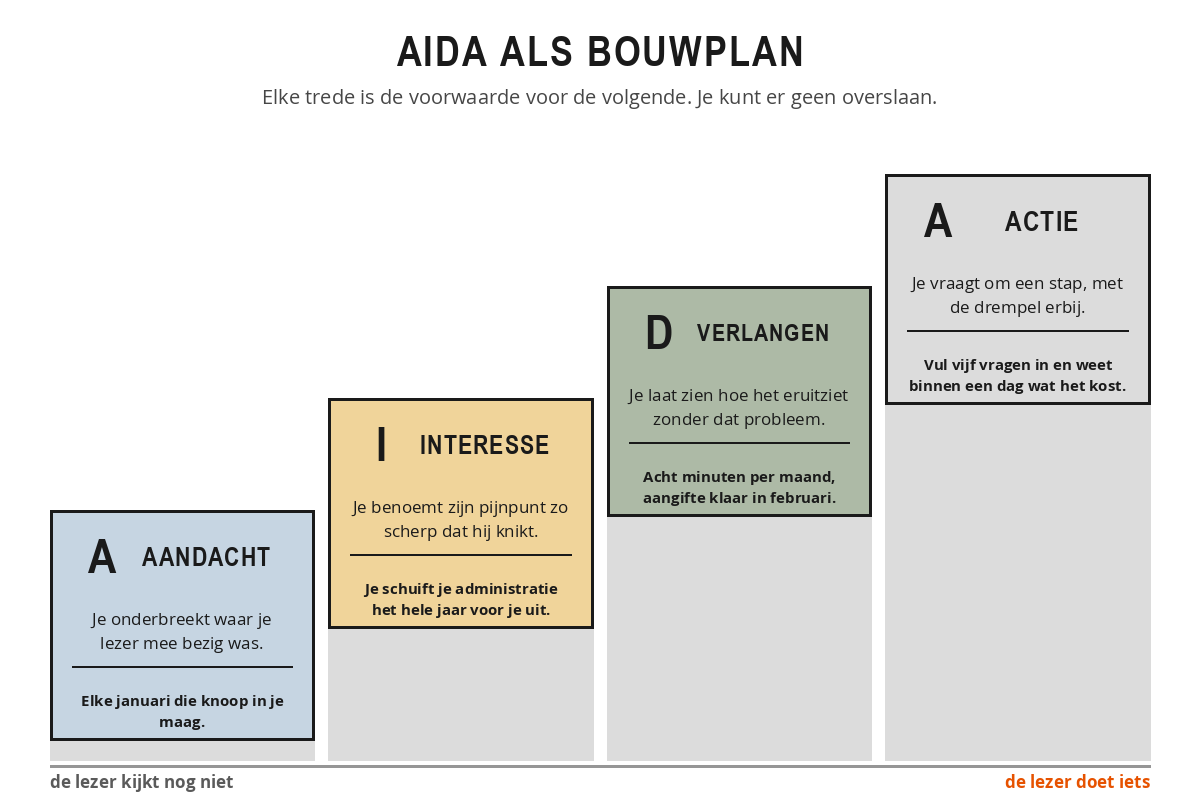
Attention. You interrupt whatever your reader was doing. This is the headline, the first sentence, the first second. There is no room for a run-up, only for a trigger that touches on his situation. Most texts are already lost here, with a first sentence about the sender.
Interest. You make it clear that this is about him. You name his pain point so sharply that he nods without realising it, and you show that you understand the problem better than he expected you to. Recognition is your tool here, not information.
Desire. You show what his situation looks like once the problem is gone. Here you climb the ladder from chapter 1, from feature to meaning, and you put the evidence alongside it. Desire without evidence is hot air; evidence without desire is a specification sheet.
Action. You ask for the step you want. One step, concrete, with the threshold stated. This is the place where copywriters suddenly become polite and where the text therefore peters out.
Why the order cannot be reversed
Most texts that produce nothing jump from A to A. They open with the name of the product and end with "get in touch". The two middle steps are missing, and those are precisely the steps in which your reader decides that this is about him. You are asking for action from someone who does not feel anything yet.
The reverse also happens. Texts that get stuck in Desire: they build up wonderful longing and then let the reader go without telling them what to do next. That is wasted attention, and it happens above all in texts where the writer finds it uncomfortable to ask for something.
An accountancy firm writes an advertisement aimed at freelancers. The first draft: "Administratiekantoor Vermeer has been handling the complete financial administration for SMEs and freelancers since 1998. Contact us for a no-obligation conversation."
That is Attention and Action, without the two steps in between. The rewrite does walk down the staircase. Attention: "That knot in your stomach every January." Interest: "You put off your admin all year, and in January you pay for that with three weekends." Desire: "Our clients submit their receipts once a month via the app and spend eight minutes a month on it beyond that. Their tax return is ready in February." Action: "Request the bookkeeping scan. You answer five questions and know within a day what it will cost you."
The same facts, roughly the same length. The difference is that the second version only asks for something once the reader wants something.
Where AIDA fits and where it doesn't
AIDA is built for texts that ask something of your reader while he has not asked for it: advertisements, promotional landing pages, job adverts, a cold email, an invitation. If your reader is still in the phase where he is discovering his problem, or comparing options, the model does its work.
As soon as your reader is already motivated, AIDA works against you. Someone who looks up a manual himself, or opens a quotation he asked for himself, does not need to be won over. He wants his answer, and quickly. In that case you put the main point at the top and the conditions at the bottom, and you leave out the build-up to a climax. That is a very different blueprint, and the full course covers it in detail.
On short channels you sometimes run through all four steps in two lines. In an advertisement of fifteen words, Attention is your first four words, Interest your next five and Action your last three. The steps shrink, they do not disappear.
The opening with a promise
The weakest point in most texts is the first sentence, because that is usually where the run-up sits: a greeting, a reason for writing, a bit of company history. An opening with a promise does the opposite. You set out what your reader will gain by reading on, and in doing so you make the time you are asking of them worthwhile in advance.
This is how you build one. First you write down in plain words what your reader will know, be able to do or feel after reading. That is your promise. Then you turn that gain into a single sentence that starts with him and not with you. Next you delete everything you had put before that sentence, and that is almost always more than you thought. Finally you check whether the rest of your text actually delivers on that promise, because a promise you do not keep still costs you the reader, with a bad taste left behind.
"In five minutes you will know why four out of every ten of your quotations go unanswered" promises something. "We think it is important to inform our customers properly" promises nothing and costs your reader just as many seconds.
Test your opening by reading it separately from the rest. If that first sentence could just as easily sit above a text written by your competitor, you are not making a promise but a statement.
The balance between opening, middle and close
A text has three parts, and the balance between them is not a law but it is a useful alarm bell. Roughly ten to fifteen per cent opening, seventy to eighty per cent middle, and another ten to fifteen per cent closing. If your opening takes up a third of your text, you need too long a run-up and your promise is probably not sharp enough yet. If your closing is a single line, you let go of your reader at the very moment he is most willing to do something.
A consultancy sends a quotation of four paragraphs. The first two are about the introductory meeting, the third about the proposal, the fourth is a single line: "We look forward with interest to your response."
The ratio is 50-40-10, with an opening that is twice as long as it should be. After the rewrite the first paragraph is still there, but now at the bottom: "This proposal follows on from our conversation of 12 March." At the top it now says: "From mid-May, your eight advisers will write with one recognisable voice. Three half-day sessions, in your own office, with your own client letters as course material. Investment: 4.800 euro." Exactly the same information, a different order.
The closing
Many texts die a quiet death. The writer has told everything, tacks on "I look forward to hearing from you" and clicks send. Yet the closing is precisely the place where your reader is fully present one last time, because he senses that something is about to be asked of him.
A closing that works does three things in succession. First referring back: you repeat the promise from your opening in different words, so that the circle is complete. "You will get those two hours on Monday morning back." Then the lower the threshold: you state what the step will cost them in time, money or commitment. Something that has been stated feels smaller than something the reader has to estimate for themselves. And only then questions: one action, not three options side by side.
What you do not do in a closing is introduce a new argument. Everything your reader needs to know in order to say yes is in the middle. If a surprise still turns up in your final paragraph, it belongs higher up.
Weak closing: "Should you have any further questions, you can of course always contact us. We look forward with interest to your response."
Strong closing: "Your advisers will speak with one voice by mid-May. We'll schedule the first session in consultation. Call 020 6369 293 and we'll put a date in the diary together; it'll take you five minutes."
The strong version picks up the promise again (mid-May, one voice), names the barrier (five minutes) and asks for one thing (a phone call). The weak closing does none of the three, and yet it is the version that gets sent most often.
Take a piece of persuasive copy you have written or sent recently yourself: an advertisement, a job ad, a mailing or a landing page.
- Mark where Attention, Interest, Desire and Action appear. Note down which step is missing or too short.
- Cut the text into three parts and estimate the percentage taken up by the opening, the middle and the closing. Which part is out of proportion?
- Number your paragraphs by importance to the reader, from 1 up to the number of paragraphs. If number 1 is not at the top, move it there.
- Rewrite your opening sentence as an opening with a promise. First note down your promise in plain words, and only then write the sentence.
- Rewrite your closing in three sentences: one that picks up the promise again, one that names the barrier, one that asks for the action.
Show the old and the new version to someone from your target group, with two questions: which of the two keeps you reading, and which one gets you to pick up the phone? Note down his reason as well, because that is worth more than his choice.
Summary
- AIDA stands for attention, interest, desire and action. Each step is the condition for the next, so you cannot skip any of them.
- Texts that deliver nothing usually jump straight from A to A: product name at the top, "contact us" at the bottom, nothing in between.
- Getting stuck in desire is the opposite mistake: desire built up without a request is attention wasted.
- AIDA suits readers who have not asked for it. If your reader is already motivated, put the main point at the top instead of trying to win him over.
- An opening with a promise says what the reader gains and starts with him. Everything that came before it, you delete.
- Aim for roughly 10 to 15 per cent opening, 70 to 80 per cent middle and 10 to 15 per cent closing.
- A closing picks up on what came before, lowers the threshold and only then asks for one action, without introducing new arguments.
An advertisement opens with the company name and closes with "contact us for a no-obligation conversation". According to this chapter, what is wrong with it?
You are writing a quotation the client asked for himself after a good conversation. What do you do with AIDA?
Which closing follows the three movements from this chapter?