


Introduction
Conversations are the work. Whether you are managing colleagues, advising clients, delivering bad news or simply trying to make your point in a meeting: how you conduct the conversation largely determines what comes out of it. Some conversations run smoothly of their own accord. Others get stuck, and only days later do you notice that your message never landed the way you meant it. That is good news, because conversation techniques can be learned.
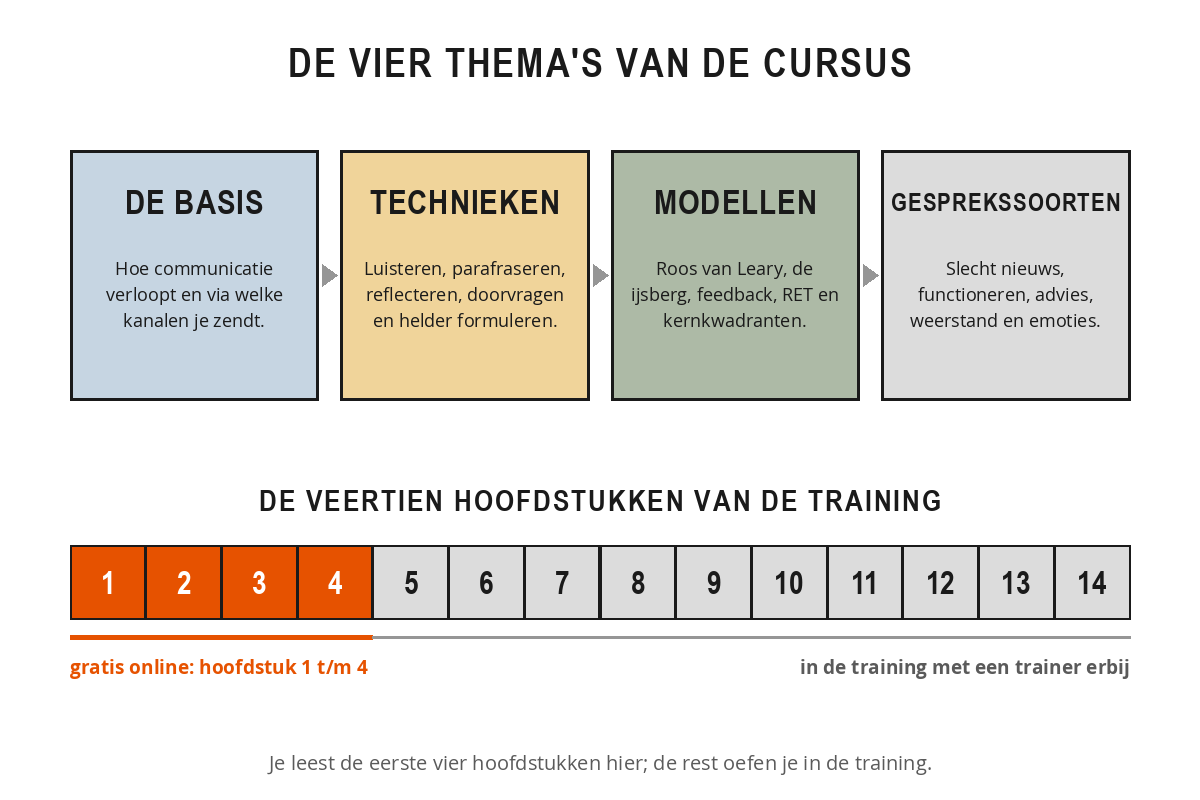
This free course contains the first four chapters: the orange part of the bar above. At the bottom of chapter 4 you will find the full course.
What you will learn
You start with listening, because that is where the most is to be gained. You learn the three levels on which you listen simultaneously in every conversation and which habits get in your way. You are then given the four basic techniques: encouraging, paraphrasing, reflecting feeling and making things concrete, plus the difference between open and closed questions. Chapter 3 covers Leary's Rose, which shows why you are always assigned the same role in certain conversations and how to break that pattern. Chapter 4 is about feedback: the 4G model, the difference between observing and judging, and how to receive feedback without immediately becoming defensive.
How the course is structured
The course follows four themes that build on one another. You start with the basicshow communication works and through which channels you send. Then come the techniques: listening, paraphrasing, probing and formulating clearly. After that, the models that explain what is going on beneath the conversation: the Leary Rose, the iceberg, feedback, REBT and core quadrants. And you finish with the types of conversationbad news, performance, advice, and conversations in which resistance or emotion plays a part. Each chapter contains theory, a model, examples from practice and an exercise that you apply to your own conversations.
Practical tips for use
- Don't just read, do something as well. Try out a technique in a real conversation that same day.
- Work through the chapters in order. The models in chapters 3 and 4 build on the listening covered in chapters 1 and 2.
- For each chapter, choose one conversation from your own work to apply the material to. Preferably one you find difficult.
- Practise one technique at a time. Anyone who wants to paraphrase, probe, mirror and give feedback in the same conversation will do all four only half well.
- Look back afterwards. What did you notice in the other person, what did you notice in yourself, and what was difficult?
Each chapter ends with a short knowledge check of three questions: answer them correctly to mark the chapter as completed. Your progress is saved automatically in your browser.
Enjoy reading, and above all: enjoy the conversations that will go differently from now on.