


1. Active listening
Listening seems like the easiest part of a conversation. You don't have to come up with anything, you don't have to defend anything, you only have to be quiet. In practice, most people rarely really do it. We hear, we nod politely, and meanwhile we are already busy with what we are going to say next. This chapter is about the difference between hearing and listening, and about what you have to let go of in order to make that difference.
After this chapter:
- You know what sets active listening apart from merely hearing or nodding politely.
- You recognise the three levels on which you listen at the same time: content, feeling and intention.
- You know which three types of obstacles prevent you from really listening.
- You know five anchor points with which to improve your listening skills step by step.
- You can deliberately apply active listening in a conversation you are having today.
Listening is a choice, not a character trait
In active listening you are entirely focused on the other person. You take in what is being said, you pay attention to the tone, and you see what the body language adds or in fact contradicts. At the same time you hold back your own reaction for a moment. Not because you have nothing to say, but because you want to understand first before you want to be understood.
That sounds obvious, and it is not. Anyone who observes conversations sees that on average people start thinking up their answer after three or four seconds. From that moment on you are no longer listening to the other person but to your own internal monologue. You still hear words, but the meaning seeps past you. And the other person notices. Not always consciously, but the energy drains out of the conversation and the story becomes shorter than it could have been.
Active listening means switching off that autopilot. You give space, you allow a silence rather than filling it straight away, and you use short signals that show you are present: a nod, an "mm-hm", eye contact that feels right. None of this is complicated. The difficulty lies in keeping it up, especially when you disagree with what you are hearing.
Three layers on which you listen
In every conversation, three layers run together. Anyone who learns to tell them apart hears far more than someone who only pays attention to the words.
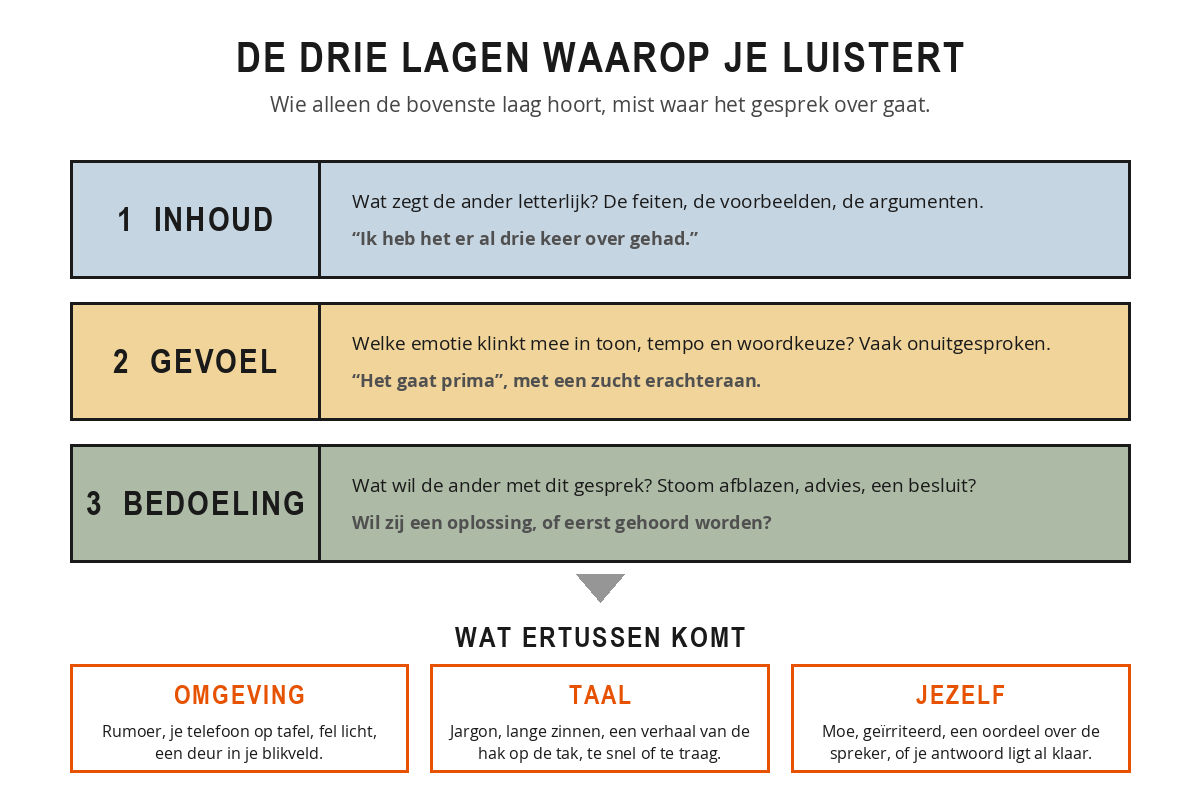
The first layer is the content: what is the other person literally saying? What facts, examples and arguments are put on the table? This is the layer that is easiest to follow, and that is precisely why most people get stuck in it.
The second layer is the feeling: which emotion comes through in the tone, the pace and the choice of words? Someone who says "it's going fine" followed by a sigh is telling you something different from someone who says the same sentence with a smile. The feeling layer is often precisely in what is left unsaid.
The third layer is the intention: what does the other person want from this conversation? Do they want to let off steam, get advice, force a decision, or simply be heard? Anyone who misses this often gives a neat answer to a question that was never asked.
Good listeners switch constantly between these three layers and check them against each other: does what I hear on the content layer match what I pick up on the feeling layer? If the two do not fit together, that is the moment to ask further questions.
Sanne is a team leader and is speaking with Bas, who has been doing the reporting for three months. Bas says: "Sure, I can take on that reporting as well, no problem." At the content level, that is a commitment. At the feeling level, Sanne hears something else: he is speaking faster than usual and the "no problem" follows just a little too quickly. At the intention level, she suspects that Bas mainly does not want to come across as someone who cannot handle it. She could have left it at "great, that's settled then". Instead she says: "You're saying yes, but I hear you hesitating. What would have to give way if this were added?" Bas: "Honestly, the monthly analysis. That would be pushed back two weeks." That was the conversation that needed to be had.
What active listening is not
There are three persistent misconceptions about active listening. They sound plausible and lead you in precisely the wrong direction.
It is not a parroting: repeating literally what the other person has just said feels artificial, as if you are performing a trick rather than having a conversation. Nor is it a staying silent: you remain a conversation partner, not a wall of sound. And it certainly does not mean that you agree must be with what you hear. You can listen closely and then take a firm position of your own. In fact, your position lands better precisely then, because the other person knows they have been heard and does not feel they have to start all over again.
Three types of barriers
Listening well sounds simple, but in practice you run into all sorts of things. The obstacles come from three directions, and for each direction there is something you can do.
The first is the environment. A room that is too warm, a squeaking chair, your phone buzzing on the table, a colleague walking past the window: they seem like trifles, but they draw your attention away without you noticing. Smells, bright light or a noisy corridor also play a part. You can remove most of this in advance: a quiet room, your phone out of sight, and a chair from which you are not constantly looking past the other person towards the door.
The second is the language of the other person. Jargon you do not know, endless sentences, a monotone voice, speaking too fast or agonisingly slowly. A poorly organised account, in which someone jumps from one thing to another, also makes listening hard work. Here it helps to ask follow-up questions and summarise, and so restore the structure together.
The third, and the most difficult, is yourself. You are tired, irritated or still caught up in a previous conversation. You have an opinion about the speaker and this filters what comes in. Or you are so busy with your own answer that you miss half of it. Sometimes you think you know after three sentences where it is going and put the rest on autopilot. That is the moment when you miss the turning.
Do you catch yourself with your answer ready before the other person has finished speaking? Then take a calm breath, park your reaction, and ask a question instead. Nine times out of ten you will hear something you would otherwise have missed, and your answer will still be there in thirty seconds.
Five pointers for listening better
Listening is a skill, not a character trait. That means you can improve at it. Five concrete pointers:
- Clear your head beforehand: finish off your previous task, put your phone away and decide for yourself that for the next half hour you are there for this person.
- Listen to understand, not to respond: as long as you are busy with your own answer, you miss what is actually being said. Postpone your response until the other person has finished.
- Summarise regularly: a short summary ("So if I understand you correctly...") forces you to listen properly and gives the other person the chance to adjust.
- Ask further about what you notice: a hesitation, a word that comes up twice, an emotion you pick up on. That is often where the heart of the matter lies.
- Check your own interpretation: what you think you hear is coloured by your own experience. Test it by giving it back to the other person.
Peter is an account manager and has a customer on the line complaining about the delivery time. His first response is ready: explaining that the delay lies with the supplier and not with them. He holds it back and asks instead: "What does that extra week actually mean for you?" The answer surprises him. The customer had promised his own client a date and had to go back on it. It was not about that week at all, it was about him being left looking foolish. Peter could have spent twenty minutes explaining whose fault it was. Instead he offered to call his customer's client himself with the new date. That took him ten minutes and the conversation ended better than it began.
Have three conversations this week in which you give yourself one task: only after the other person has completely finished speaking do you formulate your response. Not before. Then answer for yourself:
- How often did you actually want to interrupt, and where in the conversation did that happen?
- What did you hear that you would otherwise have missed?
- Which of the three layers were you on most yourself: content, feeling or intention?
- Which obstacle played the biggest part: the surroundings, the other person's language or your own mind?
- How did the other person respond to the space you gave them?
Note down your findings briefly, so that you can read them back in a month's time.
Summary
- Active listening means being fully focused on the other person and holding back your own response for a moment. On average, people start on their answer after just three to four seconds.
- You listen on three layers at once: the content (what is literally said), the feeling (what comes through in tone and choice of words) and the intention (what the other person wants from the conversation).
- If the content layer and the feeling layer do not match, that is the moment to ask follow-up questions.
- Active listening is not parroting, not staying silent and not agreeing.
- Obstacles come from the surroundings, from the other person's language or from your own mind. The last of these is the hardest.
- Your listening skills grow by deliberately making space, postponing your reaction, summarising, asking follow-up questions and checking your interpretation.
A colleague sighs and says "it's going fine" when you ask how the project is going. On which layer do you pick up that sigh?
According to this chapter, which statement about active listening is correct?
Halfway through a conversation you notice that you are already formulating your own answer. According to this chapter, what is the best move?