


2. The basic techniques: paraphrasing, reflecting and probing
Active listening only takes shape once you make it visible. As long as it remains an attitude, the other person does not know whether you are following them. With small signals, brief repetitions and the right question you show: I am following you, I understand you, please go on. This chapter gives you four techniques and the difference between the two types of questions.
After this chapter:
- You can recognise the difference between encouraging, paraphrasing, reflecting feeling and making things concrete.
- Do you know when to use which technique, and when to leave it alone?
- You can formulate a paraphrase that meets three requirements.
- You can offer a reflection of feeling that invites rather than pins down.
- You choose deliberately between an open and a closed question, and translate vague language into a concrete moment.
Four ways to respond
The four techniques range from light to directive. On the left you leave control entirely with the other person; on the right you provide direction yourself. None of the four is better than the others; what matters is that you make a choice.
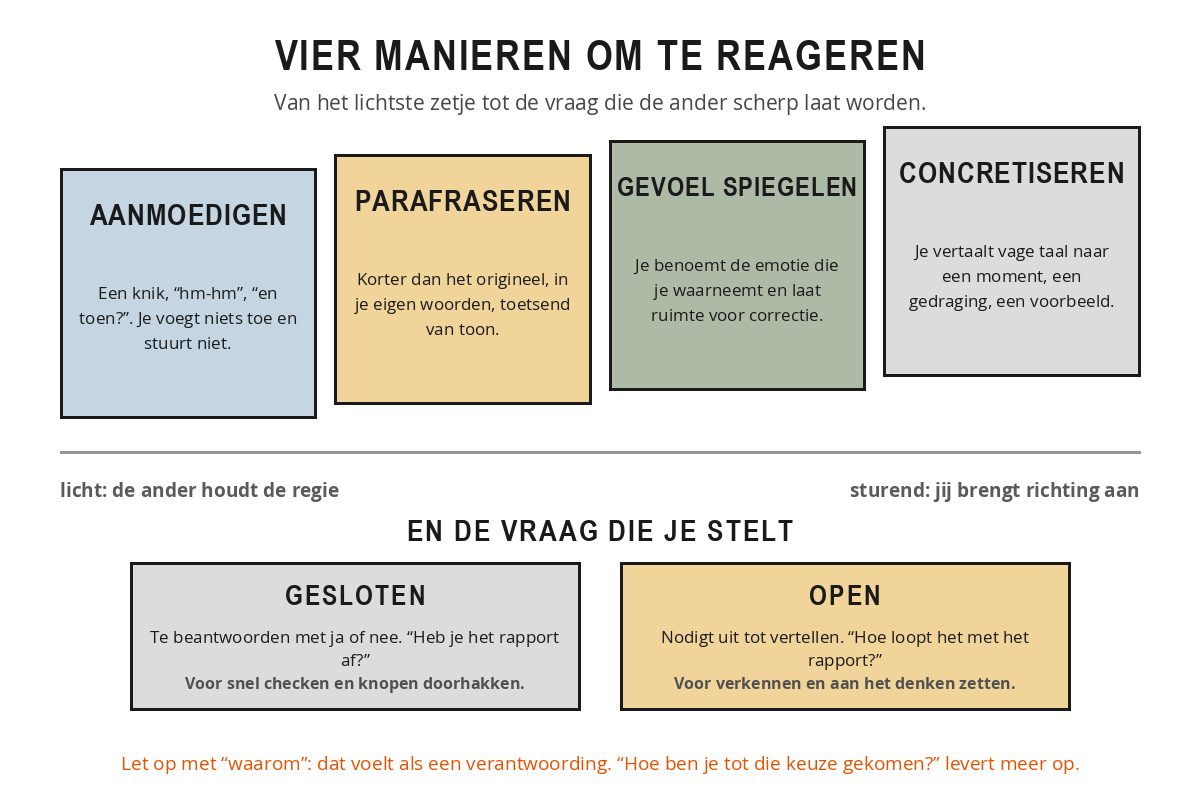
Encouraging is the lightest. A nod, an "mm", a "yes", an "and then?" or simply eye contact with an open posture. You add no content and you do not steer the conversation, you give the other person a nudge to carry on. It seems small, but it works. Someone who gets no signal at all starts to wonder: is the other person actually listening? Do they find it boring? And then the story tails off, just at the moment it was getting interesting.
Paraphrasing goes a step further: you give back in your own words what the other person said. Mirroring feeling is about what the other person feels, even when that has not been said out loud. And making it specific is the most directive: you translate vague language into a moment, a behaviour, an example. The rest of this chapter works those three out.
Pay attention to your own encouragers for once. Many people have one favourite, usually "okay, okay, okay", and do not notice that after a while it sounds automatic and meaningless. Variation helps, and the signal should fit what the other person is saying.
Paraphrasing: giving back the core
When you paraphrase, you repeat in your own words what the other person has just said. Not a literal repetition, because that sounds like parroting. You take the core and give it back. A good paraphrase meets three requirements. It is shorter than the original: what the other person told you in five sentences, you sum up in one. It is in your own words, so that the other person hears how it landed with you. And it is checking in tone: you leave room for correction with openings such as "So you think that...", "Do I understand correctly that..." or "What you're saying is...".
Karin complains to her colleague: "I've discussed it with him three times now, but every time he comes back with the same remark. I no longer know what to do about it. Sometimes I just think: never mind."
The colleague paraphrases: "So you feel that talking about it has no effect, and you've reached the point where you're almost giving up?"
Karin: "Yes, exactly. Well, giving up is putting it strongly, but I don't know how else to approach it."
Notice what happens. Because of the paraphrase, Karin corrects herself on the word "giving up" and puts more sharply what she means. That is the power of paraphrasing: you don't push, you offer, and often the other person refines their own account.
You can paraphrase at two levels: on the content ("You've mentioned that three times now") or on the feeling ("You don't feel heard"). Which one you choose depends on what is needed. If it concerns a factual problem that has to be solved, you stay close to the content. If you notice emotion coming through that needs space, you move to the level of feeling.
Paraphrasing is not a trick you use in every sentence. Do it too often and it becomes irritating, and you slow the conversation down unnecessarily. It works best at key moments: when the other person says something important, when you don't quite understand something, or when you notice that the other person needs more room to elaborate.
Mirroring feelings: naming what you observe
In a conversation, feelings are very often not put into words. Far more often you see and hear them: a tremor in the voice, a sigh, a raised shoulder, a gaze that drifts away. Anyone who responds only to the content misses that layer. And that is frequently exactly where the real subject of the conversation lies.
A reflection of feeling has three ingredients: you name the emotion, you link it to the situation, and you leave room for correction. The basic form is: "I hear that you are [emotion] about [situation], is that right?" In practice that sounds like "It sounds as though you don't feel heard in that meeting", "I notice that this affects you" or "You seem to be doubting whether you want to take this any further".
Note the difference between naming a feeling and passing judgement. "You are angry" is a statement, and the other person can only say yes or no to it. "It seems as though this makes you angry" is an invitation. That small difference determines whether the other person feels invited or becomes defensive.
Ingrid tells her manager that she has been passed over for an interesting project for the third time this year. She keeps her voice neutral, but her jaw tightens.
Without reflection: "How annoying. Have you discussed it with the project leader yet?" Ingrid says she will, and the conversation is over within two minutes. Nothing changes.
With reflection: "I can see this affects you. And I understand that, three times is a lot." Silence. And then it emerges that she is wondering whether she still belongs here. That is the conversation that needed to be had, and only then does it make sense to look at solutions.
Mirroring emotion works well in conversations in which emotions play a role: feedback conversations, bad-news conversations, conflicts, or moments when someone is visibly affected. In a business, content-focused conversation it can come across as overdone. A colleague asking about the status of a report is not waiting for "I can see you're really invested in this".
Do you sense that you have named the feeling incorrectly? No problem. A simple adjustment works perfectly well: "Right, so disappointed rather than angry. Tell me more." The other person notices that you are genuinely trying to understand, and that is what counts. It is not about the right label, but about the willingness to look along with them.
Open and closed questions
Good questions move a conversation forward. Bad questions steer, judge or distract. The difference often comes down to a few words.
A closed question can be answered with yes or no: "Have you finished the report?" An open question invites the other person to talk: "How is the report coming along?" Both have their uses. A closed question is handy when you want to check something quickly or reach a decision. An open question works when you want to explore, understand or make the other person think. Open questions usually begin with what, how, when, where or who.
With "why" you need to be more careful. For many people that question feels like being asked to justify themselves, and then the answer comes from a defensive position rather than out of curiosity. "How did you arrive at that choice?" almost always yields more than "Why did you do that?".
Making it specific: from vague to visible
People often speak in abstractions. "It isn't running smoothly." "We don't work together well." "I find it difficult." Such statements sound clear, but say little. Making things concrete is the technique with which you convert vague language into visible facts and behaviour. You do that with questions such as "What exactly do you mean by 'not smoothly'?", "Can you give an example of a moment when that came up?", "What specifically went wrong?" and "Who was involved and what did that person say?".
By probing in this way you get a grip on what it is really about. And it often helps the other person too: having to put something into words makes it sharper in their own mind. Take a team member who says: "I feel like I don't belong here." Four questions later ("When did you last have that feeling?", "What happened then?", "Who was there and what did they do?", "How do you notice it?") you have a concrete situation you can talk about further. Without making things concrete you remain stuck in a general feeling that nobody can do anything with.
Be careful with leading questions: questions that already contain the answer. "You thought that meeting was useless too, didn't you?" is not a question, but an invitation to agree with you. A good test: could you be surprised by the answer? If not, it probably isn't a real question.
Choose a conversation you will have this week, with a colleague, a client or at home. Decide in advance on one technique to practise deliberately.
- Technique: one of the four (encouraging, paraphrasing, reflecting feeling, making concrete).
- Intention: a concrete course of action. For example, "I will paraphrase at least twice before giving my own opinion".
- Reflecting afterwards: what did you notice in the other person, what did you notice in yourself, what was difficult?
- Next step: which technique will you use in your next conversation?
By working on one technique per conversation, you steadily build your repertoire without asking too much of yourself.
Summary
- Four ways to respond, from light to directive: encouraging, paraphrasing, mirroring feelings and making things concrete.
- Encouraging takes two words and keeps the other person talking. Without any signal at all, a story peters out.
- A good paraphrase is shorter than the original, is in your own words and sounds like a check.
- A reflection of feeling names the emotion, links it to the situation and leaves room for correction. "It seems this makes you angry" invites a response, "you are angry" pins it down.
- Closed questions are for checking and settling matters, open questions for exploring and understanding. Replace "why" with "how".
- Making things concrete translates vague language into a moment, a behaviour and an example. Four follow-up questions are usually enough.
Which three requirements does a good paraphrase meet?
A colleague tells you, with a tense jaw, that she has been passed over for a project again. Which response is a reflection of feeling as this chapter means it?
A team member says: "Things just aren't running well in our meetings." What do you do if you want to make it concrete?