


Introduction
Inappropriate behaviour at work rarely starts with shouting. It starts with small things that nobody names: a joke that is always about the same person, a colleague who is consistently passed over, a chat group in which someone is the target. Taken separately, those moments are hard to pin down. Added together, they determine whether people enjoy their work or call in sick.
This free course is about behaviour between colleagues: between team members and between manager and employee. If it concerns aggression from customers, patients or visitors, then the free Dealing with Aggression course the place where that is dealt with.
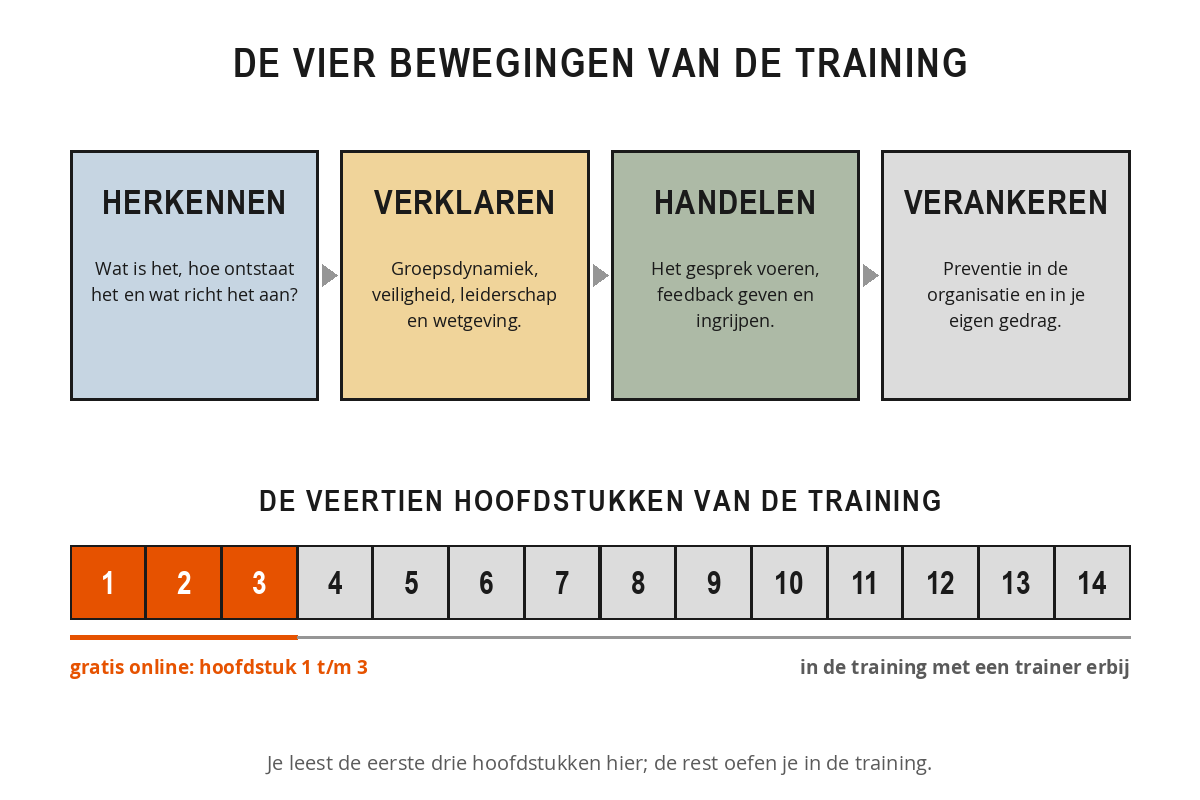
This free course contains the first three chapters: the orange part of the bar above. At the bottom of chapter 3 you will find the full course.
This is a course, not a reporting point and not a support service. Learnit does not handle reports of inappropriate behaviour, does not carry out investigations and does not mediate. Nor does the course replace your own organisation's arrangements: the code of conduct, the complaints procedure and the confidential adviser at your workplace always take precedence over what you read here.
If something is going on at your own workplace, that is where you start. The confidential adviser is the place where you can tell your story without anything automatically being set in motion; in addition, your manager, HR, the works council and the occupational health physician are all possible points of entry. If there is no confidential adviser, or you are getting nowhere, you can turn to your trade union, the Juridisch Loket or the Netherlands Labour Authority. In the case of a criminal offence, such as a threat or sexual assault, the police are the appropriate route. If you are in such a situation yourself and are suffering from sleep problems, tension or low mood, discuss this with your GP or occupational health physician.
What you will learn
You first learn where the line lies and why it lies with the recipient rather than with the sender's intention. You get a picture of the five forms that organisations distinguish, from bullying to abuse of power. Then you look at the team: how unwritten rules come about, why seven people around a meeting table all stay silent even though they disagree, and how a group can become stuck in fixed roles. The third chapter is the practical part: how to separate an observation from your own interpretation, which ways of intervening there are, and which route in your organisation fits which situation.
How the course is structured
The full course follows four movements that build on one another. You start with recognising: what it is, how it arises and what damage it does. Then comes explaining: group dynamics, psychological safety, leadership and legislation. After that acting: the conversations themselves, giving feedback and intervening in a conflict that is already under way. And finally embedding: what is structurally needed in the organisation and in your own behaviour. The three chapters you are reading here come from the first and the third movement.
Practical tips for use
- Keep a notepad or a blank document to hand. The exercises only work if you actually complete them.
- Link each chapter to one situation you have seen or experienced yourself. That is the difference between reading and learning.
- You decide for yourself what you share and what you keep to yourself. Nothing in this course asks you to take anything outside the room.
- If a section affects you more than you expected, put it aside and come back to it later. That is not failure, that is sensible.
- Do not read it all in one go. One chapter a week, with time to try it out, yields more.
Each chapter ends with a short knowledge check of three questions: answer them correctly to mark the chapter as completed. Your progress is saved automatically in your browser.
Enjoy reading, and above all: good luck with the first moment when you speak up.