


2. Ambivalence and the language of staying the same
Someone has been considering giving up smoking for three years. He knows it is bad for him, he has lost two parents to the consequences, his children say something about it. And still he is out on the balcony every morning. Ask him whether he wants to stop and he says "yes, I suppose so". Ask him when and he says "well, not right now". Both answers are sincere. That is not weakness and not an excuse; that is ambivalence, and it is the normal state of someone on the verge of change.
After this chapter:
- You can explain what ambivalence is and why it is not a sign of a lack of motivation.
- Do you recognise the five forms of sustain talk in what someone says?
- Do you understand why countering sustain talk with arguments produces more sustain talk?
- Can you hear the function that the current behaviour serves for someone?
- You know how to acknowledge both sides of the scales without choosing one.
Two sides that are both true
Ambivalence is the simultaneous presence of wanting to change and wanting to stay the same. Neither voice is lying. One says it costs too much, the other says it delivers something that has nothing to replace it yet. They exist side by side, and that is exactly what makes the conversation difficult.
The biggest mistake you can make as a professional is to think that ambivalence is a problem you have to solve. As if doubt were a symptom of too little motivation, too little discipline or too little insight. Starting from that idea, you automatically begin to push: "but surely you know that...", "you said yourself that...", "what if you were to...". It feels helpful and it is the opposite.
Ambivalence is not a defect. It is the normal response to any choice that comes at a cost. Someone who loses weight also loses their comfort. Someone who stops drinking also loses a social routine. Someone who moves for a job loses the friends round the corner. Wherever change promises something, there is also something that goes away. Ambivalence is the internal bookkeeping that weighs the two against each other. Anyone not doing that bookkeeping is not in doubt; they have already made their choice.
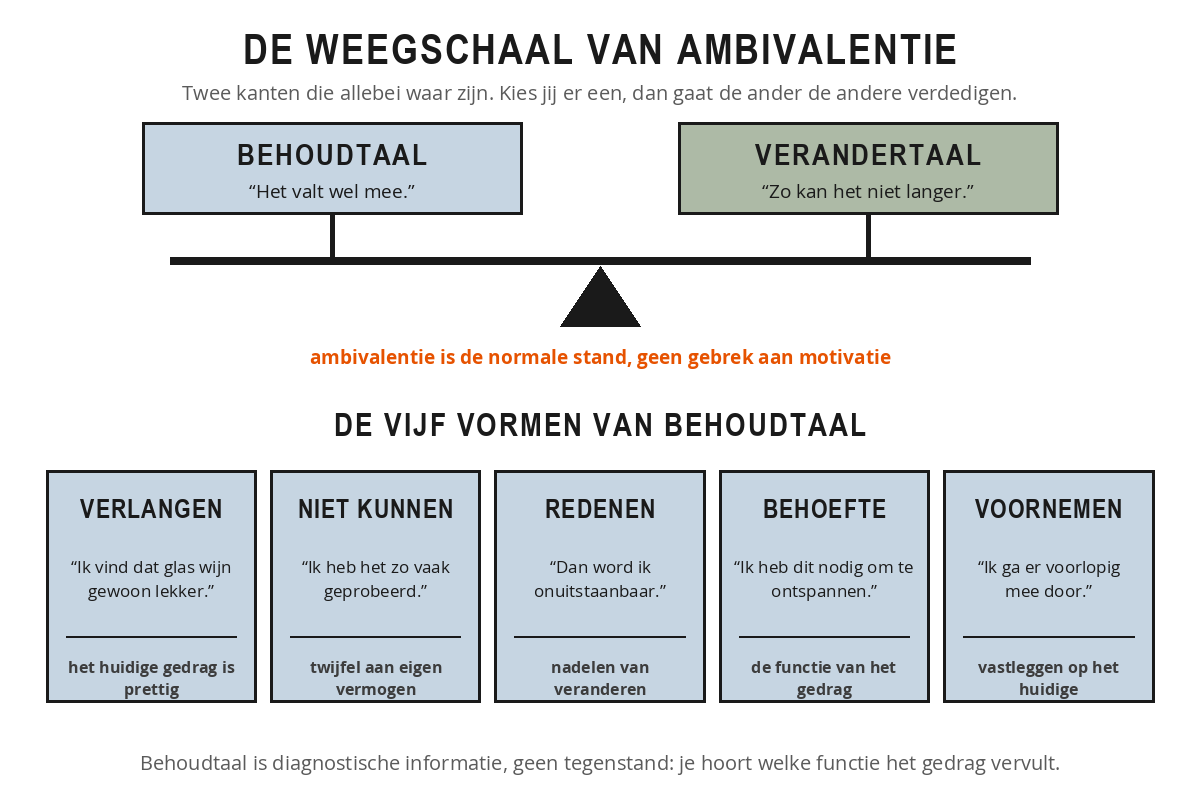
The five forms of sustain talk
Sustain talk is everything someone says out loud to defend, explain or justify their current behaviour. It is the voice of how things are now. Anyone hearing sustain talk is not hearing someone who is unwilling, but someone putting one side of their own set of scales into words. There are five forms, and it helps to keep them apart, because they tell you different things.
- Desire for the current behaviour. "I just enjoy that glass of wine in the evening." The current behaviour is pleasant, and he says so out loud.
- Being unable to change. "I've tried so many times already, I'm never going to manage it." He doubts his own ability, not whether it would be desirable.
- Reasons not to change. "If I stop smoking I'll become unbearable for my colleagues." He is naming the drawbacks of the change itself.
- Need to keep things as they are. "I really need this to relax." He is pointing to a function that the behaviour serves.
- Commitment to keeping things as they are. "I'm just going to carry on with it for now." He is committing himself to the current situation.
The difference matters. Someone who says they will never manage it needs a different conversation from someone who says they enjoy it. With the first it is about self-confidence, with the second about what will take its place. If all you hear is "he doesn't want to", you miss that difference and give them both the same unsolicited tip.
A client who is considering giving up online gambling says the following in one breath:
"I know it sounds strange, but when I get home in the evening that game is simply the only thing that still lets me relax. I know it costs money and that it's making my wife ill. Only last week she said things can't go on like this. And in a way she's right. But then, what am I supposed to do in the evenings?"
In thirty seconds, four things are on the table. Sustain talk: "the only thing that lets me relax" (a need) and "what am I supposed to do in the evenings" (the function again). Change talk: "it costs money" and "it's making my wife ill" (reasons). His scales are in balance and you hear both sides within the same paragraph.
Why pushing back produces more sustain talk
Sustain talk is treacherous for anyone new to the method, because it sounds like something you should argue against. If someone says "it's not that bad", you want to show that it is. If someone says "I can stop whenever I want", you want to explain why that probably isn't true. And usually you are right, too.
The point is what it produces. The more often someone voices sustain talk, the more convinced they become of their own arguments. If you push back, your push elicits more sustain talk, and with it they mainly convince themselves. You have won the conversation and lost the change.
Sustain talk is diagnostic information, not opposition. If you hear it, you know two things: there is ambivalence, otherwise no defence would be needed, and you hear what function the current behaviour serves for this person. You will need that function later on, because something will have to take its place.
Acknowledging both sides, without choosing
Once you understand that ambivalence is normal, you no longer need to be alarmed by the moment someone names their doubts. You will even come to value the fact that it is said out loud, because otherwise it would have stayed invisible. That asks three things of you, and all three are harder than they look.
Acknowledge the ambivalence out loud. State that there are two sides and that both are real. "On the one hand it helps you relax, on the other hand you notice that your health is suffering. Both are true." That shows you have heard the whole story, not just the half that suits you.
Steer clear of the "yes, but". The moment you add a "yes, but" to what the other person says, you take a side in their internal debate, and the other side pushes back harder. Replace "yes, but" with "and at the same time", or simply leave the objection out.
Suppress the judgement about which side is right. Even if it is crystal clear to you what would be sensible, that is your picture. Don't nod extra enthusiastically at an argument for change and don't raise your eyebrows at an argument for staying the same. For the other person both have to feel equally safe to say, otherwise you will only hear the part they think you want to hear.
Team leader Karin hears from her employee Joost, who has been working from home four days a week for fourteen months: "I know it would be easier if I were in the office more often, but I simply can't fit that hour of travelling a day into my schedule any more."
Karin, with judgement: "Plenty of people travel an hour, you know. And two years ago you were here every day as well."
Joost, immediately afterwards: "Yes, but back then I didn't have a child at nursery either. I just can't manage it." Karin has said one sentence and there are now two new reasons on the table for leaving things as they are.
Karin, without judgement: "Those days at home give you something you don't yet have anything to offer in return for. And at the same time, you notice yourself that it would be easier at the office."
Joost, after a short silence: "Yes. To be honest, I do miss out on things too. That business with the quotation last month wouldn't have happened if I'd been there." That is a sentence Karin could not have spoken without it losing its force.
Take the case you wrote down in chapter 1, or a new one: someone who is in two minds about a change.
- Write down three to five statements that argue for keeping things as they are. Verbatim, exactly as they sounded.
- After each statement, note which of the five forms it is: desire, inability, reasons, need or intention.
- What function does the current behaviour serve for this person? What does it give them?
- Which statements pointed towards change? Even if there was only one.
- Did you respond to the sustain talk with a "yes, but", an argument or a solution? Write down what you said.
- Formulate a response that acknowledges both sides without taking sides. One sentence.
Summary
- Ambivalence is wanting to change and wanting to stay the same at once. It is normal and it comes with every choice that costs something.
- Doubt is not a lack of motivation; it is the internal weighing up of what change delivers against what it costs.
- Sustain talk takes five forms: desire for the current behaviour, doubt about one's own ability, reasons against change, the need the behaviour fulfils, and the intention to leave things as they are.
- The difference between those forms determines which conversation is needed: about self-confidence, or about what will take its place.
- If you argue against sustain talk, it provokes more sustain talk and the other person mainly convinces themselves.
- Sustain talk is information: you hear what function the current behaviour serves, and you'll need that later.
- Acknowledge both sides out loud, replace "yes, but" with "and at the same time", and don't judge which side is the right one.
Someone says: "I've tried so many times already, I'm never going to manage it." Which form of sustain talk is this?
Why does this chapter call sustain talk "diagnostic information"?
According to this chapter, what is the problem with "yes, but" in response to doubt?