


Introduction
A course that sticks rarely comes about on the day itself. It comes about at your desk, weeks beforehand, in the choices you make about the request, the goals and the order. Yet almost everyone starts with the enjoyable part: looking for activities. The result is a programme full of good components, of which nobody can say afterwards what it changed.
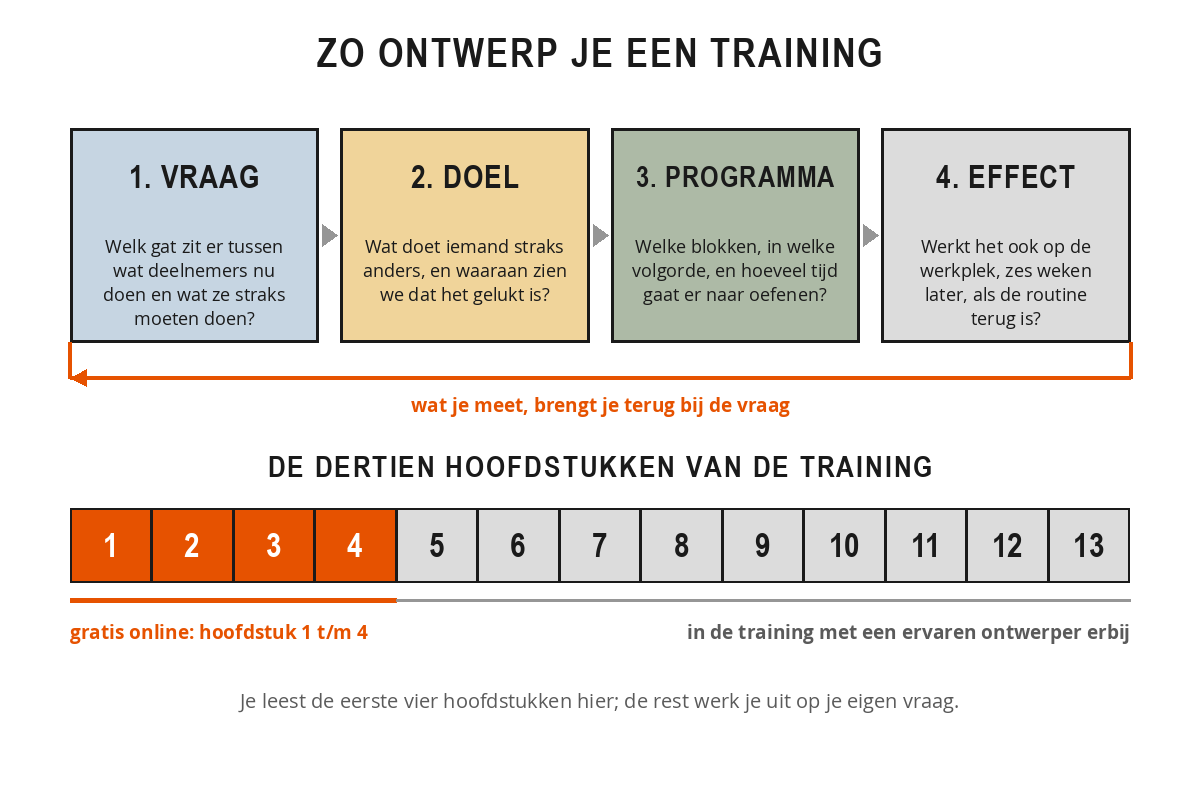
This free course contains the four chapters from the orange section of the bar above. At the bottom of chapter 4 you will find the full course.
What you will learn
You learn to take a training request apart until you know which gap you are actually closing. You turn that gap into goals you can test, rather than into directions everyone agrees with. You build a programme around it that fits the hours available, with enough time to practise. And you agree in advance how you will establish, six weeks later, whether anything has changed. After that, the course goes on to the models behind learning itself, choosing your core exercise, and the running order that actually helps you on the day.
How the course is structured
The four chapters follow the order in which you actually design a course. You start with the question: what is actually the problem here, and whose is it? Then the objective: what will someone do differently afterwards, and how will we see that? Then the programme: which blocks, in which order, with how much practice time? And finally the effect: how will you know in six weeks' time whether it has landed? That last step brings you back to the first, because what you measure tells you where your design was wrong.
This course has one sentence that keeps coming back: first the gap, then the programme. The gap is the difference between what your participants do now and what they will need to do afterwards. As long as that gap isn't on paper, every working method you choose is a guess. In the course such a sentence is called a hook phrase, and in chapter 3 you'll read how to write one yourself for your own programme.
Who this course is for
For anyone who has to get something across to a group and works out the format for it themselves. That could be a trainer or a training adviser, but just as easily a team leader preparing a working session, a specialist showing colleagues the ropes in a new system, or someone who has been given an afternoon to fill on collaboration after a reorganisation. You don't need a background in education. What you do need is a real question to work on.
Practical tips for use
- Choose one training request of your own and hold on to it throughout the course. All the exercises work on the same case, so that at the end you don't have four separate answers but half a design.
- Keep a notepad or a blank document to hand. The exercises are meant to be written on, not read.
- Don't read it all in one go. One chapter a week, with a conversation or a phone call in between, gets you further than reading through it in an afternoon.
- Don't skip chapter 1 because you already know the subject. It is precisely those who know the content well who move past examining the request too quickly.
- Do you notice halfway through that your goal isn't right? Go back. That isn't wasted time, that is the model.
Each chapter ends with a short knowledge check of three questions: answer them correctly to mark the chapter as completed. Your progress is saved automatically in your browser.
Enjoy the read. And if you take away one thing: first the gap, then the programme.